
TL;DR:
- Efflorescence on brickwork signals moisture movement and possible cavity wall insulation failure.
- An independent inspection using borescope and thermal imaging confirms if remediation or extraction is necessary.
White salt deposits on your brickwork are not just a cosmetic nuisance. On any property with cavity wall insulation, efflorescence is diagnostic evidence that moisture is actively moving through your wall fabric, and it may be the first visible sign that your CWI is failing. The right next step is an independent CWI Condition Inspection Survey before any remedial work begins. Standards to ask for: PAS 2030:2023, BS 8104, and TrustMark registration. OSCAR Onsite, author of the UK’s NVQ Level 2 qualifications in both CWI Surveying & Inspection and CWI Extraction & Clearance, provides exactly that independent, evidence-led service.
- Efflorescence = soluble salts carried to the surface by moisture movement and deposited as water evaporates.
- On CWI properties, recurring salts often indicate trapped or bridging moisture linked to insulation failure.
- Arrange an independent CWI condition inspection before commissioning any extraction or repair.
- Relevant standards: PAS 2030:2023, BS 8104, TrustMark.
Table of Contents
- Is your efflorescence cosmetic or a warning sign?
- How efflorescence actually forms
- Why CWI makes efflorescence more serious
- What a proper CWI condition inspection must include
- Remedial options: from cleaning to certified clearance
- Realistic timeframes and cost factors
- Red flags that need urgent attention
- What to ask and document when commissioning an inspection
- Why OSCAR Onsite’s credentials matter here
- Key takeaways
- The case for independent surveying over quick fixes
- Concerned about CWI-related salt deposits? Here is where to start
- Authoritative UK sources for further reading
Is your efflorescence cosmetic or a warning sign?
Not every white salt patch demands urgent action. The key is pattern and persistence.
Likely cosmetic (monitor and maintain):
- Appears only externally, dries out between wet spells, no internal symptoms.
- Confined to new or recently repointed brickwork where construction moisture is still drying out.
- Disappears after dry weather and does not return in the same location.
Signs of a deeper problem (commission an inspection):
- Salts recur after cleaning, especially at the same location, indicating an unbroken moisture pathway.
- Internal staining, cold or wet patches on the inner leaf, or mould growth coinciding with external deposits.
- Visible mortar loss, spalling bricks, or rising heating costs despite no change in usage.
- Any sign of corroded or failed wall ties alongside surface salts.
If two or more of the second group apply, stop monitoring and book an independent CWI condition inspection.
How efflorescence actually forms
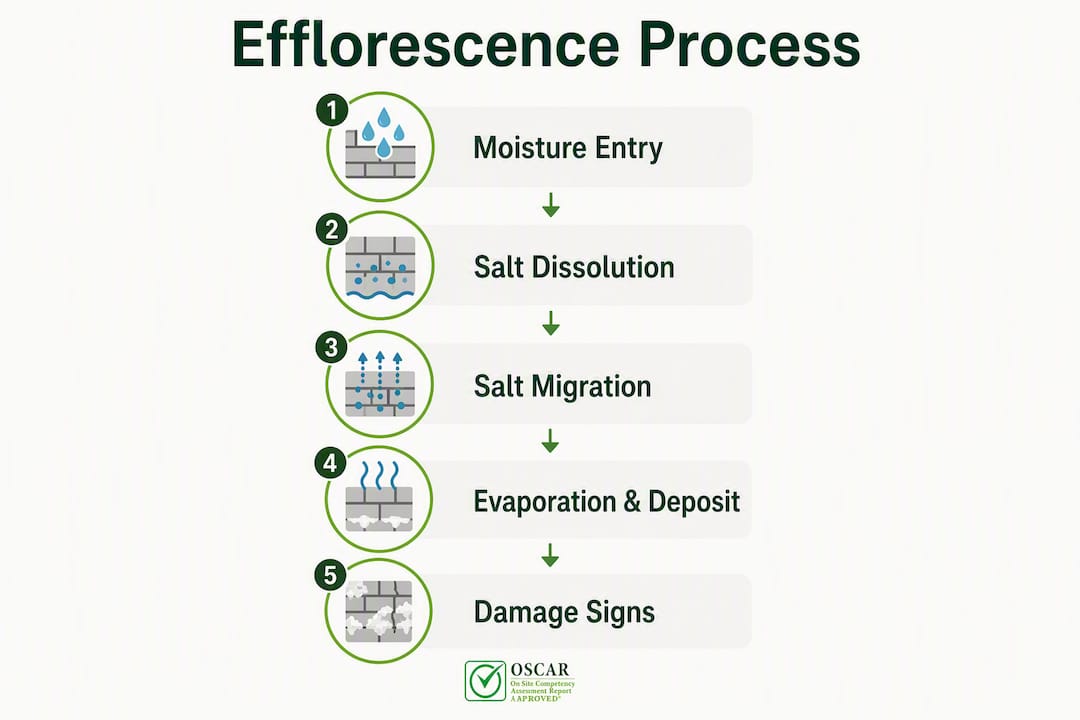
Moisture dissolves soluble salts naturally present in brick, mortar, and stone. As that moisture migrates to an evaporative surface, the water escapes and the salts crystallise, leaving the familiar white crust.
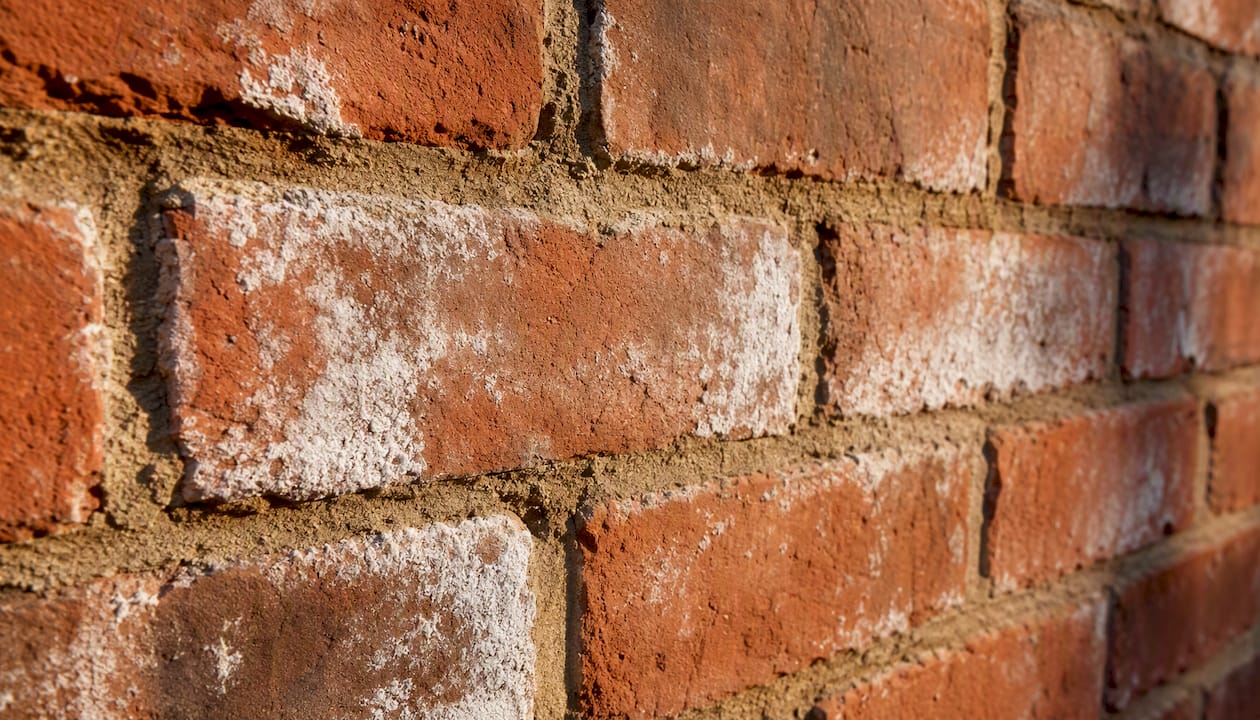
Two salt types matter in practice. Efflorescent salts (sulphates, carbonates) are relatively harmless once dry and may weather off. Hygroscopic salts (chlorides, nitrates) absorb atmospheric moisture and can keep a wall reading as “damp” even when no free water is present, which is why hygroscopic salts distort moisture meter readings and make surface-only diagnostics unreliable.
Salts that return after cleaning are the critical signal. A one-off deposit from curing mortar is normal. Recurring deposits at the same spot mean the moisture pathway is still active, and no amount of surface cleaning addresses that.
Why CWI makes efflorescence more serious
A clear cavity allows moisture that penetrates the outer leaf to drain down and evaporate. Cavity wall insulation changes that dynamic entirely. Impermeable materials and incompatible renders trap moisture that would otherwise escape, concentrating salts at the outer face or driving them inward.
Common CWI failure modes that produce visible salts include:
- Bridging: insulation debris or mortar droppings spanning the cavity, creating a direct moisture path from outer to inner leaf.
- Voids and settlement: gaps in the fill allow water to pool and track rather than being absorbed uniformly.
- Degraded or saturated material: aged or water-logged insulation loses thermal performance and actively holds moisture against the masonry.
Left unaddressed, salt crystallisation weakens mortar and brick cohesion, eventually causing spalling, mortar loss, and corroded wall ties. Thermal performance drops too, which is why rising heating bills sometimes accompany visible salt deposits on insulated walls.
What a proper CWI condition inspection must include
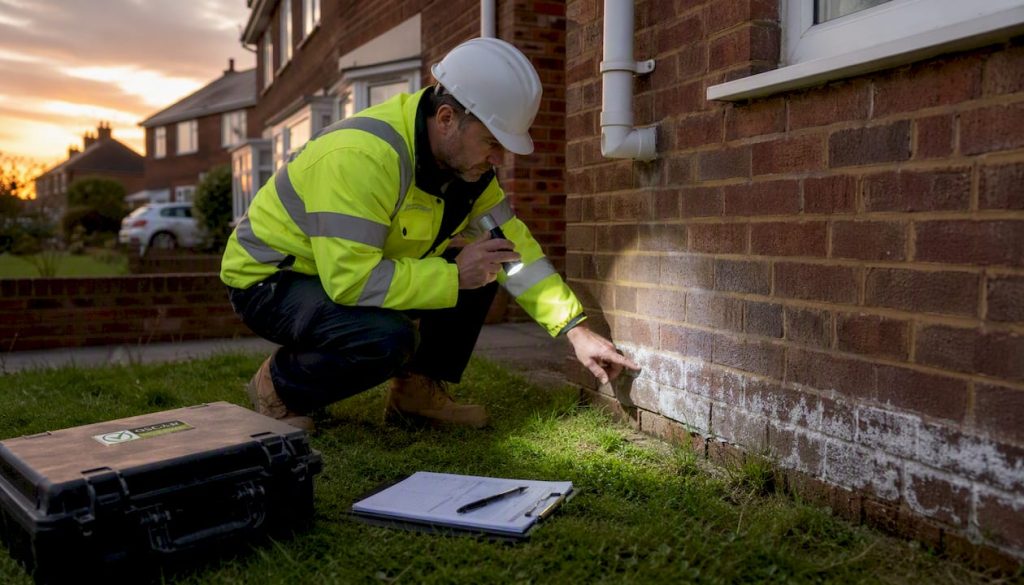
A credible inspection is not a quick moisture-meter sweep. Borescope inspection and independent condition surveys are the standard that qualified retrofit professionals apply before any extraction decision.
Core diagnostic steps:
- Visual inspection of both external and internal elevations, noting salt location, pattern, and any mortar or masonry damage.
- Borescope cavity inspection at multiple locations to confirm insulation condition, bridging, debris, voids, and wall-tie state.
- Deep-substrate moisture probing rather than surface-only readings, because salts are conductive and will give false-positive results on standard meters.
- Thermal imaging to map cold tracks, moisture pooling, and insulation voids non-invasively.
- Wall-tie checks and sample extraction where corrosion or failure is suspected.
- Documented findings referenced against PAS 2030:2023 and BS 8104 expectations, with clear photographic and borescope evidence.
Pro Tip: Before agreeing to any survey, ask for a written scope listing every method to be used, the locations to be inspected, and a clear decision rationale. If a surveyor cannot provide that in writing, find one who can.
Remedial options: from cleaning to certified clearance
The right remedy depends entirely on what the inspection finds.
Cosmetic and low-risk measures (suitable when salts are superficial and no ongoing moisture source is confirmed):
- Dry brushing once salts have fully dried. Avoid sandblasting or aggressive chemical cleaning on traditional masonry; both risk permanent damage to brick faces and mortar joints.
- Repointing with breathable, lime-based mortars to restore permeability.
Targeted repairs (where a specific moisture source is identified):
- Fixing defective pointing, improving drainage, or removing impermeable renders that are trapping moisture.
- Addressing external defects: gutters, downpipes, cracked sills, and failed window seals per the Property Care Association’s dampness assessment guidance.
Extraction and clearance (when CWI is saturated, bridged, or causing ongoing damage):
- Independent CWI condition inspection confirms extraction is warranted.
- An OSCAR Onsite accredited member firm carries out extraction via drilled access and high-powered vacuum removal.
- Cavity drying and wall-tie inspection follow.
- Repointing and breathable repairs restore the wall fabric.
- Independent Technical Monitoring & Clearance Certification documents the completed works for lenders and conveyancing.
Pro Tip: Sequence matters. Drying and repairs must precede any re-insulation. Maintain photographic and testing records throughout; you will need them for clearance certification.
Realistic timeframes and cost factors
An independent CWI condition inspection typically takes a few hours on site; the evidence analysis and written report usually follow within a few working days.
Remedial timescales vary considerably:
- Cosmetic cleaning and repointing: days.
- Targeted repairs (drainage, pointing, render removal): days to a few weeks.
- Full extraction with cavity drying and clearance certification: weeks to several months, depending on how saturated the insulation is, how long drying takes, and whether wall ties need replacement.
Cost drivers include property size, degree of saturation, access constraints, the extent of repointing required, and whether independent technical monitoring and clearance certification are needed. For readers concerned about extraction costs, OSCAR Onsite offers extraction finance options and can provide tailored quotes through its survey service.
Red flags that need urgent attention
Some signs should prompt immediate action rather than a “monitor and review” approach.
- Recurrent efflorescence at the same location after cleaning, or deposits spreading to new areas.
- Visible mortar loss, brick spalling, or obvious wall-tie corrosion alongside surface salts.
- Internal dampness coinciding with external salt deposits, particularly where vulnerable occupants are present.
- Musty odours, mould growth, or rising heating bills with no other explanation.
- Persistent salts that could jeopardise a sale, mortgage, or letting: surveyors, lenders, and local authorities treat recurring damp and salt evidence as a material risk under HHSRS and housing law.
Any of these warrants an independent CWI condition inspection without delay. If structural damage or health risks are present, emergency remediation and monitoring may be required.
What to ask and document when commissioning an inspection
Go into any survey conversation with specific questions. Vague scopes produce vague reports.
Questions to ask:
- Which methods will be used: borescope, thermal imaging, deep moisture probing?
- Which standards does the report reference: PAS 2030:2023, BS 8104?
- How many locations will be inspected, and how are they selected?
- What is the reporting timeline and format?
Documents to expect:
- Photographic and borescope evidence for every key finding.
- A decision log explaining why extraction is or is not recommended.
- A clear recommended remedial route with rationale.
Checklist before instructing works:
- Verify TrustMark registration or equivalent credentials for any contractor.
- Where extraction is needed, request an OSCAR Onsite accredited member firm.
- Confirm that independent Technical Monitoring & Clearance Certification will follow extraction.
- Retain all reports, photographs, and certificates for mortgage, letting, or enforcement queries.
- Check that the property condition report includes CWI findings if conveyancing is involved.
Why OSCAR Onsite’s credentials matter here
OSCAR Onsite authored the UK’s NVQ Level 2 in Cavity Wall Insulation Surveying & Inspection and the NVQ Level 2 in Cavity Wall Insulation Extraction & Clearance, the national benchmark qualifications for the sector. Over the past decade, OSCAR has trained and accredited more than 250 independent firms across the UK.
The OSCAR workflow is deliberately sequenced: independent CWI condition inspection first, extraction only when the evidence supports it, followed by accredited member firms for the works and independent Technical Monitoring & Clearance Certification afterwards. That sequence protects homeowners from sales-led extraction and gives lenders, housing providers, and conveyancers the documented evidence trail they require.
OSCAR also delivers the CWI Surveyor Awareness Course for RICS surveyors, building surveyors, DEAs, retrofit professionals, housing providers, mortgage lenders, and conveyancing solicitors, raising the standard of CWI literacy across the property sector.
Pro Tip: Ask any surveyor quoting for CWI work whether they hold, or their firm is accredited under, an OSCAR Onsite NVQ Level 2 qualification. It is the clearest single indicator of technical competence in this sector.
Key takeaways
Efflorescence on a CWI property is building pathology evidence, not decoration. Treat recurring salts as a diagnostic signal and act on the evidence.
| Point | Details |
|---|---|
| Efflorescence signals moisture movement | Recurring salt deposits indicate an active moisture pathway, not a cosmetic issue. |
| CWI raises the stakes | Bridged or saturated insulation traps moisture, accelerating salt migration, mortar decay, and wall-tie corrosion. |
| Inspect before you extract | An independent CWI condition inspection using borescope and thermal imaging must precede any extraction decision. |
| Standards to verify | Require PAS 2030:2023 and BS 8104 compliance, and TrustMark registration, from any contractor. |
| OSCAR Onsite is the independent authority | As author of the UK’s CWI NVQ Level 2 qualifications, OSCAR provides evidence-led inspections, accredited extraction oversight, and clearance certification. |
The case for independent surveying over quick fixes
White salt patches on brickwork have a way of prompting two opposite mistakes: ignoring them entirely, or commissioning immediate extraction from whoever knocks on the door first. Neither serves the homeowner.
The industry has a genuine problem with sales-led extraction. A contractor with a financial interest in removal is not the right person to decide whether removal is necessary. That is precisely why OSCAR Onsite was built around the principle of independent inspection first. The NVQ qualifications OSCAR authored exist because the sector lacked a nationally recognised competence standard, and that gap was costing homeowners money and causing unnecessary damage to their properties.
Efflorescence is useful. It is the wall telling you something. The question is whether you have the right person interpreting the message. An accredited surveyor with borescope evidence and a written report referenced against PAS 2030:2023 and BS 8104 gives you a defensible, documented basis for whatever comes next, whether that is monitoring, targeted repair, or extraction with certified clearance. That documentation also protects you at sale, remortgage, or letting in ways that a verbal assurance from a contractor never will.
Concerned about CWI-related salt deposits? Here is where to start
If white salt deposits on your brickwork coincide with any of the warning signs above, the evidence-led starting point is an independent CWI Condition Inspection Survey from OSCAR Onsite. You get borescope and thermal imaging evidence, findings documented against PAS 2030:2023 and BS 8104, and a clear recommendation on whether extraction is warranted.
Where extraction is justified, OSCAR Onsite connects you with an accredited member firm for the works and provides independent clearance certification on completion, giving lenders and conveyancers the documented evidence trail they require. Finance options for extraction works are also available. Book your independent survey or request a quote directly through the OSCAR Onsite service pages.
Authoritative UK sources for further reading
- PAS 2030:2023 — the current standard for retrofit installation and the benchmark for CWI works compliance.
- BS 8104 — British Standard guidance on moisture and masonry performance in external walls.
- TrustMark — the government-endorsed quality scheme; verify any contractor’s registration before instructing works.
- SPAB (Society for the Protection of Ancient Buildings) — technical guidance on breathable repairs and damp control, particularly relevant for older or traditional masonry.
- MPA Mortar — industry guidance on safe cleaning methods and compatible repointing materials for brick and masonry.
- Protimeter — guidance on moisture detection in walls and the limitations of surface moisture meters where salts are present.
- Property Care Association (PCA) — Code of Practice for the Control of Dampness in Buildings, covering assessment methodology and diagnostic standards.
- Retain all inspection reports, borescope images, and clearance certificates. They are material evidence for mortgage applications, lettings compliance, and any future enforcement or insurance query.