
TL;DR:
- Perform an independent condition inspection of cavity walls before considering removal of urea formaldehyde foam insulation.
- This step ensures that removal is only done if the foam has degraded, caused moisture issues, or affected indoor air quality.
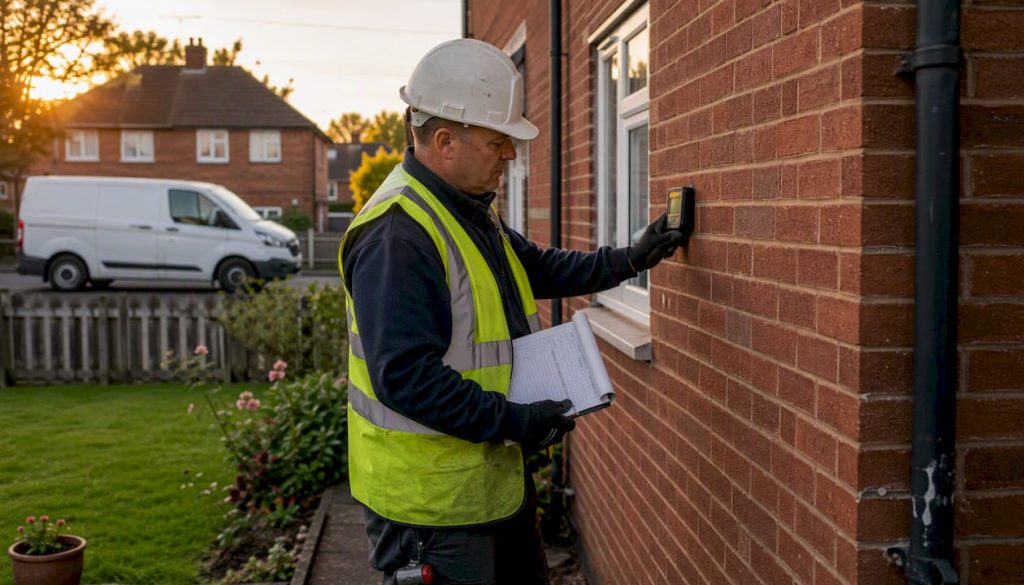
Before you book anyone to remove insulation from your cavity walls, get an independent condition inspection first. That single step separates homeowners who spend money wisely from those who pay for unnecessary work. Urea formaldehyde foam (UFF), also known as UFFI, is not automatically dangerous just because it is old, and extraction is only the right call when the foam has degraded, is causing moisture problems, or is actively affecting indoor air quality. An independent CWI Condition Inspection Survey using borescope and thermal imaging is the evidence-based starting point every time.
Pro Tip: If you are seeing new persistent damp patches, unexplained mould, a faint chemical smell, or foam oozing from mortar joints or sills, treat those as escalation signals. Book an inspection before accepting any contractor’s removal quote.
Signs that raise the urgency for inspection:
- New or worsening damp patches on internal walls, particularly after rain
- Visible mould growth on internal surfaces near the cavity
- A faint, persistent formaldehyde or chemical smell inside the property
- Foam visible at sills, around window frames, or through mortar joints
- A surveyor or mortgage lender flagging UFF in a condition report
Table of Contents
- What is urea formaldehyde foam and where was it used?
- How can you tell whether your cavity contains UFF?
- What risks does failed UFF pose, and why might you remove it?
- What does a proper independent CWI condition inspection involve?
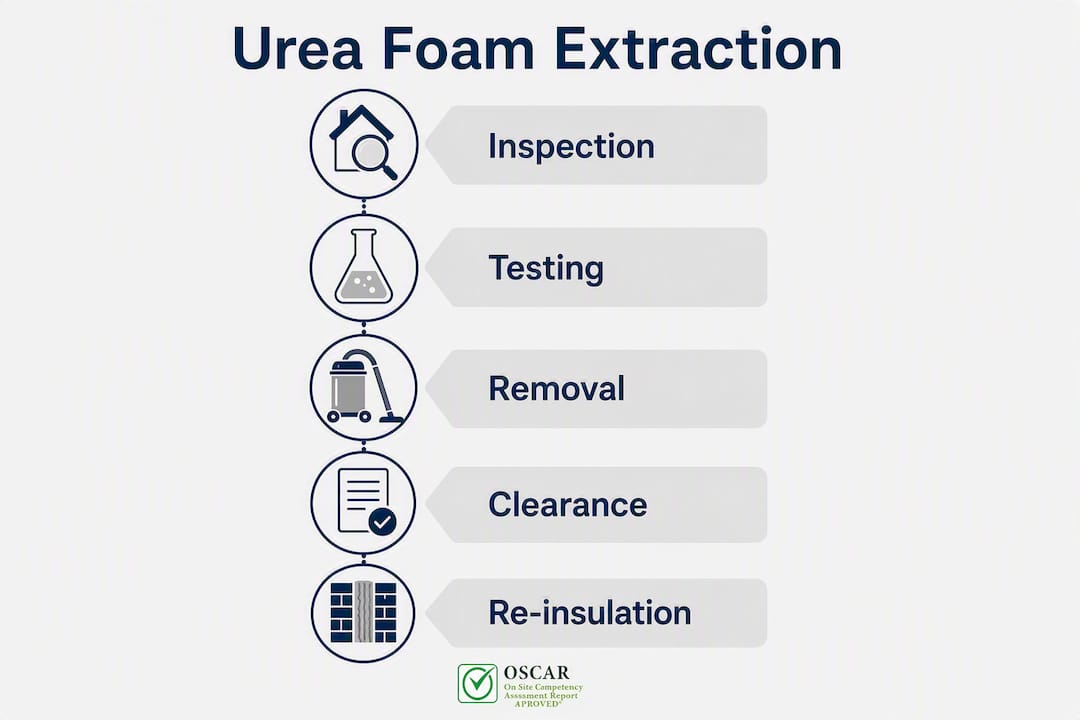
- How is accredited UFF extraction carried out?
- How long does extraction take, and what drives the cost?
- What happens after extraction?
- What questions should you ask, and what are the red flags?
- How OSCAR Onsite helps: independent surveys, accreditation and clearance
- Key takeaways
- The case for slowing down before you act
- Book an independent survey or find an accredited OSCAR member
- Authoritative UK sources and standards to consult
What is urea formaldehyde foam and where was it used?
Urea formaldehyde foam insulation was developed in Europe in the 1950s as a way to insulate hard-to-reach cavities without opening walls. Contractors mixed urea-formaldehyde resin, a foaming agent and compressed air on site, then injected the resulting foam directly into cavity walls. As it cured, it formed a rigid, cellular plastic that filled the void.
In the UK, UFF was most widely installed during the 1970s and 1980s, driven by the energy crisis and government-backed retrofit programmes. It appeared predominantly in post-war semi-detached and terraced housing with 50mm–75mm cavities, though some Victorian properties with later cavity construction also received it.
The critical difference between UFF and modern cavity fill materials:
- Appearance: UFF typically cures to a pale yellow or cream colour, becoming darker and more brittle with age
- Texture: Fresh UFF is rigid, but crumbly; aged UFF shrinks and degrades into particulate dust, leaving voids in the cavity
- Off-gassing: UFF releases formaldehyde vapour during and after installation; emissions decline over time but disturbing degraded material can release particulates and VOCs
- Regulatory status: Building Regulations Part D effectively withdrew UFF from cavity fill use in England, recognising it as an unacceptable risk for new installations
- Comparison with modern systems: Blown mineral wool and EPS bead systems do not shrink, do not off-gas formaldehyde, and are installed under current BBA/ETA certification requirements
How can you tell whether your cavity contains UFF?
You will not know for certain without a borescope inspection, but several clues point strongly in that direction before a surveyor arrives.
Visual checks you can carry out yourself:
- Look for circular plugs or filled holes in the mortar joints on the external leaf, typically 12mm–22mm in diameter, spaced at regular intervals. These are the injection points.
- Check window sills and the base of the external wall for foam residue or a pale, crumbly material oozing from joints.
- In the loft, look at the top of the cavity. Aged UFF often appears as a pale, powdery crust along the inner leaf.
The crush test is a reliable field indicator. UFFI crumbles to a fine powder when probed, unlike mineral wool (which springs back) or EPS beads (which roll freely). If a small sample from a sill or joint disintegrates under light finger pressure, UFF is the likely culprit.
What a surveyor’s borescope inspection adds:
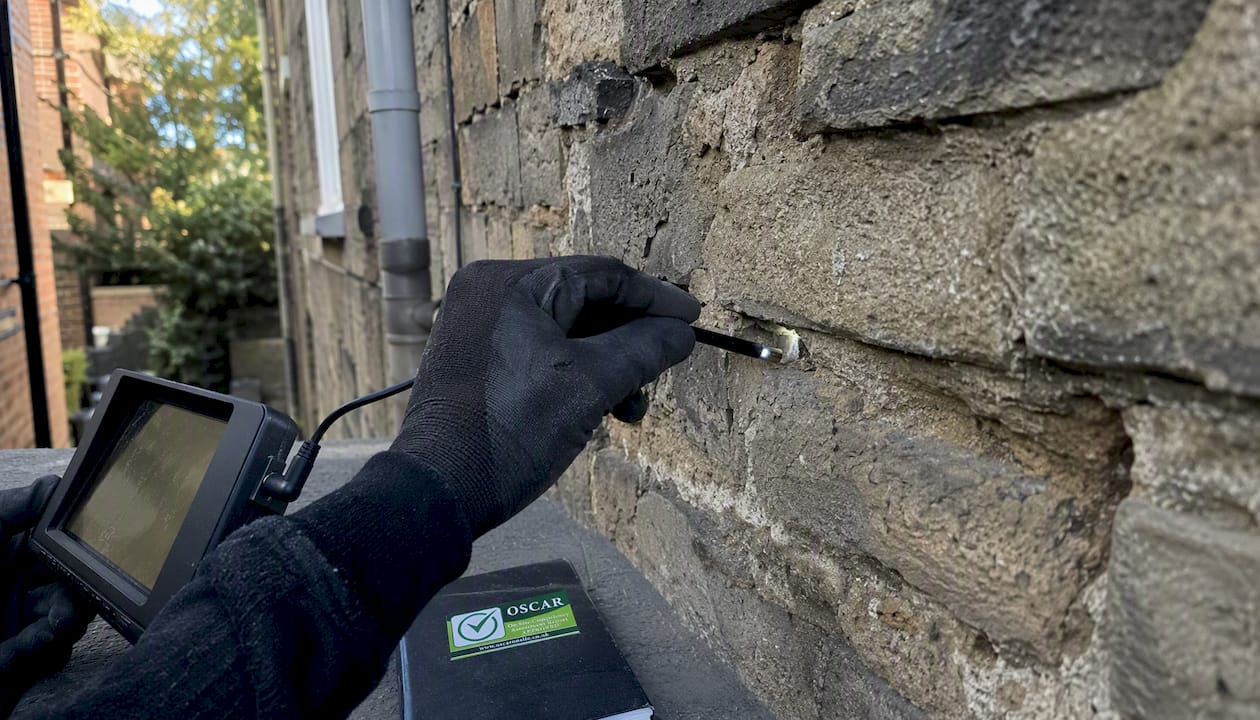
A borescope is a thin, flexible camera inserted through a small drilled hole in the mortar joint. It gives the surveyor a direct view of the cavity contents. Key indicators on the images include:
- Pale yellow or cream foam with a cellular structure
- Visible shrinkage gaps between the foam and the masonry leaves
- Powdery debris at the base of the cavity
- Mixed materials where foam has partially collapsed and other fill has been added later
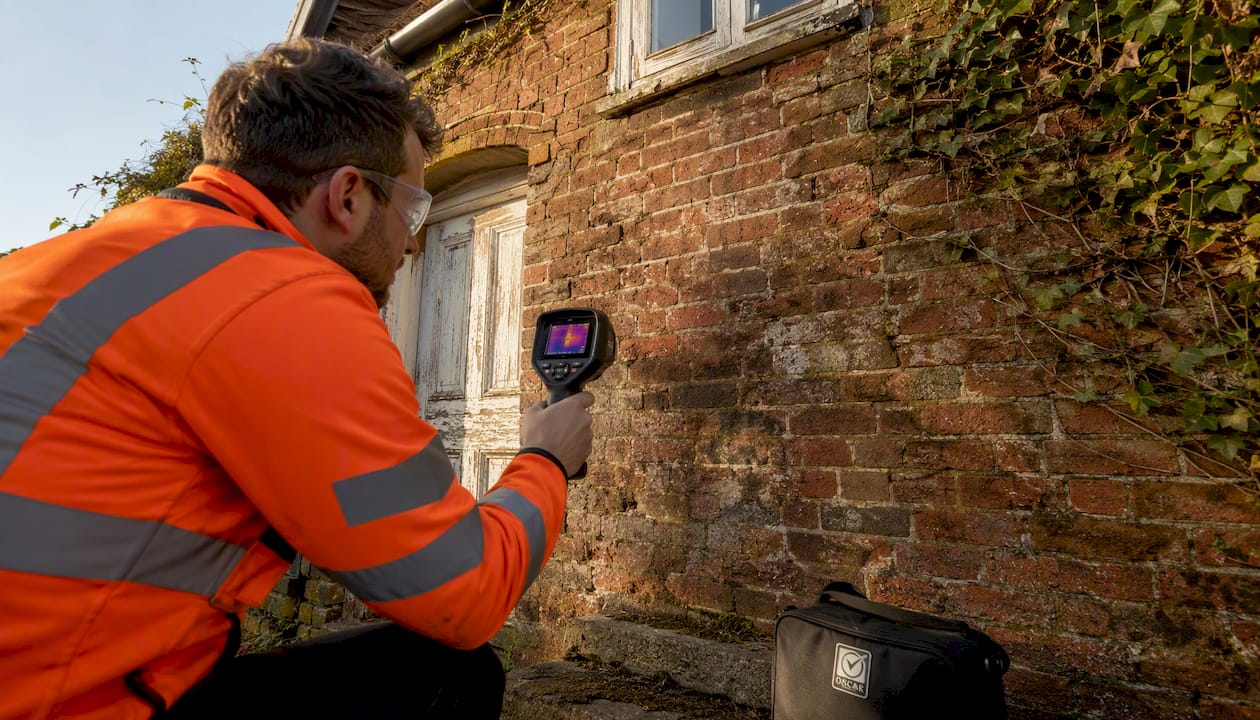
Thermal imaging complements the borescope by showing cold bridging, moisture patterns and areas where the insulation has failed. Together, these two methods give a surveyor enough evidence to make a clear recommendation without destructive investigation.
Pro Tip: Ask your surveyor to provide borescope stills and thermal images as part of the written report. These photographs are what mortgage lenders and insurers need to assess the property, and they form the baseline record if extraction is later required.
Air testing for formaldehyde or VOCs is not always necessary. It becomes relevant when occupants report symptoms, when the property has been closed up for a long period, or when a lender specifically requests it. A competent inspector will advise whether sampling is warranted based on the borescope findings and the property’s history.
What risks does failed UFF pose, and why might you remove it?
The case for extraction rests on four distinct risk categories. Not every property with UFF faces all four, which is why an independent inspection matters before any decision.
Health and indoor air quality. UFF releases formaldehyde during curing and in the years immediately after installation. Research published in Environmental Health Perspectives notes that health concerns fall into irritant, allergenic and potential carcinogenic categories, though the long-term hazard profile is not straightforward. What is clear is that disturbing degraded UFF, whether during drilling, renovation or extraction itself, can release particulates and residual VOCs. Controlled extraction with proper containment is therefore safer than ad hoc disturbance.
Moisture and building pathology. As UFF shrinks and degrades over time, it creates voids that allow cold bridging and condensation. Degraded foam can also hold moisture against the inner leaf masonry, encouraging mould colonisation and, over time, accelerating wall tie corrosion. These are building pathology problems, not just cosmetic ones.
Property transactions and mortgage lending. Many lenders and conveyancing solicitors flag UFF in valuation reports. Some mortgage products are declined or conditioned on removal. A surveyor’s flag does not automatically mean the property is unmortgageable, but it often triggers a specialist inspection requirement, and without a clearance certificate after extraction, the issue stays on the record.
When removal is not necessary. Stable, intact UFF with no evidence of moisture transfer, no occupant symptoms and no transaction pressure does not automatically need removing. Encapsulation or a monitoring approach is sometimes the right technical decision, particularly where the cost and disruption of extraction outweigh the benefit. Independent inspection upfront is what distinguishes a genuine clinical decision from a sales-led one.
Note: UFF was banned or withdrawn in many jurisdictions because of health concerns. Removal can be very costly and disruptive, so independent surveys are strongly advised before committing to any extraction programme.
What does a proper independent CWI condition inspection involve?
A robust inspection is not a quick visual check. It follows a defined scope and produces a written report that stands up to scrutiny from lenders, insurers and solicitors.
Typical inspection scope:
- Property history review: installation records, previous survey reports, any complaints or damp history
- External visual survey: injection plug locations, mortar condition, signs of foam egress, drainage and exposure assessment
- Internal visual survey: damp staining, mould, cold bridging patterns, plaster condition
- Borescope inspection: minimum of three access points per elevation, with photographic record
- Thermal imaging: conducted under appropriate temperature differential conditions (typically a 10°C difference between inside and outside)
- Moisture testing: pin or non-invasive meter readings at suspect locations
- Cavity sampling: where the material type is ambiguous or where VOC testing is requested
- Written condition report: clear recommendation (leave in place / monitor / encapsulate / extract) with supporting evidence
Credentials and standards to look for:
- Surveyors trained to NVQ Level 2 in CWI Surveying and Inspection, the qualification authored by OSCAR Onsite as the national benchmark
- Membership of the OSCAR Onsite Member Accreditation Scheme, which requires audited technical and ethical standards
- Awareness of PAS 2030:2023 and relevant BS standards
- TrustMark registration where applicable
A surveyor operating to these standards will not apply sales pressure. The report should state clearly what was found, what it means, and what the options are, including the option to do nothing. If a contractor conducts the inspection and then immediately quotes for extraction, that is a conflict of interest. Independence matters.
How is accredited UFF extraction carried out?
Urea formaldehyde foam removal, carried out properly, follows a defined sequence. Shortcuts at any stage create risk: to occupants, to the building fabric, and to the contractor’s liability.
- Independent inspection report reviewed. The extraction contractor receives the condition report and borescope findings before mobilising. No reputable firm should proceed without this.
- Risk Assessment and Method Statement (RAMS) prepared. The RAMS documents the specific hazards (formaldehyde particulates, dust, access risks), the controls in place, PPE requirements and the waste disposal route. This document must exist before work starts.
- Site preparation and temporary works. Furniture and soft furnishings near affected walls are protected or removed. Ventilation is managed to prevent cross-contamination of internal spaces.
- Drilling of extraction and inspection holes. Holes are drilled at regular intervals through the external mortar joints, typically at multiple heights per elevation, to allow access for extraction equipment and post-work verification.
- Containment and negative pressure. Where UFF has degraded into powdery particulate, staged vacuum extraction with negative pressure and HEPA filtration is used to prevent cross-contamination of internal finishes. Containment must be documented in the RAMS.
- Extraction. Compressed air dislodges foam from the cavity faces; specialist mechanical tools break up rigid or heavily degraded sections; high-efficiency vacuum extraction removes the material in stages. Dust suppression is applied throughout.
- PPE and safety controls. Operatives wear appropriate respiratory protective equipment (RPE), eye and skin protection. The site is segregated from occupied areas. All removed material is handled as controlled waste under the relevant waste carrier regulations.
- Post-extraction verification. A borescope inspection of the cleared cavity confirms the material has been removed. Moisture readings are taken. Any structural issues identified during extraction, such as corroded wall ties or damaged masonry, are recorded.
- Independent technical monitoring. Where required, an independent monitor attends during extraction and signs off on the post-extraction borescope evidence.
- Clearance certificate issued. The cavity clearance certificate documents the work completed, the verification evidence and the condition of the cavity at handover.
Pro Tip: Ask to see the RAMS before work starts. If a contractor cannot produce one, or says it is not necessary for a job of this size, that is a serious red flag. The RAMS is your evidence that the contractor has thought through the risks.
In severe cases, where the foam has caused structural damage to the inner leaf or where wall ties have failed extensively, full or partial wall strip-out may be necessary. This is uncommon but should be identified during the condition inspection, not discovered mid-job.
How long does extraction take, and what drives the cost?
A straightforward semi-detached property with accessible external walls and moderate foam degradation typically moves from inspection to clearance certificate in two to four weeks. That includes the inspection report, RAMS preparation, extraction work itself (usually one to three days on site) and post-extraction verification.
Factors that extend the timeline:
- Scaffold requirements for properties above two storeys or with restricted access
- Severe degradation requiring staged extraction over multiple visits
- Structural repairs to wall ties or masonry identified during extraction
- Damp remediation works needed before re-insulation can proceed
- Independent technical monitoring scheduling
Main cost drivers:
- House size and number of elevations to treat
- Condition of the foam (powdery and degraded costs more to extract safely than intact material)
- Access and scaffolding requirements
- Waste disposal costs for controlled material
- Whether independent technical monitoring is included
- Whether structural or damp repairs are required alongside extraction
The table below gives indicative cost bands for typical UK residential properties. These are guidance figures only; actual costs depend on the specific property and the scope of work confirmed in the condition report.
| Property type | Typical extraction scope | Indicative cost band |
|---|---|---|
| Mid-terrace (2 bed) | Two elevations, good access | — |
| Semi-detached (3 bed) | Three elevations, standard access | — |
| Detached (4 bed) | Four elevations, standard access | — |
| Any property with scaffold | Add scaffold requirement | — |
| Severe degradation / structural repairs | Extended scope | Quoted separately after inspection |
For a detailed breakdown of what drives removal pricing, the cavity wall insulation removal cost guide covers the main variables and what to look for in a quote.
The cheapest quote is rarely the right one. A quote that omits RAMS preparation, independent technical monitoring and a clearance certificate is not a complete job. Those elements are not optional extras; they are what makes the work defensible to a lender or insurer.
What happens after extraction?
Extraction is not the end of the process. Three things need to happen before the property is fully resolved: certification, repairs and a decision on re-insulation.
Clearance certification. A valid cavity clearance certificate records the pre-extraction condition, the extraction method used, the post-extraction borescope evidence and the cavity condition at handover. Mortgage lenders and insurers rely on this document. Without it, the extraction has no formal record and the property’s status remains uncertain.
Common follow-on works:
- Repointing of drilled mortar joints and any joints disturbed during extraction
- Replacement of corroded or failed wall ties identified during the borescope survey
- Plaster repairs to internal surfaces where moisture damage has occurred
- Damp specialist involvement where penetrating or rising damp is confirmed as a separate issue
Re-insulation options. Once the cavity is clear and dry, re-insulation is possible using materials that comply with current UK standards:
- Blown mineral wool: widely used, BBA-certified, suitable for most standard cavity widths
- EPS bead systems with adhesive: good for irregular cavities, requires BBA/ETA certification and an accredited installer
- Approved PU systems: available where certified for the specific wall construction type
OSCAR Onsite recommends using an accredited member firm for re-insulation and verifying that the chosen product carries current BBA or ETA certification. The blown insulation removal and replacement guide covers the technical considerations for selecting a compliant replacement material.
What questions should you ask, and what are the red flags?
Questions to ask before appointing any inspector or contractor:
- Can you provide an independent inspection report before quoting for extraction?
- What NVQ or formal training do your surveyors and operatives hold?
- Will you provide a full RAMS before work starts?
- What is your public liability insurance limit, and can I see the certificate?
- Who is your registered waste carrier, and how is the removed material disposed of?
- Will you issue a cavity clearance certificate on completion?
- Do you object to independent technical monitoring during extraction?
Absolute red flags:
- The inspector is also the person quoting for extraction, with no independent report in between
- No RAMS offered, or the contractor dismisses it as unnecessary
- Refusal to allow independent technical monitoring
- No public liability insurance details available
- No waste carrier registration number
- Pressure to sign and pay on the day of the survey
- Vague or verbal-only promises about clearance certification
Verifying credentials quickly. Check whether the firm is an OSCAR Onsite accredited member. OSCAR’s Member Accreditation Scheme requires audited technical and ethical standards, and member firms are trained to the NVQ Level 2 qualifications OSCAR authored. You can also ask the contractor to reference their PAS 2030:2023 awareness and any TrustMark registration.
How OSCAR Onsite helps: independent surveys, accreditation and clearance
OSCAR Onsite is the UK’s leading authority in CWI surveying, extraction and clearance. The recommended pathway for any property with suspected or confirmed UFF is straightforward:
- Step 1: Independent CWI Condition Inspection Survey. OSCAR Onsite’s inspection service uses borescope and thermal imaging to produce a written report with a clear recommendation. This is the evidence base for every subsequent decision.
- Step 2: OSCAR Onsite Accredited Member extraction (if the inspection justifies it). Member firms are trained to the NVQ Level 2 in CWI Extraction and Clearance, the qualification OSCAR authored as the national benchmark. They operate to defined technical and ethical standards, verified through audits and continuous professional development.
- Step 3: Independent technical monitoring. An independent monitor attends during extraction and verifies the post-extraction borescope evidence. This step protects the homeowner and gives lenders and insurers a defensible record.
- Step 4: Clearance Certificate. Issued on completion, documenting the cavity condition and the verification evidence.
OSCAR Onsite also runs the CWI Awareness Course for Surveyors, designed for RICS surveyors, building surveyors, DEAs, retrofit professionals, mortgage lenders and conveyancing solicitors. This CPD programme ensures that the professionals advising homeowners understand what they are looking at.
Trust signals to look for from any OSCAR Onsite accredited firm: audited member standards, PAS 2030:2023 and BS 8104 references, NVQ-qualified operatives, and written RAMS and clearance certification as standard.
Key takeaways
Independent inspection before extraction is the single most important step a UK homeowner can take when UFF is suspected, because it separates properties that genuinely need removal from those that do not.
| Point | Details |
|---|---|
| Inspect before you extract | Book an independent CWI Condition Inspection (borescope + thermal imaging) before accepting any extraction quote. |
| UFF is not always an emergency | Stable, intact foam with no moisture or health symptoms may not need removal; encapsulation or monitoring is sometimes the right call. |
| Insist on RAMS and a clearance certificate | Any extraction without a written Risk Assessment and Method Statement and a post-work clearance certificate is incomplete and unverifiable. |
| Cheapest quote is rarely complete | A quote that omits independent technical monitoring and clearance certification is missing the elements lenders and insurers require. |
| OSCAR Onsite accreditation | Use an OSCAR Onsite accredited member firm for extraction, backed by NVQ-qualified operatives and independent technical monitoring. |
The case for slowing down before you act
The pressure to “just get it out” is understandable. A surveyor flags UFF, a lender raises a concern, and suddenly the path of least resistance looks like booking the first contractor who answers the phone. That instinct is exactly what sales-led extraction firms rely on.
What the evidence actually shows is more nuanced. Not every UFF installation is failing. Not every failing installation is causing harm. The properties where extraction is genuinely urgent are those with active moisture transfer, confirmed mould, occupant symptoms, or a transaction that cannot proceed without a clearance certificate. For the rest, the right move is a proper inspection, a written recommendation, and a decision made on evidence rather than anxiety.
The other thing worth saying plainly: the extraction industry in the UK has a history of poor workmanship and inadequate oversight. OSCAR Onsite was established specifically to address that. The NVQ qualifications, the Member Accreditation Scheme, the independent technical monitoring pathway — these exist because the alternative, an unregulated contractor drilling holes and vacuuming out material with no RAMS and no clearance certificate, leaves homeowners with no recourse and no documentation.
Independent verification is not bureaucracy. It is the difference between a resolved problem and a liability that follows the property through every future sale.
Book an independent survey or find an accredited OSCAR member
The evidence-led route to resolving a UFF concern starts with an independent inspection, not a removal quote. OSCAR Onsite’s CWI Condition Inspection Survey gives you a borescope and thermal imaging report with a clear, written recommendation — no sales pressure, no conflict of interest.
Where extraction is justified, OSCAR Onsite connects you with an accredited member firm trained to the NVQ Level 2 standard, with independent technical monitoring and a cavity clearance certificate as part of the process. You can also review the full extraction service to understand what accredited removal involves before you commit to anything.
Book your independent CWI Condition Inspection Survey through OSCAR Onsite to get the written evidence you need to make the right decision for your property.
Authoritative UK sources and standards to consult
When reviewing contractor documentation or verifying claims, these are the sources and standards worth checking:
- PAS 2030:2023 — the UK standard governing energy efficiency measures in existing dwellings; any contractor working under ECO or grant-funded schemes must reference it
- Building Regulations Approved Document Part D — covers toxic substances in building materials; Part D guidance effectively withdrew UFF from cavity fill use in England
- BBA/ETA certification — ask for the current certificate for any replacement insulation product; British Board of Agrément (BBA) approval is the standard reference for cavity fill materials in the UK
- OSCAR Onsite NVQ qualifications — the NVQ Level 2 in CWI Extraction and Clearance is the national benchmark qualification; ask contractors to confirm their operatives hold it
- OSCAR Onsite CWI Condition Inspection Survey — the independent inspection service and written report that should precede any extraction decision
- TrustMark — the government-endorsed quality scheme for retrofit and home improvement work; check whether your contractor is registered
- Energy Saving Trust and BRE guidance — useful background on cavity wall insulation performance and failure modes; always cross-reference with a qualified surveyor’s findings for your specific property
When requesting documentation from a contractor, ask specifically for: the BBA/ETA certificate for any replacement material, the RAMS before work starts, the waste carrier registration number, and the clearance certificate template so you know what the final document will contain.
This article provides general information for UK homeowners and property managers. It is not a substitute for professional advice. Always confirm current regulations and your specific property’s requirements with a qualified surveyor or accredited specialist.