Mineral wool cavity extraction is necessary when the insulation inside your cavity walls has become saturated, slumped, or contaminated to the point where it is actively causing damp, mould, or significant heat loss. The immediate next step is not to book a contractor to remove it. Book an independent CWI Condition Inspection Survey first.
That survey will do three things: confirm whether the mineral wool has genuinely failed, produce a written condition report with borescope evidence, and set out a clear route to extraction and clearance certification if removal is justified. Without it, you risk paying for an irreversible procedure that may not solve the problem.
- Confirm failure: borescope images and moisture readings establish whether the material is wet, slumped, or bridging the cavity.
- Recommend the right action: extraction, targeted repair, or simply addressing an external defect such as a blocked weep hole.
- Map the clearance route: if extraction proceeds, the survey defines the scope, method, and certification requirements.
Key takeaways
Mineral wool cavity extraction is only justified when an independent borescope survey confirms saturation, slumping, or contamination. Survey first, extract only when the evidence demands it, and insist on a clearance certificate when the work is done.
| Point | Details |
|---|---|
| Survey before extraction | An independent borescope condition report is required before any extraction decision is made. |
| Failure modes to recognise | Saturation, slump, cavity bridging, and contamination each justify extraction; external defects often do not. |
| Removal rates vary by material | Mineral wool extracts at 75–85% by vacuum; loose EPS beads reach 90–95%; bonded materials are lower. |
| Timescale and cost depend on condition | A typical semi-detached takes 1–2 days; contamination, access, or foam presence extends this to 2–4 days. |
| OSCAR Onsite | Provides independent surveys, accredited extraction referrals, technical monitoring, and clearance certification across the UK. |
Table of Contents
- When does mineral wool cavity extraction become necessary?
- How extraction is carried out: the step-by-step process
- Which cavity materials are extractable, and how does mineral wool compare?
- What does mineral wool cavity extraction cost, and how long does it take?
- What happens after extraction: drying, repairs, and clearance certification
- When extraction is not the answer
- How to choose a safe, accredited extraction contractor
- OSCAR Onsite’s evidence-led approach to surveying, extraction, and clearance
- OSCAR Onsite: independent surveys before any extraction decision
- Sources
When does mineral wool cavity extraction become necessary?
Mineral wool, sometimes called white wool or glass wool, was injected into cavity walls as loose fill from the 1970s onwards. When it works, it works well. When it fails, the consequences tend to be slow, persistent, and easy to misread.
The four main failure modes
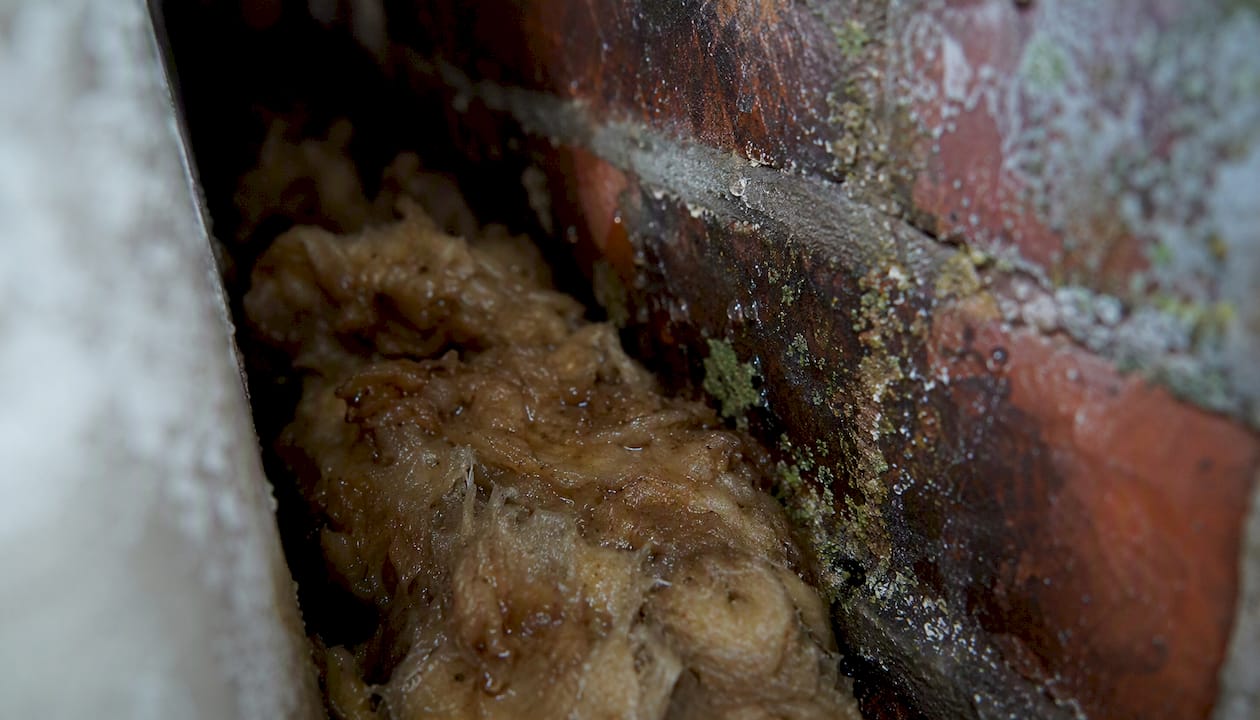
Saturation is the most common. Mineral wool is hydrophilic, meaning it absorbs moisture readily. Once wet, it loses most of its thermal resistance and begins conducting moisture across the cavity to the inner leaf. Internal damp patches, particularly on windward elevations, are the most visible result.
Slump and settlement happen over time as the fibres compact under gravity, leaving voids near the top of the wall. Those voids become cold bridges, and heating bills rise without an obvious explanation.
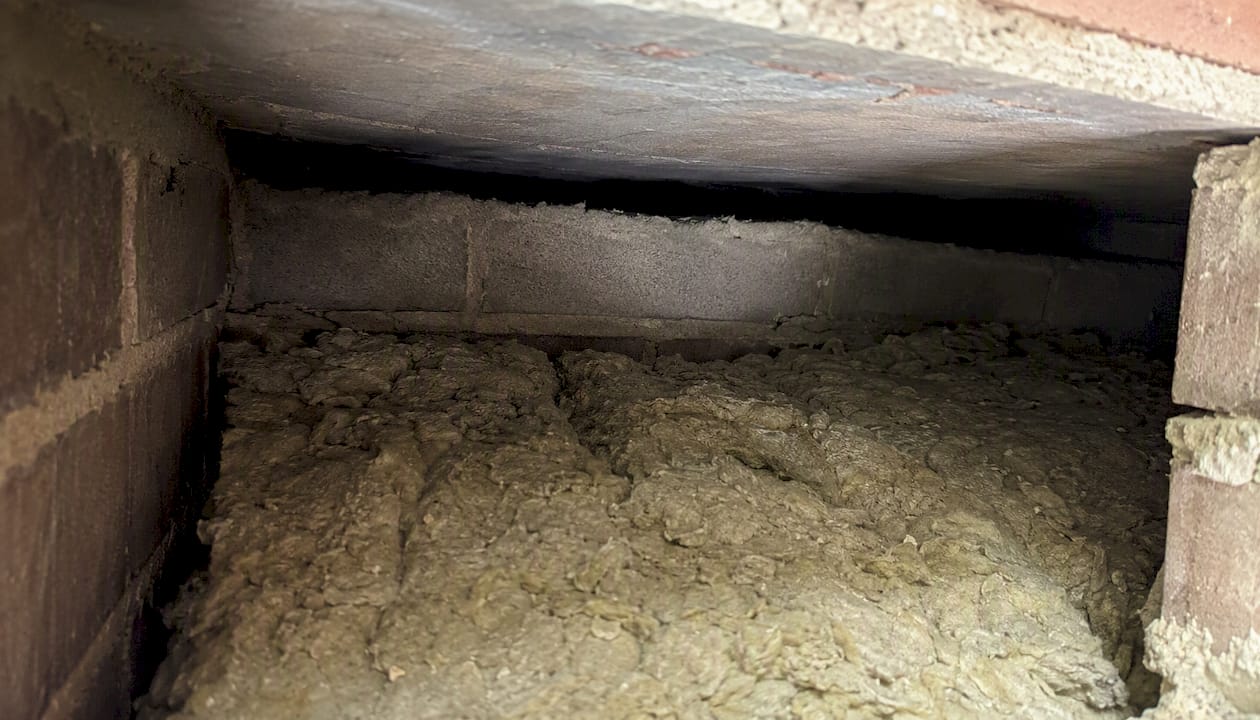
Cavity bridging occurs when saturated or displaced material spans the full width of the cavity, creating a direct path for moisture from the outer leaf to the inner leaf. This is particularly damaging in exposed locations.
Contamination covers debris, mortar droppings, and biological growth within the cavity. Contaminated material can no longer be remediated in place and must come out.
A windward gable wall showing persistent damp patches at mid-height, with no obvious external defect, is a classic presentation of saturated mineral wool bridging the cavity. The pattern is almost diagnostic on its own — but borescope confirmation is still required before any extraction decision is made.
Pro Tip: Before assuming insulation failure, check the guttering, downpipes, pointing, and weep holes. Practical guides consistently warn that leaking gutters and blocked weep holes are frequently misattributed to failed insulation. Fixing an external defect costs a fraction of extraction.
Symptom checklist for homeowners:
- Damp patches on internal walls, especially on the side of the house facing prevailing weather
- Mould growth at skirting level or in corners, not explained by ventilation issues
- Cold spots on walls that feel noticeably colder than adjacent areas
- Heating bills rising year on year without a change in behaviour or occupancy
- A musty smell in rooms on external walls
None of these symptoms alone confirms extraction is required. They are the trigger to arrange a borescope condition inspection, not a removal job.
How extraction is carried out: the step-by-step process
Mineral wool extraction follows a defined workflow. Understanding it helps you assess whether a contractor is doing the job properly or cutting corners.
-
Pre-extraction survey and material identification. A qualified operative uses a borescope to inspect the cavity at multiple points, confirming the material type, its condition, and the extent of failure. Only two approved removal techniques exist: vacuum extraction for loose-fill materials and chemical softening followed by vacuum for injected foams. The survey determines which applies.
-
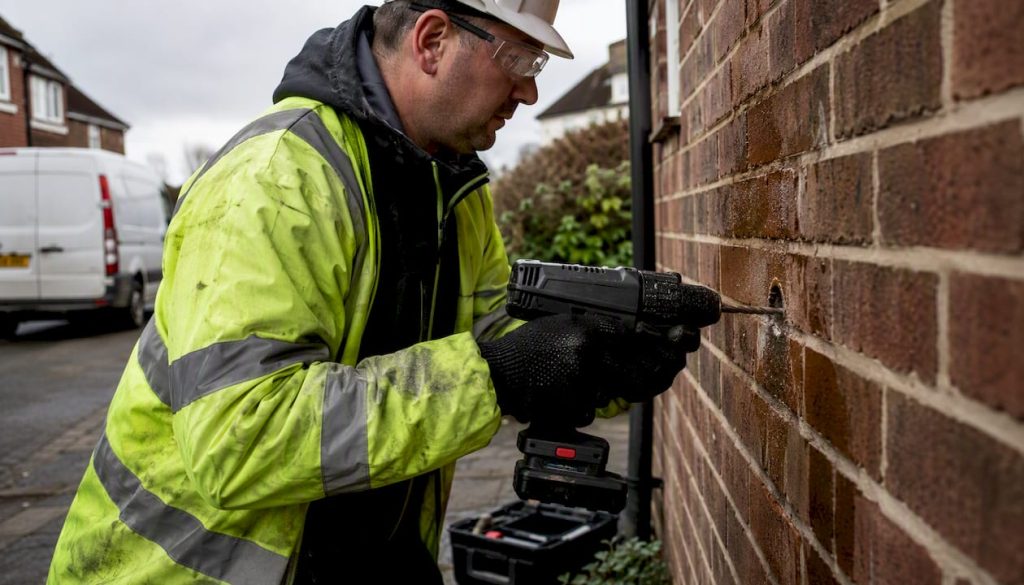
Drilling access holes. Operatives drill a pattern of holes through the outer leaf, typically at 1.2–1.5 metre intervals in a progressive sequence designed to maximise extraction coverage. Hole diameter is usually 22–25mm.
-
Industrial vacuum extraction. A high-powered extraction unit connects to each hole in sequence. The vacuum draws the loose mineral wool fibres out of the cavity and into a sealed collection system. The progressive hole sequence is critical: skipping holes leaves pockets of material behind.
-
Post-extraction borescope verification. Once extraction is complete, the operative re-inspects the cavity through the access holes with a borescope to confirm the cavity is clear. This step is non-negotiable. Without it, there is no evidence that the job is done.
-
Hole sealing and making good. Access holes are filled with matching mortar and the wall is made good. The quality of this work matters: poorly sealed holes become new moisture entry points.
-
Waste disposal. Extracted mineral wool is classified as controlled waste and must be removed by a licensed waste carrier. Responsible contractors confirm their waste carrier arrangements before work starts. Mineral wool can be recycled, but contractors should confirm the disposal route in advance.
Timescale: Vacuum extraction typically takes 1–2 days for an average semi-detached property, extending to 2–4 days where walls are heavily contaminated, access is restricted, or the property is larger. Detached houses with complex elevations or injected foam present can take longer still.
Key figure: Mineral wool is typically 75–85% removable by vacuum extraction, compared with 90–95% for loose polystyrene beads. That residual percentage matters for post-extraction drying and re-insulation decisions.
Safety note on old injected foams: urea-formaldehyde foam (UFFI), injected widely in the 1970s and 1980s, cannot be removed by vacuum alone. It requires chemical softening before extraction and generates hazardous waste requiring specialist disposal. If your property was insulated before 1985, a pre-extraction survey must confirm the material before any work is scheduled.
Which cavity materials are extractable, and how does mineral wool compare?
Not every cavity fill responds to the same removal method. The table below sets out the common materials found in older UK homes, the appropriate extraction technique, and the typical completeness of removal.
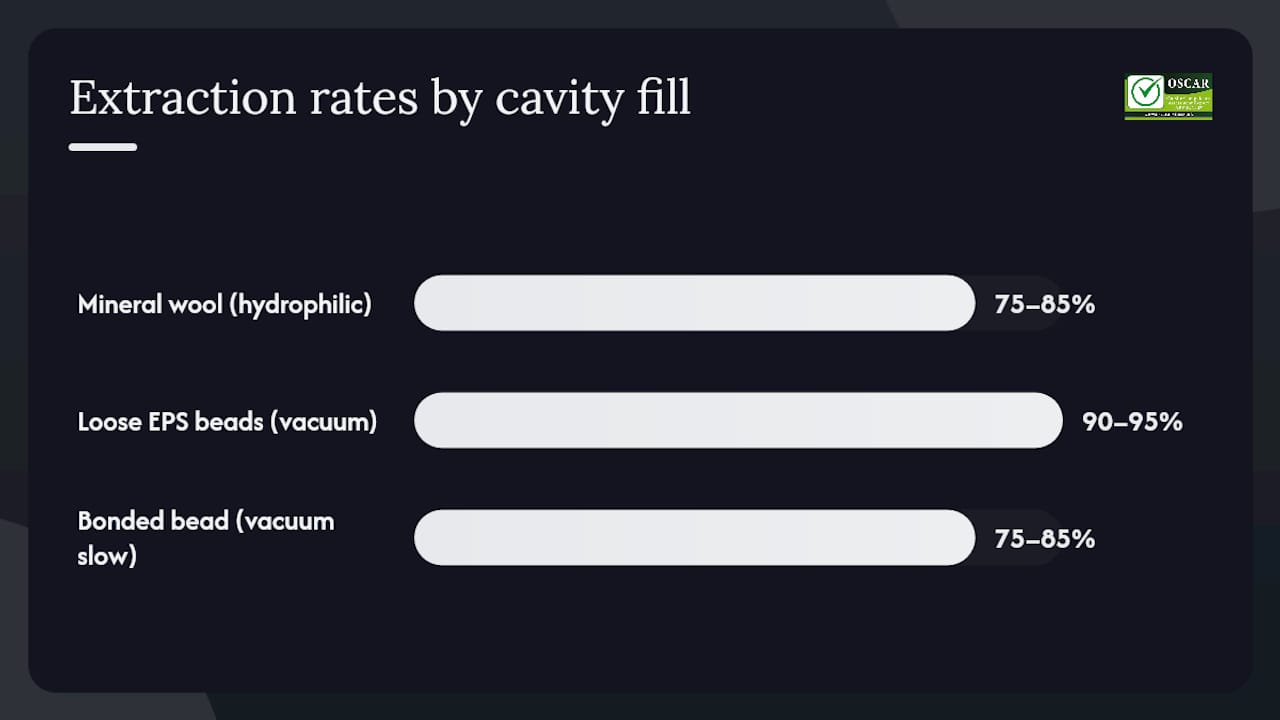
| Material | Common name | Extraction method | Typical removal rate | Notes |
|---|---|---|---|---|
| Mineral wool (glass/rock fibre) | White wool, Rockwool | Vacuum extraction | 75–85% | Hydrophilic; loses thermal value when wet; fibres may compact |
| Expanded polystyrene beads (loose) | EPS bead | Vacuum extraction | 90–95% | High removal rate; beads can migrate if cavity has gaps |
| Bonded polystyrene bead | Bonded bead | Vacuum extraction (slower) | 75–85% | Adhesive bonding reduces extraction speed and completeness |
| Urea-formaldehyde foam | UFFI | Chemical softening + vacuum | Variable | Hazardous waste classification; specialist disposal required |
| Polyurethane foam (injected) | PU foam | Chemical softening + vacuum | Variable | Rare; specialist assessment required before work starts |
Rockwool is a branded mineral wool product and behaves identically to generic mineral wool in extraction terms. The distinction that matters is not brand but condition: dry, settled mineral wool may be partially salvageable; wet, contaminated mineral wool is not.
Bonded bead presents a different challenge. The adhesive used to bond EPS beads in place slows extraction considerably and reduces completeness. Where bonded bead is present alongside mineral wool in a mixed-fill cavity, the extraction plan must account for both.
What does mineral wool cavity extraction cost, and how long does it take?
Cost and timescale are the two questions homeowners ask first. The honest answer is that both depend heavily on what the survey finds.
Main cost drivers:
- Property size and wall area: more wall area means more holes, more extraction time, and more disposal volume.
- Material condition and contamination: heavily saturated or contaminated material takes longer to extract and may require additional drying works.
- Access difficulty: scaffolding requirements, restricted access on terraced properties, or complex roof lines all add cost.
- Presence of injected foam: chemical removal is more labour-intensive and generates specialist waste disposal costs.
- Repair works: repointing, wall-tie replacement, or internal remediation following extraction are separate line items.
- Re-insulation: if you plan to re-insulate after extraction, that is a further cost and a separate specification decision.
Published cost guides offer indicative per-square-metre figures, but these vary significantly by region, contractor, and property condition. Always request an itemised quote that separates the survey fee, extraction, disposal, any repair works, and re-insulation as distinct line items. A single lump-sum quote makes it impossible to understand what you are paying for or to compare contractors fairly.
Indicative timescale: a typical three-bedroom semi-detached property takes 1–2 days for straightforward vacuum extraction. Complex cases, including heavily contaminated walls, restricted access, or foam removal, extend to 2–4 days. For detailed timescale guidance by property type, see cavity wall extraction timescales.
Pro Tip: Ask every contractor for a written, itemised quote and confirm that the survey fee is charged separately from the extraction fee. A contractor who bundles the survey into a “free assessment” and then quotes immediately for extraction has a financial incentive to recommend removal regardless of what the borescope shows.
What happens after extraction: drying, repairs, and clearance certification
Extraction is not the end of the process. What happens next determines whether the property performs better or simply has an empty cavity.
Drying and structural checks
Once the cavity is clear, the walls need time to dry out. How long depends on how saturated the material was and how long the problem had been present. In some cases, drying takes several weeks before re-insulation is appropriate. Wall ties should be inspected during this period: saturated mineral wool accelerates corrosion, and ties that were borderline before extraction may need replacement.
Mortar joints and any areas of poor pointing should be repaired before re-insulation. Sending new insulation into a cavity with existing moisture pathways simply repeats the original failure.
Clearance certification
A cavity clearance certificate is the document that proves the cavity has been independently verified as clean and dry. Without it, you have only the contractor’s word that the job is done. Insurers, mortgage lenders, and future retrofit guarantee providers will ask for it.
The certification process works as follows: an independent technical monitor inspects the cavity post-extraction using a borescope, confirms cleanliness and dryness, and issues a written clearance certificate. This is a separate function from the extraction contractor. The monitor’s independence is what gives the certificate its value.
If you plan to install External Wall Insulation (EWI) after extraction, INCA’s CWI/EWI interaction guidance requires that you notify your cavity guarantee provider, use suitably qualified operatives, and obtain an extraction certificate before EWI installation proceeds. Skipping this step can void future EWI guarantees.
OSCAR Onsite provides cavity clearance certification as an independent service, separate from extraction.
Re-insulation options
Once the cavity is dry and certified clear, re-insulation options include:
- EPS bead insulation: high removal rate if future extraction is ever needed; well-established in the UK market.
- Hybrid systems: combining partial-fill boards with blown bead in the remaining cavity space.
- External wall insulation: avoids re-filling the cavity entirely and addresses thermal bridging at the same time.
The right choice depends on wall construction, exposure zone, and the original reason for failure. A condition survey before re-insulation is as important as the one before extraction.
When extraction is not the answer
Extraction is irreversible and not always necessary. Several situations call for a more measured response.
-
Dry, settled mineral wool with localised voids. If borescope inspection shows the material is dry but has settled, leaving voids near the top of the wall, topping up with compatible insulation may be appropriate. This is only viable where the existing material is genuinely dry and there is no evidence of bridging or contamination.
-
Damp caused by an external defect, not insulation failure. If moisture readings show elevated levels but the borescope reveals intact, dry insulation, the source is almost certainly external. Repointing, gutter repair, or clearing blocked weep holes resolves the problem without touching the cavity.
-
Localised failure in an otherwise sound installation. Where failure is confined to a small section of wall, targeted remediation, such as local extraction and re-fill of the affected area, may be proportionate. Full extraction of a largely sound installation is rarely justified.
-
Thermal underperformance without moisture ingress. If the insulation is dry but heating bills are high, the cause may be air leakage, poor draught-proofing, or a different part of the building fabric. A full energy assessment is more useful than extraction in this scenario.
The decision between remediation and full extraction should always follow a borescope survey with moisture readings. Where those readings indicate a salvageable condition, remediation is the proportionate response. Cavity wall insulation causing condensation is a related but distinct problem that warrants its own diagnostic pathway.
How to choose a safe, accredited extraction contractor
The extraction market contains a wide range of operators. Some are excellent. Others pressure homeowners into unnecessary removal. This checklist helps you tell the difference.
| What to look for | What to ask or check | Red flag |
|---|---|---|
| Independent pre-extraction survey | “Will you provide a written condition report with borescope images before quoting?” | Immediate quote without borescope evidence |
| NVQ-qualified operatives | “Are your operatives NVQ Level 2 qualified in CWI Extraction & Clearance?” | Vague answer or no qualification cited |
| PAS 2030/2035 awareness | “Are you familiar with PAS retrofit requirements for pre-installation inspection?” | Blank response or dismissal |
| Independent technical monitoring | “Will an independent monitor verify the cavity post-extraction?” | Contractor offers to self-certify |
| Clearance certificate | “Will you issue a cavity clearance certificate on completion?” | Refusal or “we don’t do that” |
| Licensed waste carrier | “Can you confirm your waste carrier licence number?” | Reluctance to provide documentation |
| Appropriate insurance | “Do you carry public liability insurance for extraction works?” | No written confirmation available |
| Itemised written quote | “Can you break down survey, extraction, disposal, and repairs separately?” | Single lump-sum only |
PAS 2030:2019 retrofit requirements set out that pre-installation inspections must be detailed enough to confirm safety and suitability, and that inspection information must be provided to certification bodies. A contractor who cannot demonstrate awareness of these requirements is operating below the standard the industry expects.
Sales-led pressure to extract without diagnostic evidence is the single biggest red flag in this market. Extraction without proof of failure is an expensive, irreversible mistake that can create new condensation problems by leaving the cavity empty and unprotected.
OSCAR Onsite’s evidence-led approach to surveying, extraction, and clearance
OSCAR Onsite is the UK’s leading authority in cavity wall insulation surveying, extraction, and clearance. The organisation authored the UK’s first Level 2 NVQ Diplomas in CWI Surveying & Inspection and CWI Extraction & Clearance, establishing the national occupational standards that qualified operatives are now trained to.
The OSCAR survey workflow is built around independence at every stage:
- Independent borescope condition survey: an OSCAR-accredited surveyor inspects the cavity, produces a written condition report with photographic evidence, and makes an evidence-led recommendation. No extraction is recommended without documented proof of failure.
- Accredited extraction firm: where extraction is justified, OSCAR refers to an accredited member firm trained to NVQ level and operating to defined technical and ethical standards.
- Independent technical monitoring: a separate OSCAR monitor oversees the extraction, verifying method, completeness, and safety compliance throughout.
- Clearance certification: post-extraction borescope inspection confirms the cavity is clean and dry. OSCAR issues a cavity clearance certificate that homeowners, insurers, and lenders can rely on.
The OSCAR name stands for On Site Cavity Assessment Report. Every service the organisation provides flows from that commitment: accurate diagnostics, transparent reporting, and accountability at every stage of the process.
OSCAR Onsite also offers a CWI Surveyor Awareness Course for RICS surveyors, building surveyors, DEAs, retrofit professionals, housing providers, mortgage lenders, and conveyancing solicitors, giving the wider property sector the knowledge to identify CWI failure and commission appropriate investigation.
Trust signals to look for in any OSCAR-accredited firm:
- NVQ Level 2 qualified operatives in both surveying and extraction
- PAS 2030/2035-aligned inspection procedures
- Written condition report with borescope images provided before any extraction recommendation
- Independent technical monitoring throughout extraction
- Cavity clearance certificate issued post-extraction by an independent monitor
- Licensed waste carrier documentation confirmed in advance
The homeowner’s experience: what to expect from survey to clearance
Most homeowners arrive at this process worried about disruption and unsure whether they are being told the truth about the severity of the problem. Both concerns are reasonable.
The survey itself is low-disruption: a qualified operative drills small inspection holes, inserts a borescope, and produces a report, typically within a few hours. You receive written findings with images, not a verbal assessment over the phone. If extraction is not required, the report says so clearly, and you have documentation to support that conclusion.
Where extraction does proceed, the property is habitable throughout. The work is external, the noise is manageable, and a typical semi-detached is done within two days. The clearance certificate at the end is the document that closes the process properly, giving you something tangible to show a mortgage lender, insurer, or future buyer.
Insisting on that certificate is not bureaucratic caution. It is the difference between a job that is finished and a job that is merely done.
OSCAR Onsite: independent surveys before any extraction decision
The single most expensive mistake homeowners make in this area is booking extraction before booking a survey. OSCAR Onsite exists to prevent that. An independent CWI Condition Inspection Survey gives you the borescope evidence, the written condition report, and the professional recommendation you need to make an informed decision, without any financial incentive to recommend removal.
Where extraction is the right course, OSCAR connects you with an accredited member firm trained to NVQ level, provides independent technical monitoring throughout the works, and issues a cavity clearance certificate once the cavity is independently verified as clean and dry. That certificate protects your property’s retrofit eligibility, satisfies insurers, and gives you a documented record of the work.
Book your independent condition survey with OSCAR Onsite before committing to any extraction works.
Sources
The following sources were used to build this guide. Each is worth reading directly if you want to go deeper on a specific aspect of the process.
- CWI/EWI interaction guidance (INCA)
- Cavity wall insulation removal: a practical guide for UK homeowners
- CWI extraction process: step-by-step guide
- How is cavity wall insulation removed? | Axiom Eco Homes