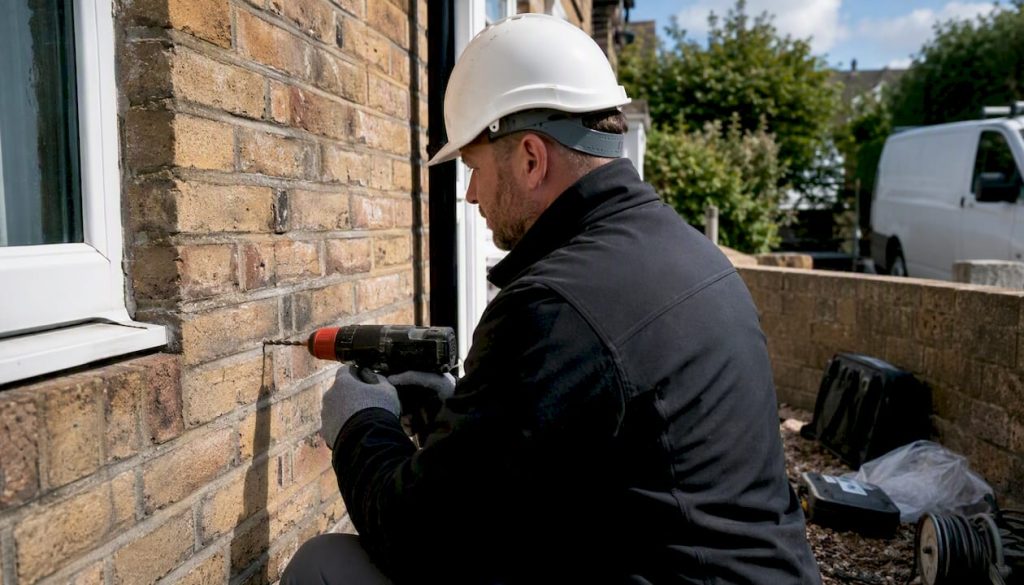
A Level 2 NVQ in cavity wall surveying, inspection and extraction exists as a formal, work-based qualification, and it is the recognised route into paid cavity wall inspection, extraction and clearance work across the UK. The qualification is awarded by GQA Qualifications and was developed in partnership with OSCAR Onsite, the training body responsible for authoring the UK’s first Level 2 NVQs in this discipline. That authorship matters because it ties the training directly to current retrofit standards rather than outdated site practice.
The GQA NVQ Level 2 Certificate in Cavity Wall Extraction Occupations carries a Total Qualification Time and guided learning hours, built around mandatory units plus a choice of pathway. Candidates must register with OSCAR Onsite before registering for the qualification itself, a step designed to keep assessment aligned with PAS 2030 and PAS 2035 rather than legacy methods.
| Quick fact | Detail |
|---|---|
| Awarding body | GQA Qualifications |
| Qualification author | OSCAR Onsite |
| Ofqual reference | 603/4678/4 |
| Total Qualification Time (TQT) | 240 hours |
| Guided Learning Hours (GLH) | 84 hours |
| Pathways | Clearance/extraction, or surveyor/inspector |
| Typical outcomes | Extraction technician, cavity insulation inspector, clearance technician |
Before you go any further, three things are worth doing straight away:
- Check the qualification’s live status on the Ofqual register using reference 603/4678/4.
- Confirm your intended training centre is OSCAR-registered, since GQA requires OSCAR registration ahead of qualification sign-up.
- Start gathering evidence of current workplace competence, even informally, before your assessment plan is agreed.
Key Takeaways
The cavity wall surveying NVQ Level 2, awarded by GQA and authored by OSCAR Onsite, gives UK operatives a regulated, evidence-based route into inspection and extraction careers based on a structured Total Qualification Time.
| Point | Details |
|---|---|
| Qualification is real and regulated | GQA awards it under Ofqual reference 603/4678/4, with TQT and GLH values reflecting the qualification’s structure. |
| Suits working operatives, not beginners | You need genuine site access for evidence, typically through an employer route. |
| Assessment is evidence based | Expect observation, witness testimony, photographic proof and professional discussion, not exams. |
| OSCAR authorship matters | Training aligns to PAS 2030/2035 because OSCAR Onsite co-developed the qualification with GQA. |
| Verify before you enrol | Check the Ofqual register and confirm OSCAR Onsite registration before signing up with any centre. |
Table of Contents
- Who is the cavity wall extraction NVQ for?
- What does the NVQ Level 2 in cavity wall surveying cover?
- How is the cavity wall assessment process structured?
- How long does the qualification take and what do you need to start?
- What accreditation and career recognition does it carry?
- How do you enrol on the cavity wall inspection course?
- Why OSCAR Onsite’s role in this NVQ matters
- An industry lead’s perspective on getting this right
- How OSCAR Onsite supports your next step
- Where to verify the details yourself
- Frequently asked questions
- Sources
Who is the cavity wall extraction NVQ for?
This qualification suits people already working, or about to start working, in cavity wall insulation removal, inspection or building maintenance with an insulation specialism. It is not an academic course you sit in a classroom for. It is a competence award, which means you need a genuine route into site work before you can gather the evidence assessors need to see.
Typical candidates include:
- Cavity wall extraction technicians removing failed or saturated insulation from wall cavities.
- Cavity insulation surveyors and inspectors carrying out condition assessments before or after extraction.
- Building maintenance operatives moving into an insulation specialism as part of a wider retrofit career.
- Retrofit operatives working under PAS 2035 coordination who need formal evidence of competence.
Training providers typically expect candidates to be at least 18, with a genuine interest in construction or an existing site role, since assessment happens on the job rather than through exams. Employer sponsorship is common where an existing extraction firm puts an operative through the qualification to formalise skills they already use daily. If you are new to the trade with no employer route in, you will usually need to secure a placement or junior role first, since there is no way to fabricate portfolio evidence without live site access.
If your ambitions run wider than cavity wall work, such as building surveying across multiple insulation types, a broader qualification like the Level 2 NVQ Diploma in Insulation and Building Treatments may suit you better than the cavity-specific certificate.
What does the NVQ Level 2 in cavity wall surveying cover?
The certificate is built from mandatory units everyone completes, plus a pathway choice that shapes your day-to-day competence focus. Course outlines from approved providers point to a consistent structure across centres.
Mandatory units generally cover:
- Conforming to general health, safety and welfare in the workplace.
- Productive working practices in construction environments.
- Moving, handling and storing resources safely on site.
From there, you choose at least one pathway. The clearance and extraction pathway focuses on cavity wall clearance techniques, safe material removal and site reinstatement. The surveyor and inspector pathway focuses on assessment skills, including diagnosing wall tie corrosion, moisture ingress and insulation failure before any extraction decision is made. GQA’s qualification structure confirms candidates can complete one pathway or both, depending on their role.
Related programmes also list optional units covering broader insulation and building treatment skills. If your employer’s work spans more than cavity extraction, expect your assessor to flag which optional units are realistically achievable given your actual site exposure.
How is the cavity wall assessment process structured?
Assessment is entirely evidence based. There is no written exam, which surprises some candidates expecting a classroom-style test. Instead, an assessor builds a picture of your competence through direct observation, questioning and documented proof gathered over weeks or months of real work.
Typical evidence includes:
- Direct workplace observation by a qualified assessor watching you carry out extraction or survey tasks.
- Witness testimony from a supervisor confirming you performed specific tasks to standard.
- Photographic evidence of borescope inspections, wall tie condition, or cavity clearance in progress.
- Completed risk assessments, method statements and equipment checks.
- Professional discussion, where the assessor questions your reasoning on why you chose a particular remedial route.
Course descriptions consistently emphasise a fabric-first approach: candidates are trained to correctly identify defective insulation and recommend the appropriate remedy, not to default to extraction as the automatic answer. That distinction shapes how assessors mark professional discussion evidence.
Pro Tip: Keep a running competency logbook from day one, even before your formal registration is confirmed. Date every photo, note the site address and task, and file risk assessments as you complete them. Assessors spend far more time chasing scattered evidence than reviewing it, and a tidy logbook can shave weeks off your overall timescale.
How long does the qualification take and what do you need to start?
The GQA certificate carries a Total Qualification Time and guided learning hours. In practice, most of that time is spent working, not sitting in training sessions, since NVQs are assessed on the job rather than through a fixed classroom timetable. How quickly you complete the qualification depends heavily on how much relevant site work you get, not just how many hours you study.
Entry requirements are straightforward:
- Minimum age of 18 at most centres.
- Recommended prior experience in construction, or a confirmed employer placement giving you access to real extraction or survey work.
- Some centres or employers will expect a current CITB Health, Safety and Environment test pass before allowing you on site.
Delivery is almost always employer-led. You work your normal role, your assessor visits site periodically to observe and gather evidence, and any centre-based sessions tend to be occasional workshops rather than regular classes. Learner and assessor administration typically runs through the GQA Online portal, where you log evidence and track progress against each unit.
What accreditation and career recognition does it carry?
GQA Qualifications awards the certificate, and its Ofqual registration under reference 603/4678/4 confirms it as a formally recognised qualification within the UK regulated framework, not an informal industry certificate. That distinction matters when you are applying for roles that specify a regulated qualification as a condition of employment.
Career outcomes tend to fall into three brackets: extraction technician, cavity insulation inspector, and clearance technician, with some candidates progressing into Level 3 diploma study or broader CPD routes once they have the Level 2 certificate under their belt. Level 2 NVQs in insulation and building treatments are also widely used to evidence competence under retrofit frameworks such as PAS 2035, and can map to CSCS card eligibility where your specific occupation is covered.
The qualification’s Total Qualification Time sits at 240 hours with 84 guided learning hours, against a minimum credit value of 24, according to GQA’s official qualification summary. That structure gives employers a consistent benchmark when comparing candidates trained through different centres.
Health and safety runs through every part of this qualification rather than sitting as a standalone module. Cavity work involves confined access, potential contact with historic insulation materials, and manual handling risks that a competent surveyor must recognise and record correctly, which is exactly what the mandatory health and safety unit is designed to test.
How do you enrol on the cavity wall inspection course?
Getting started is a sequence, not a single application form. Miss a step and you risk registering for a qualification your evidence cannot actually support.
- Confirm the qualification’s current Ofqual status using reference 603/4678/4 on the Ofqual register.
- Check your chosen training centre is properly linked to GQA and, where the extraction or surveying pathway requires it, registered with OSCAR Onsite in advance.
- Register with OSCAR Onsite before registering for the GQA qualification itself, since this order is a stated requirement rather than a suggestion.
- Agree a realistic evidence collection plan with your assessor, covering which sites, tasks and pathway units you will be assessed against.
Before committing, ask any training centre these questions:
- How often will an assessor actually visit site, and how is that scheduled around live jobs?
- What happens if a unit’s evidence falls short first time, and what does reassessment cost?
- Is the centre’s registration with GQA and OSCAR current and verifiable?
Be wary of any centre promising a fast paperwork route with minimal on-site assessment. A genuine NVQ cannot be rushed through without real observed competence, and a centre offering to shortcut that process is offering you a certificate that will not hold up under scrutiny from an employer or a housing association auditing your credentials.
Why OSCAR Onsite’s role in this NVQ matters
OSCAR Onsite authored the UK’s first Level 2 NVQs in Cavity Wall Insulation Surveying & Inspection and Extraction & Clearance, which means the training content was built specifically around current PAS 2030 and PAS 2035 compliance rather than adapted from older general insulation courses. That authorship is why GQA requires candidates to register with OSCAR before registering for the qualification itself, keeping every cohort trained against live building regulation standards rather than practices that predate current retrofit oversight.
OSCAR Onsite’s position in this space extends beyond training delivery. The organisation’s recommended sequence for any actual cavity wall job is an independent CWI condition inspection survey before extraction is even considered, since a fabric-first diagnosis often reveals the real problem is moisture management rather than the insulation itself. Where extraction genuinely is the right call, OSCAR Onsite recommends using an accredited member firm, followed by independent technical monitoring and clearance certification, so the same organisation is never both diagnosing the fault and profiting from removing it.
For NVQ candidates specifically, OSCAR Onsite offers:
- Academy delivery of both the surveying/inspection and extraction/clearance NVQ pathways.
- A CWI Surveyor Awareness Course aimed at RICS surveyors, building surveyors, Domestic Energy Assessors, retrofit professionals, housing providers, mortgage lenders and conveyancing solicitors who need to understand cavity wall risk without extracting anything themselves.
- CPD opportunities that support progression from operative-level work into full survey and inspection roles.
An industry lead’s perspective on getting this right
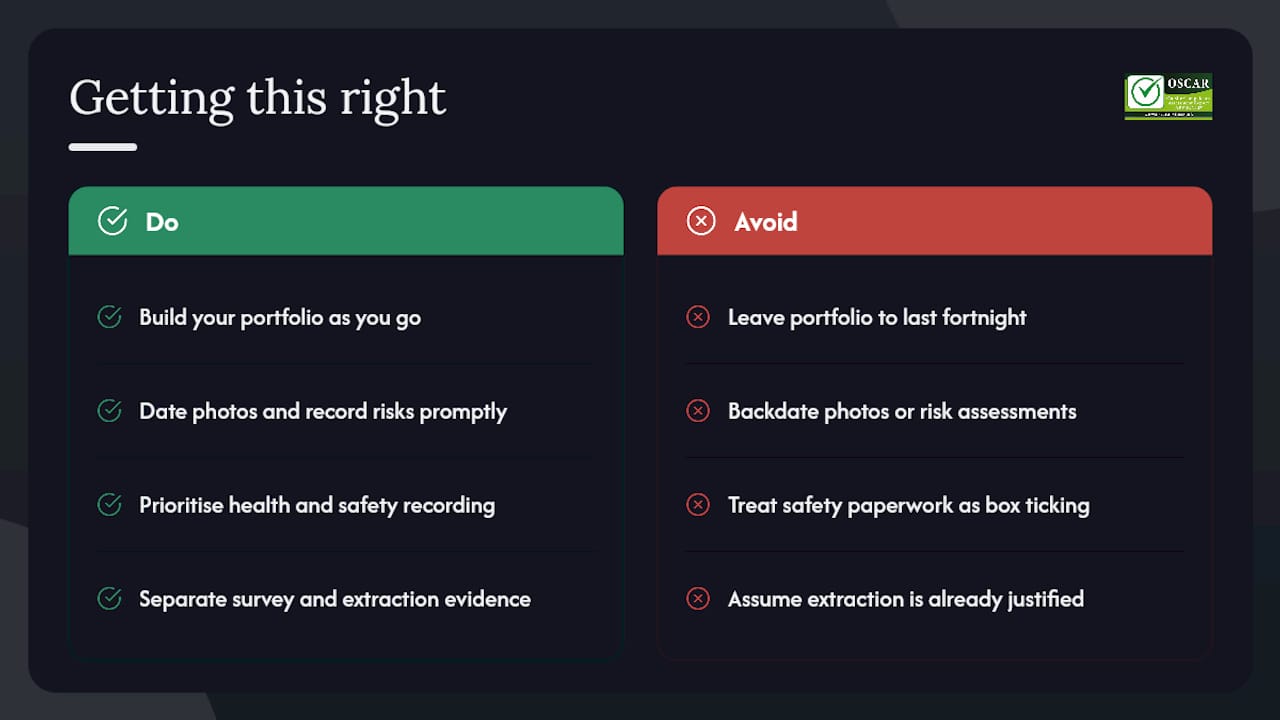
The most common mistake I see is candidates treating the portfolio as an afterthought, something to pull together in the last fortnight before a review meeting. Assessors can tell the difference between a logbook built as you went and one reconstructed from memory. Photographs without dates, risk assessments filled in retrospectively, vague answers under professional discussion. None of it holds up, and it slows candidates down far more than doing it properly from week one ever would.
The second mistake is underestimating how much weight sits on health and safety recording specifically. It is easy to assume the “real” skill being tested is extraction technique or inspection accuracy, and to treat the safety paperwork as box ticking. Assessors do not see it that way, and neither should you: a technically excellent extraction with sloppy risk assessment records will not pass.
The third, and the one I care about most, is candidates confusing survey scope with extraction scope, particularly when an employer’s business model is extraction led. A competent surveyor’s job is to establish whether extraction is actually justified, not to assume it and work backwards. If your day-to-day training is happening inside a firm that treats every inspection as a precursor to a sale, you need to consciously separate the two disciplines in your own evidence and your own thinking. Independent inspection before extraction is not bureaucratic caution. It is the entire point of having a qualified inspector in the first place, rather than leaving that judgement to whoever profits from the removal job.
Use your CPD time deliberately once you have the Level 2 certificate. The jump from extraction technician to inspector, and from inspector towards diploma-level surveying, happens through people who actively sought out awareness training and broader retrofit knowledge, not through people who waited for their employer to suggest it.
How OSCAR Onsite supports your next step
If you are ready to move from research to registration, OSCAR Onsite runs the authorised delivery route for both NVQ pathways discussed here, built by the same organisation that authored the qualifications with GQA. That means the training you receive is tied directly to current PAS 2030 and PAS 2035 expectations rather than a generic interpretation of the syllabus.
For homeowners, landlords or contractors reading this because you are weighing up an actual extraction job rather than a career move, the same evidence-led principle applies: book an independent CWI condition inspection survey before any extraction work is agreed, so the decision is based on a genuine diagnosis rather than a quote from whoever is doing the removal. If extraction proves necessary, work with an OSCAR Onsite accredited member firm and follow up with independent clearance certification, keeping diagnosis and remedial work properly separated.
If you are the one training for a career in this field, start with the NVQ Level 2 in Cavity Wall Surveying &/or Inspection Occupations academy page to check current intake dates and registration requirements, or the NVQ Level 2 in Cavity Wall Extraction & Clearance page if the clearance pathway fits your current role better.
Where to verify the details yourself
Do not take any single source’s word on unit content, registration codes or delivery timescales. Cross check against the organisations that actually govern this qualification.
- For unit breakdowns, credit values and pathway details, go directly to GQA’s qualification page.
- For confirmation of current regulatory status and the qualification reference number, check the Ofqual register directly.
- For a real-world example of how a training centre presents delivery and entry requirements, see SERC’s course listing.
- For OSCAR-specific delivery, registration and booking, use the OSCAR Onsite Academy pages directly rather than relying on secondhand summaries.
If your query relates to how cavity work affects a property’s energy rating, EPC guidance resources can help you understand how insulation condition feeds into wider certification.
Frequently asked questions
Is the NVQ Level 2 in cavity wall surveying a recognised qualification?
Yes. It sits on the Ofqual register under reference 603/4678/4, awarded by GQA Qualifications and developed with OSCAR Onsite.
Do I need an employer to complete this NVQ?
Not strictly, but you need genuine access to real cavity wall sites to gather evidence, which in practice means most candidates go through an employer or a confirmed placement.
How is the cavity wall extraction NVQ different from the surveying pathway?
The extraction and clearance pathway focuses on safe removal techniques, while the surveyor and inspector pathway focuses on diagnosing insulation failure before any extraction decision is made. Some candidates complete both.
How long does the qualification take to complete?
The Total Qualification Time is 240 hours with 84 guided learning hours, though real completion time depends on how much relevant site work you have access to.
Does this NVQ lead to a CSCS card?
Where your specific occupation maps to the qualification, it can support CSCS card eligibility, though you should confirm the current mapping with your training centre and CSCS directly.
This article provides general information about the NVQ Level 2 qualification and does not replace direct guidance from GQA Qualifications, Ofqual or your chosen training centre. Confirm current rules, fees and entry requirements with those bodies before enrolling.
Sources
- GQA NVQ Level 2 Certificate in Cavity wall extraction occupations – GQA
- Level 2 Certificate in Cavity Wall Extraction Occupations – SERC
- Register