
Retrofit installer audits in the UK are carried out by UKAS-accredited certification bodies under PAS 2030:2023 and PAS 2031 surveillance rules, with DESNZ setting policy, Ofgem overseeing scheme delivery, and TrustMark coordinating find-and-fix remediation once problems surface. The scale of what these audits have uncovered is stark: representative sampling extrapolated that nearly all external wall insulation and around a third of internal wall insulation fitted under ECO4 and GBIS before mid-January 2025 has major issues requiring remediation.
Where a defect is confirmed under a government-backed scheme, the find-and-fix programme sets a 12-week target for the original installer to remediate, though complex guarantee cases can run longer. If you think your property is affected, three things matter more than anything else right now:
- Request an independent condition survey rather than relying on the installer’s own assessment.
- Locate your Certificate of Lodgement (CoL) and the full handover pack before you contact anyone.
- Ring the Ofgem ECO helpline or TrustMark directly if your installer is unresponsive or has gone out of business.
Statistic to know: government-commissioned audits found that almost every external wall insulation job sampled under ECO4/GBIS before January 2025 had a major issue, a figure that reshaped how certification bodies now sample installer work.
Key Takeaways
Retrofit installer audits work only when independent, evidence-led inspection happens before remediation decisions are made, not as a box-ticking exercise afterwards.
| Point | Details |
|---|---|
| Oversight is layered | DESNZ sets policy, Ofgem oversees delivery, TrustMark coordinates data and find-and-fix, UKAS accredits certification bodies who run the audits. |
| Surveillance has a set rhythm | PAS 2031 requires annual audits, with additional risk-based checks for installers completing over 100 measures a year. |
| Failures are widespread | Sampling extrapolated that around 98% of EWI and 29% of IWI installed under ECO4/GBIS before January 2025 had major issues. |
| Remediation has a target, not a guarantee | The find-and-fix programme sets a 12-week window for original installers to fix confirmed defects. |
| Independent verification closes the gap | OSCAR Onsite’s condition surveys, technical monitoring and clearance certification give homeowners and housing providers evidence before and after remediation. |
Table of Contents
- Who is responsible for auditing retrofit installers?
- How PAS 2030 and PAS 2031 audits actually work
- What retrofit installer audits are finding
- Who pays for remediation, and how long should it take?
- How to commission an audit or inspection, step by step
- OSCAR Onsite’s role in independent audit and remediation verification
- The gap between audit policy and what happens on site
- Get an independent assessment before you commit to remediation
- Sources
Who is responsible for auditing retrofit installers?
No single body runs retrofit installer audits from end to end. The system works as a chain of oversight, and understanding where each link sits tells you exactly who to contact when something goes wrong.
DESNZ (the Department for Energy Security and Net Zero) sets the policy framework for schemes like the Energy Company Obligation (ECO4) and the Great British Insulation Scheme (GBIS). It doesn’t inspect individual installations, but it commissions the wider oversight architecture and responds to systemic failures identified through audit data.
Ofgem oversees delivery of these schemes and administers ECO4 obligations placed on energy suppliers. Following widespread evidence of non-compliant installations in 2024, Ofgem and DESNZ established additional audits and an ECO helpline for households who suspect a problem with a scheme-funded measure. If you had insulation fitted under ECO4 or GBIS and you’re not getting anywhere with the installer, this helpline is your formal escalation route.
TrustMark sits at the operational centre of the system. It sub-licences scheme providers, collates installation data across the industry through its Data Warehouse, and leads the find-and-fix programme that coordinates remediation once defects are confirmed. TrustMark’s role is administrative and coordinating rather than regulatory, but in practice it’s often the first port of call for a homeowner trying to work out what happened to their installation.
UKAS (the United Kingdom Accreditation Service) accredits the certification bodies (CBs) that actually license and audit installers. UKAS doesn’t audit installers directly, but it audits the auditors: it sets the rules certification bodies must follow and can tighten those rules when evidence demands it. Following the scale of failures uncovered in early 2025, UKAS issued a technical bulletin instructing certification bodies to audit 20% of identified external wall insulation installations and to submit monthly audit data for UKAS oversight, a marked increase on standard surveillance levels.
Certification bodies are the ones who actually turn up. They license individual installer firms against PAS 2030 and PAS 2031, run the surveillance visits, review documentation, and decide whether an installer keeps its certification.
The Public Accounts Committee has been blunt about why this chain didn’t catch problems sooner. Its report on faulty energy efficiency installations pointed to fragmented accountability across DESNZ, Ofgem, TrustMark and certification bodies as a core reason failures went undetected for so long, and called for clearer lines of responsibility and annual public reporting on non-compliance. A retrofit assessment commissioned independently, rather than one arranged through the installer, is one practical way to close that accountability gap at the level of an individual property.
How PAS 2030 and PAS 2031 audits actually work
Every installer certified to work under a government-backed retrofit scheme is subject to ongoing surveillance, not a one-off check at sign-up. The rules governing that surveillance sit in PAS 2031, and they’re more specific than most homeowners assume.
Certification bodies must audit each installer at least once every 12 months, with an exceptional allowance stretching that window to 16 months in limited circumstances. That’s the baseline. Installers who complete more than 100 installations of a single measure in a year trigger additional, risk-based surveillance on top of the standard annual cycle, precisely because higher volume creates higher exposure if something is systematically wrong.
Following the scale of external wall insulation failures identified in early 2025, ministers went further still, instructing certification bodies to audit 20% of identified EWI installations specifically, a level of scrutiny well above the routine sampling rate.
Pro Tip: If you’re a housing association or local authority commissioning retrofit at scale, ask your installer’s certification body directly how many installations they’ve audited in the past 12 months and what proportion that represents of total output. A reluctant or vague answer is itself useful information.
What does an audit actually involve? Auditors use several distinct methods, often in combination:
- Documentary review of the installer’s competence records, method statements and commissioning paperwork, checked against what PAS 2030 requires for that specific measure.
- Mid-installation checks, sometimes called C2 inspections, carried out while work is in progress so a fault can still be corrected before the job is signed off.
- Witnessed assessments, where an auditor observes an operative carrying out part of the installation directly.
- Post-completion sampling, comparing the retrofit design against the as-built work, since a mismatch between what was specified and what was actually fitted is a recognised marker of poor practice.
- Competence and training log checks, confirming the operatives who did the work hold the qualifications the scheme requires for that measure.
Auditors expect to see specific documentation on request: operative competence logs, method statements for the particular property type and wall construction, commissioning records, and a full handover pack including the Certificate of Lodgement. Gaps in this paperwork are one of the most frequently recorded non-conformities in installer surveillance, and they matter even when the physical installation looks acceptable on the surface, because incomplete records make it far harder to prove competence or trace a fault back to a decision made on site.
What retrofit installer audits are finding
The figures released alongside government audit work in 2025 are difficult to read as anything other than a serious quality failure. Representative sampling of ECO4 and GBIS installations completed before mid-January 2025 found that an estimated 98% of external wall insulation jobs sampled had major issues requiring remediation, alongside around 29% of internal wall insulation. These are extrapolated figures from representative sampling, not a full census of every installation, but the scale is enough that it shaped the ministerial decision to raise EWI surveillance rates.
The physical defects auditors most commonly record fall into a fairly consistent pattern:
| Defect category | What auditors typically observe | Why it matters |
|---|---|---|
| Ventilation failures | Blocked or missing background ventilators, incorrect ventilation paths around new insulation | Can trap moisture and increase condensation risk within the wall build-up |
| Continuity gaps | Insulation not fitted continuously across the wall, leaving thermal bridges | Reduces the performance the measure was installed to deliver |
| Exposed or missing insulation | Material absent at junctions, reveals or below ground level | Creates cold spots and points of water entry |
| Incorrect detailing at junctions | Poor treatment around windows, doors, eaves and abutments | A recognised route for moisture ingress into the wall structure |
| Documentation gaps | Missing competence records, incomplete handover packs, absent commissioning data | Prevents verification that the work meets PAS 2030 requirements at all |
Auditors typically grade defects by severity, distinguishing between issues that affect long-term performance and those that raise an immediate health or safety concern, such as significant water ingress or a ventilation failure likely to cause damp and mould risk in an occupied home. It bears repeating that visible symptoms such as damp patches or musty smells are an indicator that something needs investigating, not a diagnosis in themselves. A confirmed link between cavity wall insulation and condensation requires proper inspection, not guesswork from symptoms alone.
Beyond the physical defects, the National Audit Office also noted a more troubling behaviour pattern: some installers appeared to reduce their audit exposure by holding certification with multiple certification bodies simultaneously, which lowered the effective sampling rate any single CB applied to their work. That’s a systemic weakness in how risk-based surveillance operates when the underlying data is incomplete or fragmented across bodies.
Who pays for remediation, and how long should it take?
Responsibility for fixing a defective installation under a government-backed scheme sits, in the first instance, with the original installer. Under the find-and-fix programme, once a defect is confirmed, the installer is expected to complete remediation within 12 weeks. That’s the target, not a guarantee, and cases involving complex insurance-backed guarantees or insolvent installers can take considerably longer to resolve.
The Certificate of Lodgement is the document that underpins most of this consumer protection. It confirms an installation was registered against a recognised scheme and is often the trigger for guarantee cover and warranty claims. A missing or invalid CoL, or evidence the work departed materially from what was actually lodged, can complicate or invalidate a claim, which is exactly why securing that paperwork early matters as much as the physical inspection.
Practical points worth knowing before you start a remediation claim:
- Housing providers and insurers typically want independent evidence of the defect (photographs, a written condition report, dated observations) before they will engage a guarantee provider or escalate a claim.
- If an installer disputes the finding or simply stops responding, TrustMark and Ofgem are the appropriate escalation points, particularly for scheme-funded work.
- Proving non-compliance generally requires more than a description of symptoms. A dedicated condition inspection survey that documents the physical evidence gives a remediation claim far more weight than an unsupported complaint.
- Where extraction of failed cavity wall insulation is being considered, that decision should follow independent assessment of cause and condition rather than precede it, and any removal work funded under ECO4 should carry clear certification of who is liable for the cost.
How to commission an audit or inspection, step by step
Getting a retrofit evaluation right depends on doing the groundwork before anyone arrives on site. This applies whether you’re a homeowner worried about a single property or a local authority managing a stock-wide remediation programme.
-
Establish whether the work was scheme-funded. If it was installed under ECO4, GBIS or a similar government scheme, your first call should be TrustMark or the Ofgem ECO helpline, since they hold the installation record and can direct you to the relevant certification body. For privately funded or older installations outside any scheme, you’ll need to commission an independent inspector directly.
-
Gather your evidence before the inspection. This means the Certificate of Lodgement, any installer paperwork or handover pack you were given, dated photographs of any symptoms (damp patches, cold spots, unusual smells), and a written record of when the problem was first noticed and how it has changed.
-
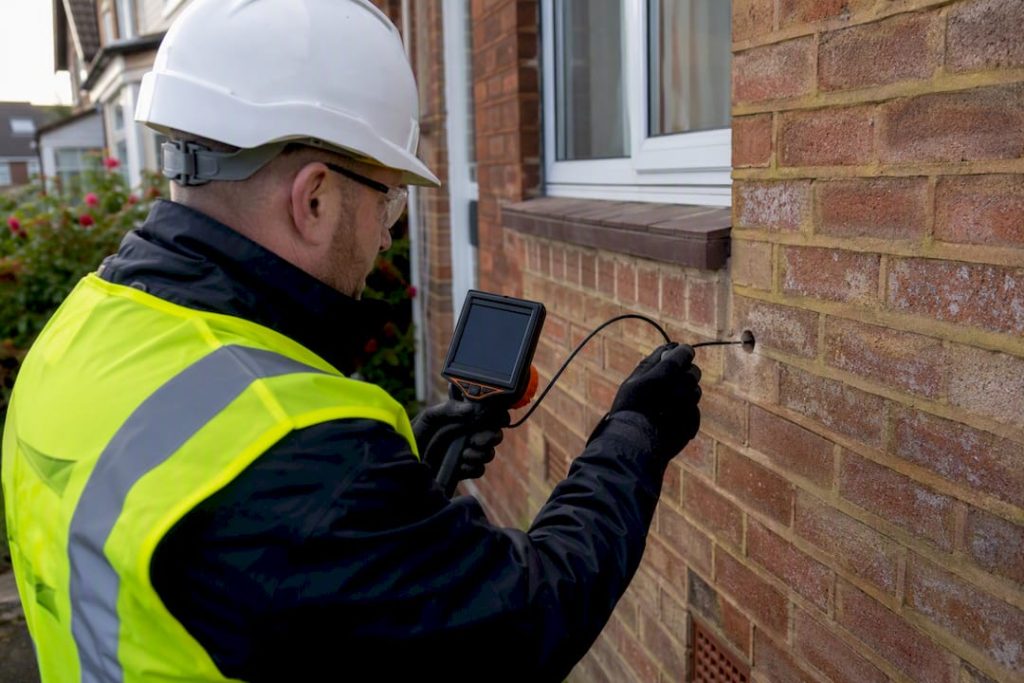
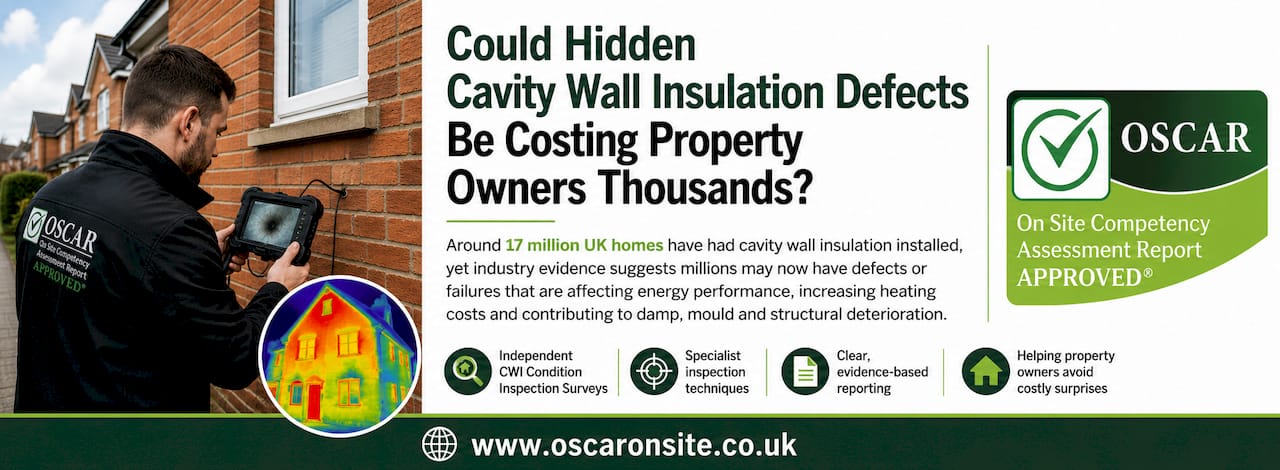
Understand what an inspection can and can’t tell you. A borescope inspection provides a direct visual view into specific access points in the cavity. Thermal imaging identifies surface temperature variations that can indicate an issue such as missing insulation or moisture, but it does not see inside the wall itself, and its readings need interpreting alongside other evidence rather than treated as a standalone diagnosis. A competent retrofit evaluation checklist combines these methods with a review of the installer’s records rather than relying on either in isolation.
-
For housing professionals, put a procurement scope in writing. Define the exact scope of works, the deliverables (written report, photographic schedule, borescope footage), the acceptance criteria for any remediation, and require formal clearance certification once any extraction or repair work is complete.
-
On the day of inspection, homeowners should ensure clear access to external walls and loft spaces, have paperwork ready, and note down any questions about the property’s construction history, such as previous extensions or re-rendering, since these affect how cavities were originally filled.
Pro Tip: Never sign off remediation work as complete on the strength of a verbal assurance from the installer. Ask for a written clearance certificate that specifically references the defect it corrects.
OSCAR Onsite’s role in independent audit and remediation verification
Independent verification only carries weight if the person doing it has genuine grounding in the standards being audited against. OSCAR Onsite was founded by Alan Hoey and has trained and accredited more than 250 independent firms across the UK, authoring the sector’s Level 2 NVQ Diplomas in Cavity Wall Insulation Surveying & Inspection and in Extraction & Clearance, both built around PAS 2030 and PAS 2035 competence requirements.
That grounding shapes how OSCAR Onsite supports audit and remediation work in practice:
- CWI condition inspection surveys combining borescope inspection and thermal imaging, producing a written report that distinguishes observation from diagnosis rather than inferring a cavity’s condition from surface symptoms alone.
- Extraction and clearance services for cavities confirmed to need remediation, restoring the wall to a clean, breathable condition once cause and condition have been independently established.
- Clearance certification issued once remediation is complete, giving housing providers and certification bodies documented evidence the corrective work meets requirements.
- Technical monitoring during installation itself, catching non-conformances while they remain remediable rather than after the wall has been closed up.
For a certification body or local authority managing a find-and-fix programme, that combination of independent survey, technical monitoring and post-remediation certification maps directly onto the PAS 2030 surveillance cycle rather than sitting outside it.
| OSCAR Onsite service | Where it sits in the audit cycle |
|---|---|
| Technical monitoring | Mid-installation, C2-style checks |
| Extraction and clearance | Corrective remediation |
| Clearance certification | Post-remediation sign-off |
The gap between audit policy and what happens on site
The official response to this crisis has focused heavily on raising surveillance percentages: 20% of EWI installations, monthly data submissions, quarterly certification body reviews. All of that matters, but percentages measure activity, not outcomes. A certification body auditing 20% of installations against an incomplete or poorly maintained data set is still working with a partial picture, and the National Audit Office’s own findings on installers gaming certification transfers show how easily a well-intentioned sampling rule can be worked around.
What the evidence actually supports is a simpler, less quotable conclusion: the single most reliable point of intervention is independent inspection before a wall is closed up or before extraction is agreed, not audit statistics after the fact. Homeowners and housing professionals who wait for scheme-level oversight to catch a problem are relying on a system that, by its own regulator’s admission, missed the bulk of these failures for years. The reader’s best move isn’t to interrogate DESNZ policy or UKAS bulletins, useful as those are for context. It’s to get a property-specific, evidence-led assessment before deciding whether extraction, repair or nothing at all is the right answer.
— Alan
Get an independent assessment before you commit to remediation
OSCAR Onsite carries out the same kind of independent condition survey that audit findings show is missing from too many retrofit projects: borescope inspection, thermal imaging, and a written report that separates what was observed from what it means, before anyone talks about extraction. That distinction matters, because recommending removal without first establishing cause and condition is exactly the kind of shortcut the NAO and PAC reports flag as a driver of poor outcomes.
If you’re a homeowner concerned about a scheme-funded installation, a landlord managing a portfolio, or a local authority preparing a remediation brief, start with a cavity wall insulation risk check to establish whether further inspection is warranted. Where a full survey is needed, OSCAR Onsite’s CWI condition inspection survey gives you a documented, independent basis for whatever decision comes next, and a clearance certificate to close the loop once any remediation is complete.
Sources
- TrustMark find-and-fix guidance
- Energy efficiency installations under the Energy Company Obligation (NAO summary)
- PAS 2030 scheme update (UKAS technical bulletin)
Recommended
- Site audit PAS 2030 insulation checks: what installers must prove
- ECO4 failed insulation removal: what to do and who pays
- Membership – Oscar Onsite
Our articles are a mix of human and automated generation, and sometimes mistakes or errors appear.
If you do spot any errors please do let us know via email to: office@oscar-onsite.co.uk