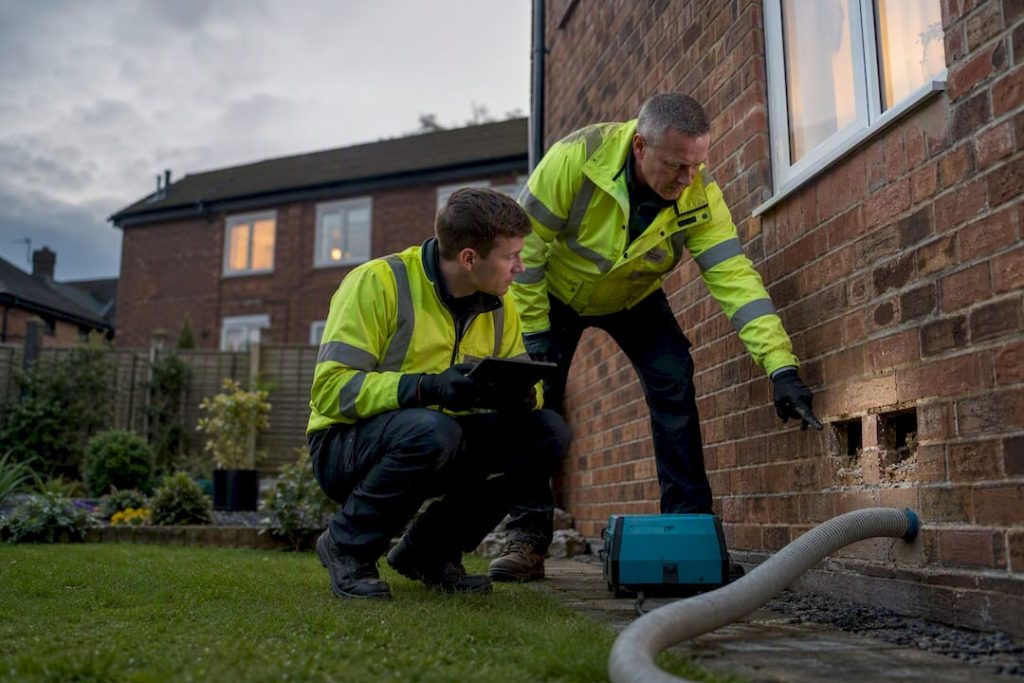
The fastest route to become a cavity wall extractor in the UK is to complete the recognised NVQ Level 2 in cavity wall extraction, choosing the clearance or survey pathway, through an accredited training centre. You should be 18 or over, and while prior construction experience helps, it is not always mandatory. Your next step: contact an accredited training provider or enrol directly on the NVQ.
TL;DR:
- Completing the NVQ Level 2 in cavity wall extraction through an accredited training provider is the fastest route to qualification, requiring 240 hours of study.
- Candidates must decide between clearance and survey pathways, with many eventually holding both, to meet the increasing demand for diagnostic and removal skills.
- Gathering continuous evidence, including photos and assessment records, is essential and accelerates the qualification process, especially when working on the job.
- Full qualification typically takes six to twelve months, with costs including training fees, registration, PPE, and optional pathway combination expenses.
- Qualified operatives find work mainly with retrofit or remediation firms, housing associations, and on government schemes, with earnings rising as experience and additional competencies grow.
Table of Contents
- What qualifications do you need to become a cavity wall extractor?
- What are the practical routes to gaining the skills?
- How do you actually get qualified, step by step?
- What skills and evidence will you be tested on?
- Where do qualified cavity wall extractors find work?
- How long does it take and what does it cost?
- Why OSCAR Onsite’s standards matter to trainees
- Legal and insurance considerations for extraction operatives
- How to secure an apprenticeship or traineeship
- What can you expect to earn as a cavity wall extractor?
- Practitioner view: when to extract, and why qualification alone isn’t the finish line
- Train and get accredited with OSCAR Onsite
- Sources
- FAQ
What qualifications do you need to become a cavity wall extractor?
The qualification employers actually recognise is the GQA NVQ Level 2 Certificate in Cavity Wall Extraction Occupations, developed in partnership with a recognised industry body. It’s a work-based award built from three mandatory units plus two distinct pathways, with a minimum credit value of 24 and a Total Qualification Time (TQT) of 240 hours, including 84 Guided Learning Hours (GLH).
The two pathways matter more than most candidates realise at the outset:
- Clearance pathway — covers safe extraction and disposal of failed or saturated insulation material from the cavity.
- Survey pathway — covers inspection, condition assessment and diagnostic reporting rather than physical removal.
Many operatives eventually hold both, because extraction jobs increasingly require someone who can assess as well as remove. Registration runs through the awarding body (GQA), and centres delivering the qualification are typically accredited or working to equivalent standards. No separate government licence exists for this trade. The NVQ, and the centre you train through, is what tells an employer you’re competent.
What are the practical routes to gaining the skills?
Three realistic paths get you to a completed NVQ, and which one fits depends on whether you’re already employed in construction or coming in cold.
- On-the-job NVQ. You work for an employer already doing extraction work, and an assessor visits site to witness your tasks, sign off competence and help build your portfolio over several months.
- Academy short courses feeding into the NVQ. Providers run structured classroom and practical sessions, such as the training route OSCAR Onsite outlines, that prepare you for the workplace assessments to follow.
- Employer-sponsored or apprenticeship-style routes. Some retrofit contractors sponsor new starters through the NVQ as part of onboarding, particularly where they need extraction capacity for PAS 2030:2023-compliant retrofit programmes.
Registration with the awarding body is usually arranged by your training centre or employer once you’ve enrolled, not something you do independently beforehand.
Pro Tip: Start photographing your work from day one, even before an assessor asks for it. A work-based NVQ lives or dies on evidence, and candidates who build their portfolio as they go finish faster than those who try to reconstruct months of work from memory.
How do you actually get qualified, step by step?
Qualifying follows a fairly fixed sequence, regardless of which training route you choose.
- Check eligibility. Confirm you’re 18 or over and check whether your prospective employer has additional entry requirements.
- Choose your pathway and centre. Decide between clearance and survey (or plan to complete both eventually), then pick an accredited training provider.
- Register with the awarding body. Your centre normally handles GQA registration once you’ve enrolled.
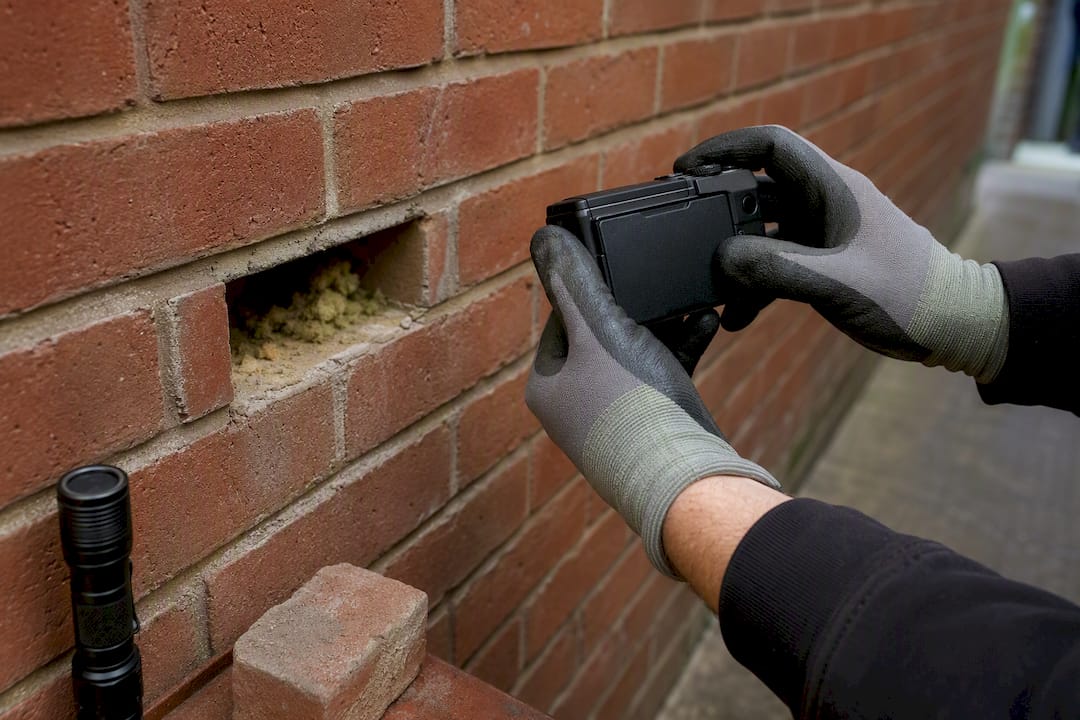
- Gather evidence continuously. Witnessed assessments, dated photographs, quantity calculations and written job records all feed into your portfolio.
- Complete the mandatory units and practical assessments. These are signed off by a qualified assessor visiting your workplace.
- Receive your certificate and prepare for work. Update your CV, compile your portfolio, and obtain any additional cards your employer requires, such as a CSCS card.
Skipping steps rarely saves time. Candidates who register late or fail to keep evidence as they work almost always end up repeating tasks purely to generate the paperwork an assessor needs.
What skills and evidence will you be tested on?
Assessment centres on real jobs, not written exams alone, so the practical skills you’ll need overlap heavily with what you’ll actually do on site.
- Setting up safe access, including scaffold or tower checks and working-at-height controls.
- Selecting and using appropriate extraction equipment for the insulation type present.
- Clearing the cavity fully and controlling dust and waste during removal.
- Calculating quantity, area and wastage for the job record.
- Interpreting job specifications and site instructions correctly before starting work.
Evidence typically includes witnessed task records, step-by-step photographs, annotated diagrams and a signed assessor statement, reflecting the kind of portfolio structure GQA’s NVQ documentation describes. Safe working practice is assessed against PAS 2030:2023 and BS 8104, the two standards that govern how retrofit and cavity wall work should be specified and carried out.
Pro Tip: Keep a simple job log with dates, addresses (anonymised if needed) and photos organised by task type. Assessors move faster through a tidy portfolio, and a tidy portfolio is faster to build if you never let it pile up.
Where do qualified cavity wall extractors find work?
Once certified, you’re employable across a fairly wide slice of the retrofit sector. Common job titles include cavity wall extraction operative, insulation removal technician, and retrofit remediation specialist.
- Retrofit and energy contractors delivering PAS 2030:2023 compliant insulation upgrades.
- Specialist remediation firms handling failed or defective installations reported through surveys.
- Housing associations and local authorities, often via tendered maintenance contracts.
- Member networks and referral lists, including those run by accreditation bodies for compliant contractor sourcing.
Job boards regularly list live cavity wall insulation extraction vacancies, and they’re a reasonable first place to check demand in your region. Operatives who hold both extraction and survey competence tend to have a wider pool of employers to approach, since firms increasingly want staff who can diagnose a problem and then fix it.
How long does it take and what does it cost?
Most candidates working through an employer-sponsored NVQ complete the qualification in roughly 6 to 12 months, which fits the 240-hour TQT and 84-hour GLH structure set out for the award. Full-time intensive routes can move faster; part-time evidence-gathering around existing work tends to sit at the longer end.
- Course or training centre fees for tuition and assessor visits.
- Registration fees with the awarding body.
- PPE and basic tools, unless your employer supplies these.
- Optional additional costs for combining clearance and survey pathways.
Employer sponsorship is common where a contractor needs qualified extraction staff, and it’s worth asking directly whether a prospective employer will fund or part-fund your NVQ before you commit to paying out of pocket.
Why OSCAR Onsite’s standards matter to trainees
The NVQ Level 2 qualifications in cavity wall extraction and surveying were authored by an industry body, and runs training, accreditation and member audits for firms nationwide. That authorship matters because it shapes what “competent” actually means in this trade.
- Diagnostic work in the sector uses tools like borescopes and thermal imaging, but these support an assessment rather than see inside a cavity directly. Thermal readings show surface temperature patterns; a qualified surveyor still has to interpret them alongside other evidence before reaching a conclusion.
- Trainees should know PAS 2030:2023, BS 8104 and TrustMark requirements, because these define acceptable practice across the whole retrofit sector, not just extraction.
- Accreditation of member firms often includes ongoing audits, which contributes to the value employers place on candidates trained through linked routes.
Legal and insurance considerations for extraction operatives
Working as an employed extraction operative differs sharply from setting up as a self-employed contractor, and the legal exposure changes accordingly. Employed operatives are generally covered by their employer’s public liability and employer’s liability insurance, but anyone moving into self-employed or subcontracted work needs their own public liability cover before taking on paid jobs. Most housing associations and larger contractors will ask for proof of this before allowing you on site.
Guarantee interactions are a separate and easily overlooked issue. Many cavity wall insulation installations carry a 25-year guarantee from the original installer or a guarantee body such as CIGA. Extracting insulation covered by an active guarantee can affect that guarantee’s validity, and industry guidance is explicit that extraction should follow evidence of failure rather than happen as a default choice. Operatives should understand this distinction even if the commercial decision sits with the homeowner or the contractor managing the job.
TrustMark registration and PAS 2030:2023 compliance also carry contractual weight for firms bidding on publicly funded retrofit schemes, including ECO4 and the Great British Insulation Scheme. An operative working for a non-compliant firm risks being caught up in disputes over substandard work, which is one reason qualification through a recognised NVQ route, rather than informal on-the-job training alone, protects you as much as it protects the client. Keeping your own certificates, assessment records and any relevant insurance documentation is sensible practice regardless of your employment status.
How to secure an apprenticeship or traineeship
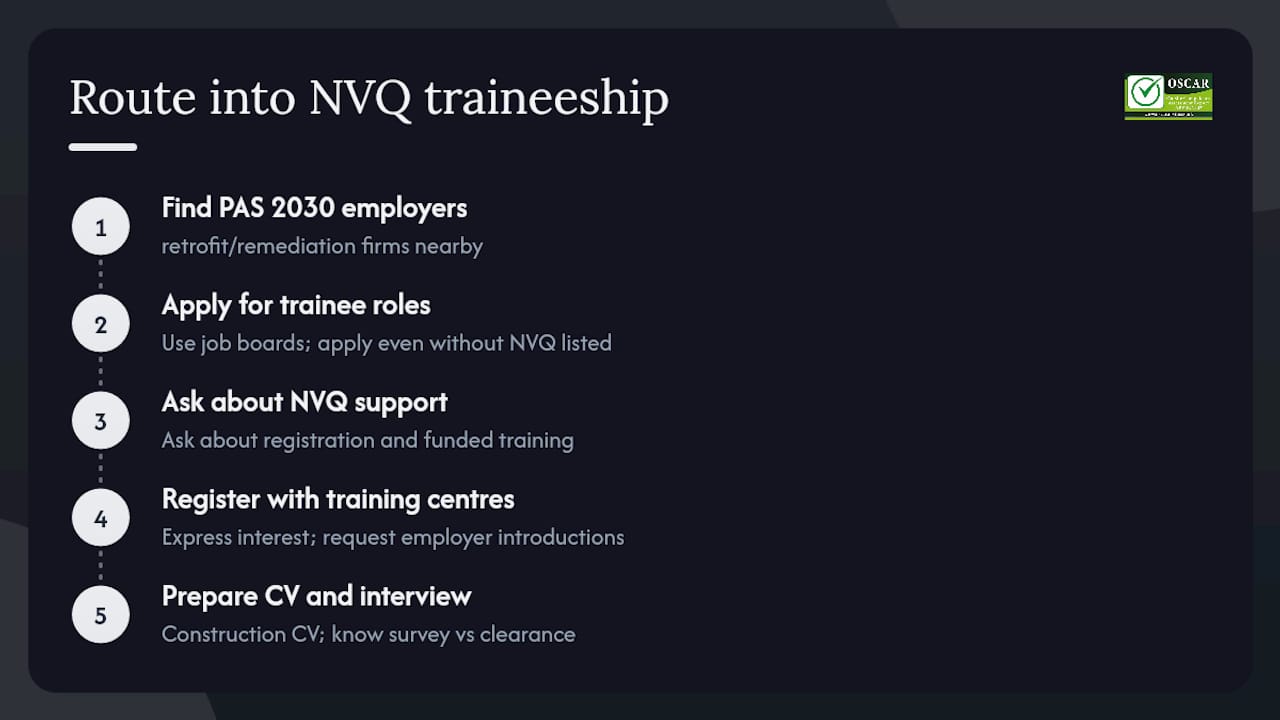
Apprenticeship-style entry into cavity wall extraction usually runs through an employer rather than a centralised national scheme, so the application process looks more like a standard job application than a formal apprenticeship pathway in other trades.
Start by identifying retrofit contractors and remediation firms in your area that already deliver PAS 2030:2023 work, since these are the employers most likely to sponsor an NVQ candidate. Many advertise trainee or entry-level positions directly on job boards, and it’s worth applying even where the listing doesn’t explicitly mention NVQ sponsorship. When you contact an employer, ask directly whether they support NVQ registration and fund training costs. Firms actively growing their extraction capacity often welcome this conversation, because sponsoring a new entrant through the NVQ is cheaper than recruiting an already-qualified operative in a tight labour market.
Some training providers and accredited centres maintain informal links with local employers looking for trainees, so registering interest with a centre before you’ve secured a job can sometimes lead to an introduction. Building a basic construction CV, even without direct cavity wall experience, helps: general labouring, insulation, or building maintenance background all count as relevant prior exposure. Turning up to an interview already familiar with the NVQ structure and the clearance versus survey distinction signals genuine intent, and employers notice the difference between a candidate who has done fifteen minutes of research and one who hasn’t.
What can you expect to earn as a cavity wall extractor?
Earnings in this trade scale fairly predictably with experience and qualification breadth, though exact figures vary by region and employer type. New entrants working towards their NVQ while gaining on-the-job evidence typically start on wages comparable to general construction labouring rates, since they’re still building competence during this period.
Once fully NVQ-qualified, extraction operatives working for retrofit contractors or remediation firms tend to see a step up in pay, reflecting both the qualification itself and the reduced supervision required. Operatives who hold both extraction and survey pathway qualifications, or who progress into site supervisor or lead assessor roles, generally command higher rates again, since they can take on diagnostic work as well as physical extraction.
Self-employed contractors who’ve built a client base and hold their own accreditation and insurance often earn more per job than employed staff, but income is less predictable and carries the added overhead of running a small business. Geography plays a role too: operatives in regions with high volumes of ECO4 and Great British Insulation Scheme activity tend to see steadier work than those in areas with less retrofit funding flowing through. Combining survey competence with extraction skills remains one of the more reliable ways to increase both earning potential and job security in this sector.
Practitioner view: when to extract, and why qualification alone isn’t the finish line
Extraction is a response to evidence, not a default step in every retrofit job. Independent assessment should confirm the cause and condition of the cavity fill before removal begins, and guarantee interactions, drying time and wall-tie condition all need checking where extraction precedes external wall insulation. The operatives who go furthest in this trade are the ones who treat survey competence as part of the job, not an optional extra.
— Alan
Train and get accredited with OSCAR Onsite
The NVQ Level 2 qualifications described here were authored by an industry body that also runs training, registration support, and member accreditation to support recognised, compliant work. Some organisations offer the qualification itself plus a route into a nationally audited contractor network, which matters for work on PAS 2030:2023 or TrustMark-linked retrofit contracts.
The NVQ Level 2 in Cavity Wall Extraction & Clearance is the natural starting point if you’re enrolling directly, while the academy training pages list the full range of courses, including the surveying and inspection pathway, for anyone weighing up which route suits their background. If you’re already working in extraction and want to see accredited practice in action, the cavity wall insulation extraction service page shows the standard OSCAR-accredited operatives work to. Get in touch through the academy pages to enquire about enrolment dates and registration support.
Sources
Check the GQA NVQ Level 2 qualification page for current unit structure and TQT/GLH figures, and the INCA CWI/EWI interactions guide for the primary guidance on extraction timing and guarantee interactions. Awarding-body and PAS/BS documents are updated periodically, so confirm details directly before enrolling.
- GQA NVQ Level 2 Certificate in Cavity wall extraction occupations – GQA
- CWI/EWI ‘interactions’ guide – INCA
- Level 2 Certificate in Cavity Wall Extraction Occupations – SERC
FAQ
How much does it cost to extract cavity wall insulation?
Costs vary by property size, insulation type and access difficulty, and no single fixed figure applies across the UK market. Homeowners should get an independent condition survey and a written quote from an accredited extraction service before assuming a price.
When did cavity walls become standard in the UK?
Cavity wall construction became widespread in UK housebuilding through the 20th century, with mass adoption particularly from the interwar period onwards as builders moved away from solid brick walls. Many properties built during the early-to-mid 20th century feature cavity construction, though exact dates vary by region and builder.
What are the regulations for cavity walls in the UK?
Cavity wall insulation and extraction work is governed primarily by PAS 2030:2023 and BS 8104, which set out installation, assessment and workmanship standards for retrofit insulation. Contractors working on government-backed schemes also typically need TrustMark registration to bid on that funded work.
Can I get my cavity wall insulation removed for free?
Free removal isn’t standard, though some cases involving failed insulation under an active manufacturer or installer guarantee may see costs covered by the guarantee provider. An independent condition survey is the way to establish whether a guarantee claim applies before committing to paid extraction.
Recommended
- Pass NVQ Level 2 Cavity Wall Extraction Training in 6–12 Months, UK
- NVQ Level 2 in Cavity Wall Extraction & Clearance
- Certificate in Cavity Wall Surveying, Extraction &/or Inspection Occupations
- NVQ Level 2 in Cavity Wall Surveying &/or Inspection Occupations
Our articles are a mix of human and automated generation, and sometimes mistakes or errors appear.
If you do spot any errors please do let us know via email to: office@oscar-onsite.co.uk