TL;DR:
- Removing cavity wall insulation without an independent inspection risks unnecessary work and expense.
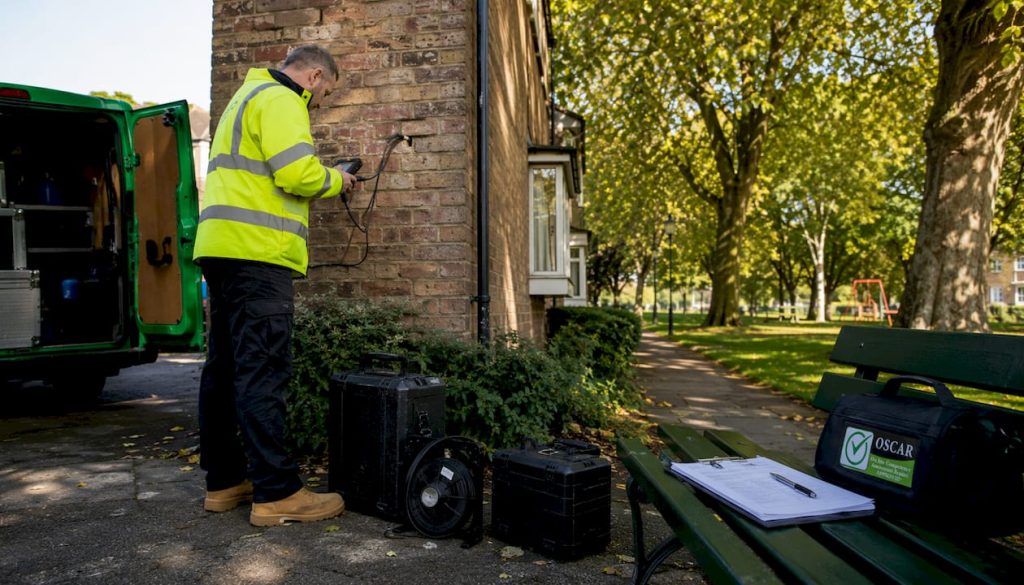
- A thorough diagnosis using borescope, thermal imaging, and expert surveys is essential before extraction.
Cavity wall insulation should only be removed after an independent condition inspection confirms it is either causing harm or was never suitable for the property. Commissioning extraction without that evidence risks spending thousands of pounds on work that will not fix the underlying problem. Before anything else, contact the original installer or your guarantee provider — CIGA holds many warranties centrally and may be able to arrange rectification at no cost to you.
If that route is exhausted or unavailable, book an OSCAR CWI Condition Inspection Survey as your independent first step.
The standards that govern this process are PAS 2030:2023, BS 8104, and TrustMark. Any extraction should be carried out by an accredited firm and followed by independent technical monitoring and a formal clearance certificate.
- Contact CIGA or the original installer first to check warranty and rectification options before spending anything.
- Commission an independent inspection (borescope and thermal imaging) before authorising extraction.
- Require PAS 2030:2023 and BS 8104 compliance, TrustMark registration, and NVQ Level 2 competence from any contractor.
- Insist on a clearance certificate and independent technical monitoring after the work is complete.
Table of Contents
- How do you know whether your cavity insulation actually needs removing?
- What does a professional extraction job actually involve?
- What does blown insulation removal cost, and who normally pays?
- What qualifications and proofs should you require from a contractor?
- What should you do after extraction is complete?
- Key takeaways
- Why an inspection-first approach is the only responsible one
- OSCAR Onsite: independent surveys, accredited extraction, and clearance certification
- Useful sources and standards
How do you know whether your cavity insulation actually needs removing?
Not every damp wall points to failed insulation. Extraction seldom fixes damp unless the insulation itself is the cause, so the diagnostic step is not optional — it is the whole decision.
The triggers that commonly justify removal are:
- Wet insulation confirmed on borescope inspection
- Thermal imaging cold spots that correspond directly to internal damp patches
- Evidence of cavity bridging carrying moisture to the inner leaf
- Persistent mould or rot that began after installation and has not responded to other remediation
- Inappropriate original specification: exposed or coastal locations, upland sites, or non-standard constructions such as no-fines concrete or Mundic block
Some properties should never have had cavity fill installed at all. Where the original specification was wrong for the exposure zone or masonry type, extraction is usually unavoidable.
Before you authorise anything, obtain an independent damp survey, a thermal imaging report, and a written borescope inspection report. An OSCAR CWI Condition Inspection Survey covers all three and produces a written condition report you can use to justify — or rule out — extraction. If you have had insulation installed under the Green Deal or Energy Company Obligation, the government consumer guide advises contacting the installer first; if they have ceased trading, go directly to the guarantee provider.
Pro Tip: Thermal imaging maps cold spots across the whole elevation; a borescope then confirms whether insulation is present, wet, or displaced at those exact points. Used together, they produce far stronger evidence than either method alone — and that evidence is what protects you if you need to pursue a warranty claim or involve a lender.
What does a professional extraction job actually involve?
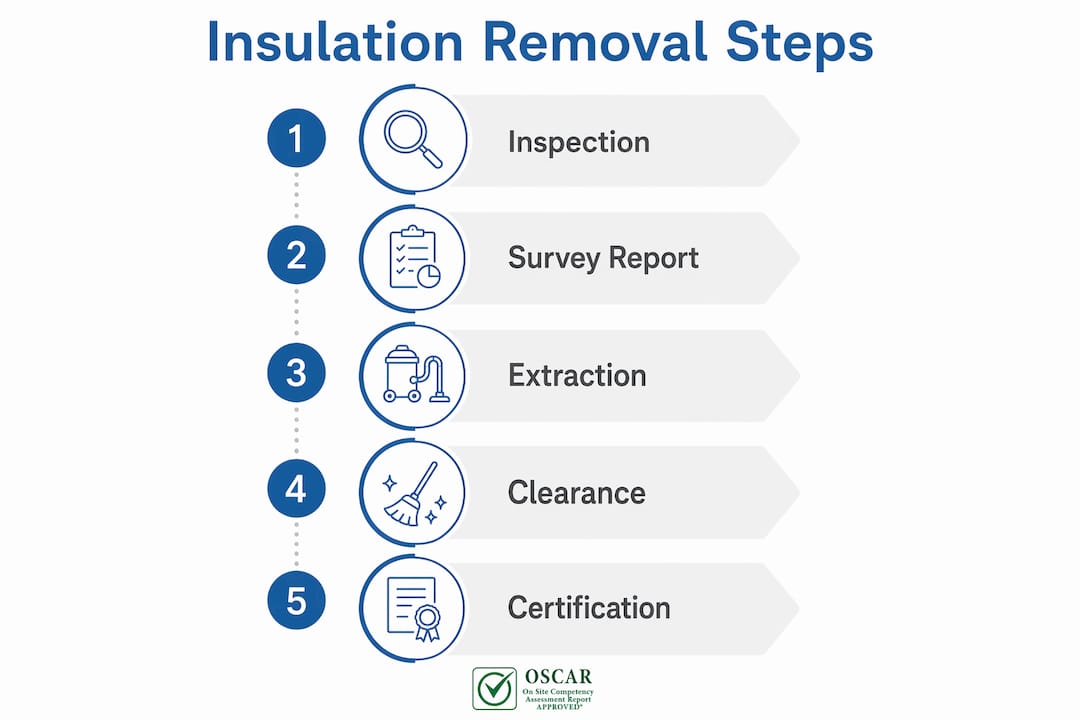
A correct extraction follows a defined sequence. Skipping any stage — particularly the post-work verification — leaves you without the evidence you need for a clearance certificate.
- Pre-works survey and risk assessment. The contractor confirms the drill grid, identifies any services in the wall, and documents the cavity condition before drilling begins.
- Drilling the access pattern. Small holes are drilled through the mortar joints at regular intervals across the affected elevations, following the manufacturer’s approved grid.
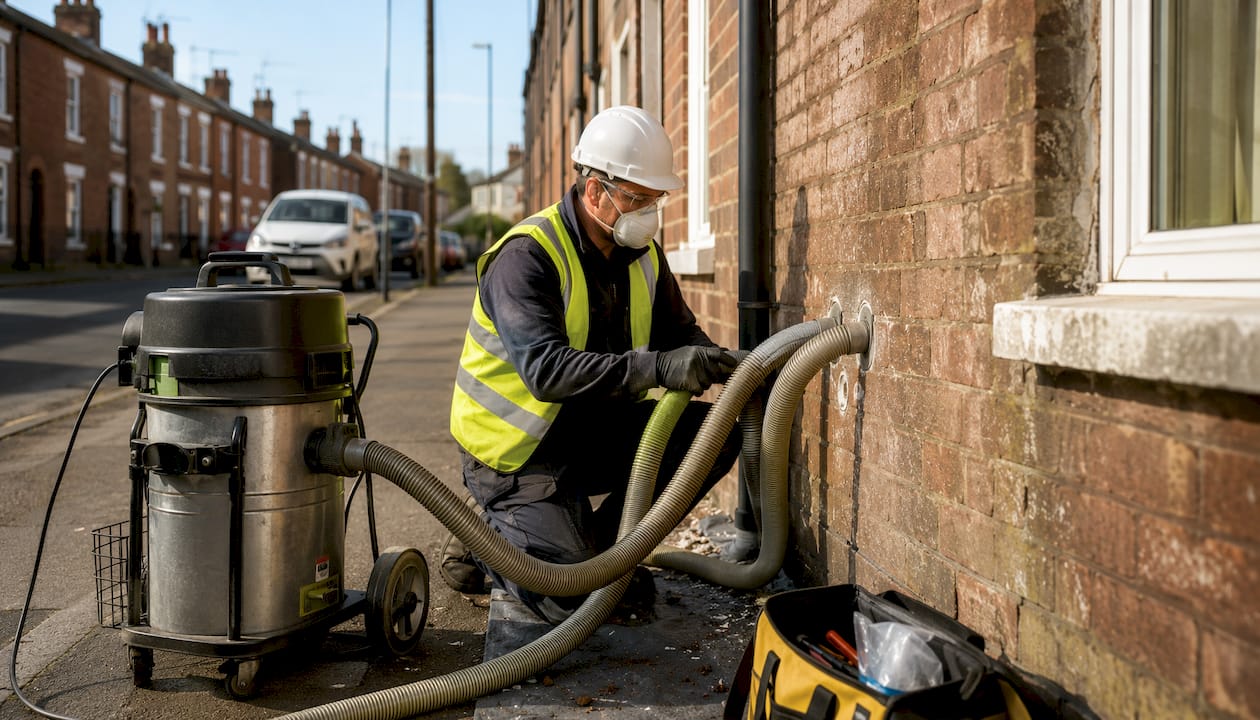
- Extraction by material type. EPS beads and mineral wool are removed by industrial vacuum extraction. Polyurethane foam often requires mechanical agitation before vacuuming, and in severe cases may demand partial structural strip of the outer leaf — the most disruptive and costly scenario.
- Hole plugging and mortar matching. Drill holes are filled with matching mortar and pointed to restore the wall’s weather resistance.
- Post-work borescope and thermal verification. A representative inspection across all elevations confirms no residual material or moisture bridges remain before the cavity is closed.
- Waste removal and disposal. All extracted material is removed from site with appropriate waste-management documentation.
Timeline: Most three- or four-bedroom semi-detached properties take one to three days on site for straightforward bead or mineral wool extraction. Foam removal or structural remediation can extend this to a week or more.
Pro Tip: EPS beads extract most cleanly and achieve the highest removal rates. Mineral wool extracts well if it has not been saturated for years. Polyurethane foam is the problem case: it can bond to the inner leaf, resist vacuum extraction, and leave residues that require a second pass or partial rebuild. If your property has foam fill, get a specialist firm with documented foam-removal experience — not a generalist.
What does blown insulation removal cost, and who normally pays?
Budget a few thousand pounds upwards for a standard three-bedroom semi. The material type is the single biggest cost driver.
| Material | Typical cost range (3-bed semi) | Typical duration |
|---|---|---|
| EPS (polystyrene) beads | £2,500–£3,500 | 1 to 2 days (estimated) |
| Mineral wool | £3,500–£5,000 | 1 to 3 days (estimated) |
| Polyurethane foam | £4,500–£6,000+ | 2 to 5 days and beyond (estimated) |
Foam removal and larger/complex properties can exceed £8,000. Other cost drivers include property size and access, exposure zone and masonry type, whether bonded or degraded insulation requires invasive work, structural repairs such as wall tie replacement or outer leaf rebuilding, and the specification for independent technical monitoring and clearance certification.
Who pays? Check the original installer guarantee and contact CIGA before spending anything privately. Poor installation can leave installers liable for remedial costs, and many warranties are now managed centrally by CIGA. Where a property sale is involved, lenders or insurers may require extraction as a condition of mortgage offer, in which case the liability question becomes part of the conveyancing process. If no warranty route is available, the homeowner or landlord typically funds the work. Finance options for extraction projects are available through OSCAR Onsite for those managing upfront cost.
What qualifications and proofs should you require from a contractor?
The single most important thing to understand: any firm that recommends extraction before conducting an independent inspection is a red flag, not a recommendation. Evidence-led decisions protect you; sales-led extraction does not.
Contractor checklist:
- Public liability insurance that explicitly covers extraction work
- TrustMark registration and adherence to PAS 2030:2023 and BS 8104
- NVQ Level 2 competence in CWI surveying and extraction (the qualifications OSCAR Onsite authored as the national benchmark)
- Manufacturer training and conformity certificates for the specific material being removed
- Photographic before-and-after evidence from recent comparable projects
- Waste-management paperwork confirming lawful disposal
Questions to ask before signing anything:
- What is the exact extraction method proposed for my insulation type?
- Who will carry out the post-work borescope and thermal checks?
- Will you provide a clearance certificate, and who will conduct the independent technical monitoring?
- Is the quote fixed-price and based on a site survey?
Red flags: verbal estimates without a survey; pressure to proceed before an independent inspection; no insurance for extraction work; reluctance to supply a clearance certificate or references.
Manufacturers must run approved-installer schemes, and checking conformity certificates reduces the risk of future failures. Always verify that the contractor’s accreditation is current, not just claimed.
Pro Tip: Ask specifically whether the firm is an OSCAR Onsite Accredited Member. OSCAR-accredited firms operate to defined technical and ethical standards, verified through audits. That accreditation also means independent technical monitoring is available — something a non-accredited firm simply cannot provide.
What should you do after extraction is complete?
Extraction is not the end of the job. The documentation and post-work steps are what convert a completed extraction into a defensible, certifiable outcome.
Post-work checklist:
- Independent clearance certificate confirming the cavity is clear and dry
- Post-work borescope and thermal imaging report across all elevations
- Drying time for the inner leaf before any re-insulation or internal decoration
- Masonry repairs, re-pointing, and reinstatement of drill holes
- Waste-disposal receipts confirming lawful removal of extracted material
Re-insulation options — in order of suitability:
- Leave the cavity empty while the wall dries, particularly in exposed locations.
- Re-insulate with EPS beads — the preferred option in moderate-to-wet exposure zones because beads do not absorb moisture and can be re-extracted if problems recur.
- Install external wall insulation (EWI) where the exposure zone or masonry type makes any cavity fill unsuitable long-term. EWI can be installed without prior extraction unless the existing fill has driven moisture into the inner leaf.
| Post-extraction action | When required | Who arranges it |
|---|---|---|
| Independent clearance certificate | Always | OSCAR Onsite or accredited firm |
| Borescope/thermal post-work report | Always | Independent inspector |
| Masonry repairs and re-pointing | Where drill holes or damage exist | Contractor |
| Drying period before re-insulation | Always | Homeowner/contractor |
| Replacement insulation or EWI | Where re-insulation is appropriate | Accredited installer |
The OSCAR Cavity Wall Extraction Clearance Certificate provides the auditable paper trail that lenders, housing associations, and insurers require. Without it, you have a completed extraction but no independent proof.
Key takeaways
Blown insulation removal is only justified when an independent inspection confirms the insulation is causing harm or was never suitable for the property — extraction without that evidence wastes money and may leave the real problem untouched.
| Point | Details |
|---|---|
| Inspect before you extract | Commission an independent borescope and thermal imaging survey before authorising any removal. |
| Contact CIGA first | Check warranty and rectification options with the original installer or CIGA before funding private works. |
| Require documented compliance | Demand PAS 2030:2023, BS 8104, TrustMark registration, and NVQ Level 2 competence from any contractor. |
| Budget realistically | Costs range from £2,500–£3,500 for bead extraction, £3,500–£5,000 for mineral wool, and £4,500–£6,000+ for foam; larger or complex jobs can exceed £8,000 on a standard three-bedroom semi. |
| OSCAR Onsite recommended | An OSCAR CWI Condition Inspection Survey is the recommended independent first step; OSCAR-accredited firms provide extraction with independent technical monitoring and a formal clearance certificate. |
Why an inspection-first approach is the only responsible one
OSCAR Onsite recommends independent inspection before extraction because removal is disruptive, costly, and only effective when the evidence genuinely supports it. That is not a cautious disclaimer — it is the lesson from a decade of working across the UK with housing associations, local authorities, and private homeowners who were told extraction was necessary before anyone had looked properly at the cavity.
The industry has a history of sales-led extraction: firms that diagnose removal before conducting a survey, or that conflate damp caused by pointing failures with damp caused by insulation. The two problems look similar from the inside of a living room. They require completely different remedies.
OSCAR Onsite was founded by Alan Hoey specifically to address that gap. OSCAR authored the NVQ Level 2 qualifications in CWI Surveying and Inspection and in CWI Extraction and Clearance — the national benchmark qualifications that define what competent practice looks like. More than 250 accredited firms across the UK now operate under OSCAR’s technical and ethical standards, with independent audits and continuous professional development built into membership.
The clearance certificate matters because it is independent. A contractor certifying their own work is not independent verification. OSCAR Onsite’s Technical Monitoring and Clearance Certification provides the auditable paper trail that protects homeowners, housing providers, and mortgage lenders alike — and it is the document that closes the job properly.
OSCAR Onsite: independent surveys, accredited extraction, and clearance certification
If you suspect your cavity insulation has failed, the right first move is an independent condition survey — not a removal quote.
OSCAR Onsite provides CWI Condition Inspection Surveys using borescope and thermal imaging, producing a written report that tells you whether extraction is justified, what method is appropriate, and what the remedial specification should be. Where extraction is confirmed, OSCAR connects you with an accredited member firm and provides independent Technical Monitoring throughout the works, followed by a formal Cavity Wall Extraction Clearance Certificate on completion.
OSCAR Onsite does not promote sales-led extraction. Every recommendation is evidence-led, independently verified, and documented. Book a condition inspection survey today and get the facts before committing to anything.
Useful sources and standards
The following primary sources underpin the guidance in this article.
- Government CWI consumer guide — official advice on what to do if you suspect a faulty installation, including how to contact CIGA and the guarantee process under ECO and Green Deal schemes.
- PAS 2030:2023 — the publicly available specification governing energy efficiency measures in existing dwellings, including installer competence and quality management requirements for cavity wall work.
- BS 8104 — the British Standard covering the assessment of wind-driven rain exposure for walls, used to determine whether a location is suitable for cavity fill in the first place.
- TrustMark — the government-endorsed quality scheme for retrofit and home improvement work; TrustMark registration is a baseline requirement for any contractor carrying out funded or compliance-critical extraction.
- CIGA (Cavity Insulation Guarantee Agency) — holds many CWI warranties centrally; contact CIGA before commissioning private extraction to check whether rectification is available under an existing guarantee.
- OSCAR Onsite condition inspection survey — the recommended independent first step before any extraction decision, covering borescope inspection, thermal imaging, and a written condition report.
- OSCAR Onsite clearance certificate — independent technical monitoring and post-extraction certification, providing the auditable documentation lenders and housing providers require.
For broader context on cavity wall insulation problems and practical guidance on diagnosing wall damp, the Survey Merchant resource hub covers both topics in useful detail.