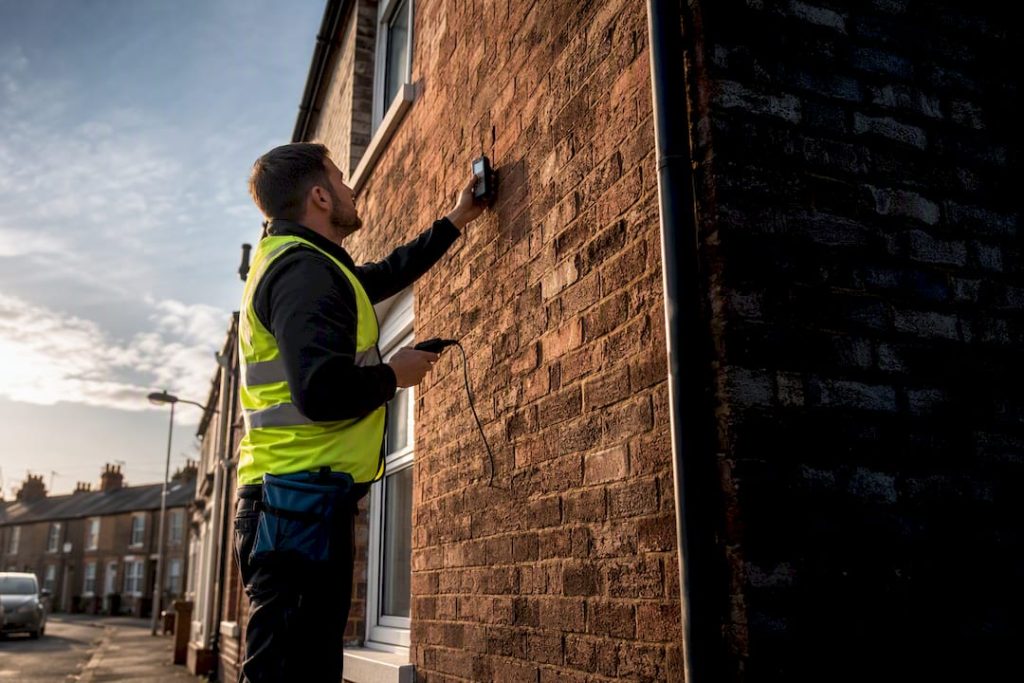
The route worth pursuing now is NVQ Level 2 in Cavity Wall Surveying or Inspection Occupations, delivered through on-site assessment (OSAT) rather than classroom-only study. It trains you in the two skills that matter most on a real job: borescope inspection to confirm cavity condition, and exposure assessment to BS 8104. Before you commit fees, check the provider’s page for PAS 2030/2035 alignment, TrustMark association, and CSCS blue card relevance.
TL;DR:
- Most candidates complete NVQ Level 2 in cavity wall surveying or inspection within a few weeks to several months, depending on how quickly they gather workplace evidence.
- The training emphasizes developing judgment to assess cavity suitability, especially in boundary zones, rather than solely mastering borescope techniques.
- Proper exposure assessment involves initial screening with BR 262 mapping, followed by BS 8104 calculations for boundary cases or unusual conditions.
- Funding options, such as CITB grants, can significantly reduce costs, especially for employers supporting retrofit projects.
- A credible course must provide real OSAT evidence, including sample inspection reports referencing BS 8104 exposure zones, to demonstrate trained assessor judgment.
Table of Contents
- What NVQ routes cover cavity wall exposure assessment training?
- What must a credible cavity wall inspection training course teach?
- How does NVQ on-site assessment actually work?
- What does cavity wall training cost, and can you get funding?
- What does a proper exposure assessment survey involve, step by step?
- OSCAR Onsite: who authors this training and what you receive
- What professionals get wrong about this training
- Ready to book training or an independent risk check?
- Standards and guidance worth reading after training
- Sources
- FAQ
What NVQ routes cover cavity wall exposure assessment training?
Two Level 2 NVQ pathways dominate the UK market, and they suit different people. The surveying and inspection diploma is built for anyone assessing existing cavities: surveyors, retrofit coordinators, and technical assessors who need to judge suitability before work starts. The cavity wall insulation diploma is aimed at installers who need to prove competence in fitting materials once a survey has confirmed the wall is suitable.
Both routes run on the OSAT model, meaning assessment happens on real sites rather than in a classroom simulation. NOCN and similar awarding organisations publish the national specifications these qualifications are assessed against, so a provider offering “equivalent” training outside that framework is not offering the same thing.
Alongside the full NVQs sit shorter CPD and safety courses focused specifically on exposure assessment and borescope technique. These suit workers who already hold a related trade qualification and need a targeted top-up rather than a full diploma.
- NVQ Level 2 Cavity Wall Surveying/Inspection — for surveyors and retrofit coordinators assessing suitability
- NVQ Level 2 Cavity Wall Insulation — for installers fitting material into approved cavities
- Short CPD exposure assessment courses — for trades people needing a focused skills top-up
- Prerequisites — most routes require current employment or site access, since evidence is gathered on live jobs
What must a credible cavity wall inspection training course teach?
A syllabus worth paying for goes well beyond “how to use a borescope.” It should build the judgement to decide whether a cavity is suitable for filling at all, rather than just the technique to look inside it.
The non-negotiable learning outcomes are:
- Borescope inspection technique, including safe drain-down procedure before drilling inspection holes
- Cavity width measurement and identification of obstructions such as wall ties, debris, or mortar droppings
- Exposure assessment methodology under BS 8104, and how exposure zone affects which insulation material, if any, is appropriate
- Defect identification across render, pointing, and partial fills that commonly precede failure
- The practical limits of thermal imaging, and when a finding needs laboratory or specialist analysis instead
Industry guidance is consistent on the single biggest cause of failure in this sector: mineral fibre installed into a wall that was too exposed for it. That is why exposure assessment guidance sits at the centre of any credible syllabus, not as an add-on module. Training should also be explicit that a thermal camera reads surface temperature differences on a wall, not the cavity contents directly. It flags a pattern worth investigating with a borescope, not a confirmed diagnosis on its own.
Pro Tip: Ask a prospective provider to show you a sample condition report from a past OSAT assessment. If it doesn’t reference BS 8104 exposure zones by name, treat that as a red flag about the course content, not just the paperwork.
How does NVQ on-site assessment actually work?
OSAT assessment is built around evidence, not exams. An assessor visits your workplace, observes you carrying out inspections, and builds a portfolio from what they see and what you can document.
- Observation and evidence gathering — the assessor watches borescope inspections in progress and records photographic and video evidence, alongside witness testimony from site colleagues or employers
- Portfolio mapping to units — evidence gets mapped against mandatory units covering inspection, health and safety, and reporting, so each unit needs its own supporting proof
- Assessor sign-off — once the portfolio satisfies every unit, the assessor confirms competence and the qualification is submitted to the awarding body
- Timescale — most candidates complete an NVQ Level 2 over several weeks to a few months, largely dictated by how quickly workplace evidence can be gathered rather than by study time
Achieving the NVQ is what typically unlocks CSCS blue card eligibility for this occupation, since the card scheme relies on recognised qualifications as proof of competence on site.
What does cavity wall training cost, and can you get funding?
Costs vary by provider and route, but three things drive the price: the number of assessor site visits required, travel to your workplace, and portfolio moderation fees. Full OSAT routes with multiple visits generally cost more than a hybrid model combining short classroom input with a lighter portfolio requirement.
Funding help exists, and it’s worth chasing before you pay the full rate yourself:
- CITB grants cover many short-period and NVQ-related qualifications for eligible employers
- Employer-funded training is common where a firm needs staff qualified to bid for retrofit contract work
- Where training links to funded retrofit delivery under schemes like ECO4, qualification costs sometimes sit within the wider project budget rather than as a standalone expense
Expect the full NVQ to run from a few weeks to several months depending on how fast evidence can be collected on site.
What does a proper exposure assessment survey involve, step by step?
Training that skips straight to borescope technique without teaching the assessment logic around it produces assessors who can look but not judge. A competent sequence runs like this:
- Assess the building’s exposure category using BR 262 mapping as an initial screen, checking orientation, altitude, and proximity to coast or exposed hillside
- Apply BS 8104 calculation for any site that falls near a zone boundary or presents unusual local conditions the map alone can’t resolve
- Rule out full-fill where zones 3 or 4 apply, since severe and very severe exposure often makes full-fill unsuitable without specific mitigation, and consider partial-fill, external, or internal insulation instead
- Carry out the borescope inspection, recording still images from the borehole, cavity width measurements, and visible defects
- Compile the minimum record set: exposure assessment narrative, photographs, borehole stills, and measurements, all referenced against BS 8104 and BR 262
- Write the recommendation, stating clearly whether further testing is needed, whether remediation must happen before any fill, or whether an alternative insulation strategy is the safer route
BEIS research classes zones 3 and 4 as severe and very severe, with worst-case spell volumes exceeding 56.5 and 100 litres per square metre respectively. Training exercises calibrated against those thresholds are what separate a candidate who can recite the standard from one who can apply it on a coastal terrace in driving rain.
OSCAR Onsite: who authors this training and what you receive
OSCAR Onsite authored the NVQ Level 2 in Cavity Wall Surveying/Inspection Occupations, built around the same OSAT evidence model described above. Courses align with PAS 2030:2023 and teach BS 8104 exposure assessment alongside correct borescope and thermal imaging use, including where thermal imaging’s limits sit against a confirmed borescope finding.
Delegates leave with the NVQ certification itself plus inspection report templates modelled on real condition survey practice, so the paperwork produced matches what an assessor and, later, a client expects to see.
What professionals get wrong about this training
Too many candidates treat the NVQ as a paperwork exercise: gather enough photographs, tick enough units, get signed off. That misses the point entirely. The qualification exists because industry guidance keeps identifying the same failure pattern, insulation installed where exposure made it unsuitable, and that failure traces back to assessors who never learned to apply BS 8104 properly rather than to bad luck or bad materials.
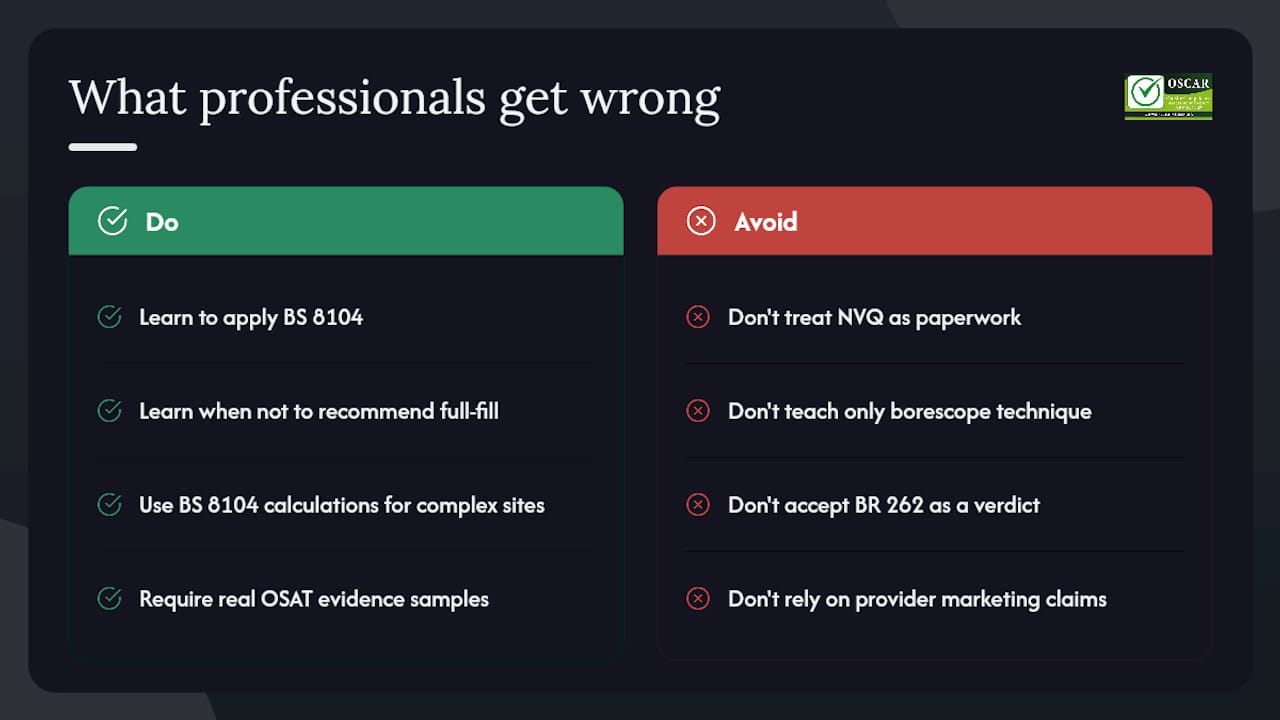
The conventional advice tends to focus on technique: how to use a borescope, how to drill an inspection hole cleanly. That’s necessary but not sufficient. What separates a competent assessor from a box-ticker is judgement about when not to recommend full-fill, and the confidence to say a wall needs further testing rather than a quick answer. BR 262 mapping is a screening tool, not a verdict. Complex or boundary sites need the formal BS 8104 calculation, and training that only teaches the map is training half the job.
Prioritise a provider who can show you real OSAT evidence from past candidates, not marketing copy about pass rates. If they can’t produce a sample exposure assessment report, they can’t prove they teach the judgement this qualification is meant to certify.
— Alan
Ready to book training or an independent risk check?
If you’re weighing up NVQ training against an immediate need to check a live job, you don’t have to choose one or the other. OSCAR Onsite runs both: standards-authored NVQ training built around real OSAT evidence, and independent cavity wall insulation risk checks for sites where you need an answer before training completes.
Before an assessor visits, gather your basic evidence set: recent borescope stills, cavity width measurements, and photographs of any external defects such as cracked render or displaced pointing. Employers arranging workplace assessment should confirm site access dates in advance so the visit isn’t wasted on logistics. For a fuller technical grounding before assessment day, the CWI condition inspection survey page sets out the inspection methods examiners will expect to see applied correctly.
To arrange course dates or a workplace assessor visit, contact the provider directly through the website and specify whether you need full NVQ assessment or a standalone risk check first.
Standards and guidance worth reading after training
- BEIS exposure zone research explains BR 262 mapping and why zones 3 and 4 demand extra caution.
- The NOCN NVQ specification shows exactly which units your portfolio evidence must satisfy.
- CITB funding pages list current grants for short and NVQ-related qualifications.
Sources
- BEIS research / WIC appendix discussing exposure zones and BR 262
- Cavity wall insulation methods & common problems (industry guidance summary)
- NOCN Level 2 NVQ Diploma for insulation and building treatments (cavity wall insulation)
- CITB grants and funding: qualification grants
FAQ
What is the best NVQ for cavity wall exposure assessment?
NVQ Level 2 in Cavity Wall Surveying or Inspection Occupations is the recognised route for professionals assessing suitability, since it’s assessed against the national qualification specification rather than a provider’s own framework.
How long does cavity wall inspection training take to complete?
Most candidates complete the OSAT route in a few weeks to several months, depending mainly on how quickly workplace evidence can be gathered rather than study hours.
Does thermal imaging show what’s inside a cavity wall?
No. Thermal imaging reads surface temperature patterns and flags areas worth investigating further; a borescope inspection is needed to confirm what’s actually inside the cavity.
Can I get funding for cavity wall NVQ training?
CITB grants support many short and NVQ-related qualifications, and employer funding is common where the qualification supports retrofit contract work.
What evidence does an NVQ assessor expect to see?
A minimum evidence set typically includes borescope stills, cavity width measurements, defect photographs, and a written exposure assessment referencing BS 8104 and BR 262, gathered through OSAT observation on a real site visit.
Recommended
- Diploma in Floorcovering Occupations (Construction)
- NVQ Diploma in Wood Occupations (Construction) V2
- NVQ Diploma in Occupational Work Supervision (Construction)
- NVQ Diploma in Decorative Finishing – Painting and Decorating (Construction)
Our articles are a mix of human and automated generation, and sometimes mistakes or errors appear.
If you do spot any errors please do let us know via email to: office@oscar-onsite.co.uk