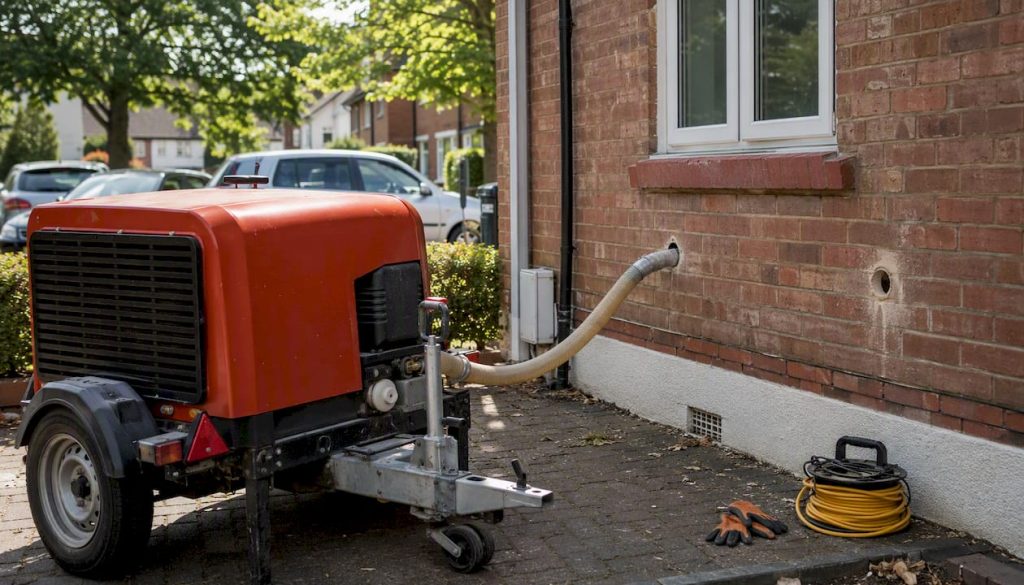
For most UK contractor jobs, a petrol towable extraction unit covers the widest range of sites and access conditions. Before you buy or hire anything, commission an independent CWI condition inspection survey first. Extraction without a prior survey wastes money, creates liability, and may breach PAS 2035 pre-works obligations.
Three quick verdicts:
- Best overall class for most contractors: petrol towable extraction unit — mains-independent, high impeller power, suits the majority of UK semi-detached and terraced stock
- Best heavy-duty option: truck-mounted electric extraction system — large bin capacity, reduced downtime, suited to volume retrofit programmes
- Recommended service route: OSCAR Onsite accredited extraction delivery with independent technical monitoring and clearance certification, where you need documented compliance evidence for housing associations, lenders, or retrofit schemes
Request an airflow specification, operator training pack, and warranty terms with every quote before committing.
Key takeaways
Professional cavity wall extraction equipment decisions hinge on site access, power source, and documented compliance, not machine price alone.
| Point | Details |
|---|---|
| Survey before extraction | Commission an independent CWI Condition Inspection Survey before purchasing equipment or starting any extraction programme. |
| Match machine class to site | Petrol towable units suit most UK sites; truck-mounted electric systems suit high-volume retrofit programmes. |
| Demand airflow at working hose length | Always request airflow figures at the working hose extension, not at the machine inlet, in every supplier quote. |
| Clearance certification is non-negotiable | Independent technical monitoring and a formal clearance certificate protect contractors on housing association and retrofit-funded projects. |
| OSCAR Onsite | Provides accredited extraction delivery, NVQ-aligned training, and independent clearance certification across the UK. |
Table of Contents
- How do the main UK cavity wall extraction equipment options compare?
- Which machine specifications actually matter for professional cavity extraction?
- Accessories, spare parts, training, and aftercare to check before buying
- Typical purchase, rental, and operating costs, and what to expect on site
- UK regulatory and safety essentials: PAS 2035, PAS 2030, and UKAS
- How to pick the right extraction machine and vendor
- Short recommendations: best overall, best budget, and best heavy-duty
- Why independent inspection matters more than the machine you choose
- OSCAR Onsite services for contractors: survey, monitoring, and clearance
- Sources
How do the main UK cavity wall extraction equipment options compare?
The table below covers the seven options contractors in the UK should evaluate, from OSCAR Onsite’s accredited service through to purpose-built machines from UK manufacturers. Manufacturer-quoted prices are flagged as such; treat them as ballpark figures until you have a formal quote.
| Option | Best for | Power source | Suction / airflow | Hose reach | Collection capacity | Portability | Price / finance | Warranty & spares | Training provided | Accessories |
|---|---|---|---|---|---|---|---|---|---|---|
| Petrol towable extraction unit | Rural sites, no mains power, high portability needed | Petrol engine | High impeller output | Long runs, typically 30m+ | Large wheeled bin | Towable trailer; moderate weight | Mid–high capital; finance available from some UK suppliers | Replacement engines and impeller parts available | Varies by supplier; ask for syllabus | Hose kits, probe sets; camera optional |
| Compact petrol portable unit | Terraced and semi-detached; tight access; small crews | Petrol engine | Moderate impeller output | Medium reach | Smaller bin or bag | Trolley or small trailer; lower weight | Lower capital cost | Spares availability varies; confirm before purchase | Varies by supplier | Basic hose kit; probes optional |
| Truck-mounted electric system | Large retrofit programmes, commercial sites, high-volume work | Electric or diesel-hybrid | High continuous output | Long reach from vehicle | Very large bin; reduced load cycles | Vehicle-mounted; requires parking access | High capital; rental options exist for volume contracts | Manufacturer-dependent; confirm CB audit trail | Specialist operator training recommended | Full hose set, probes, camera often included |
| Extract Vac | UK contractor use; details not publicly listed | Not publicly listed | Not publicly listed | Not publicly listed | Not publicly listed | Not publicly listed | Not publicly listed | Not publicly listed | Not publicly listed | Not publicly listed |
| Cavityvac EXT420 | UK contractor and small-to-medium extraction jobs | Petrol (420cc engine) | Published in manufacturer spec sheet | Confirmed in kit spec | Published in kit spec | Portable kit; trailer-mountable | From £4,350 + VAT (manufacturer quoted) | Replacement engines and spare impeller parts available | Documentation supplied; ask for training syllabus | Complete kit available; accessories listed on site |
| ExtractInsulation / Renewables specialist machines | Renewables and specialist retrofit extraction | Not publicly listed | Not publicly listed | Not publicly listed | Not publicly listed | Not publicly listed | Not publicly listed | Not publicly listed | Not publicly listed | Not publicly listed |
Key points from the comparison:
- Extract Vac and ExtractInsulation / Renewables specialist machines do not publish full specifications publicly; request a full technical data sheet and demonstration before purchase
- The Cavityvac EXT420 is one of the few UK manufacturers to publish a starting price (£4,350 + VAT, manufacturer quoted); treat this as a ballpark and confirm spare-parts lead times in your RFQ
- OSCAR Onsite is the only entrant offering independent technical monitoring and a formal clearance certificate as part of the service
Which machine specifications actually matter for professional cavity extraction?
Contractors often receive vague marketing claims rather than testable numbers. Here is what to demand.
Engine and power source
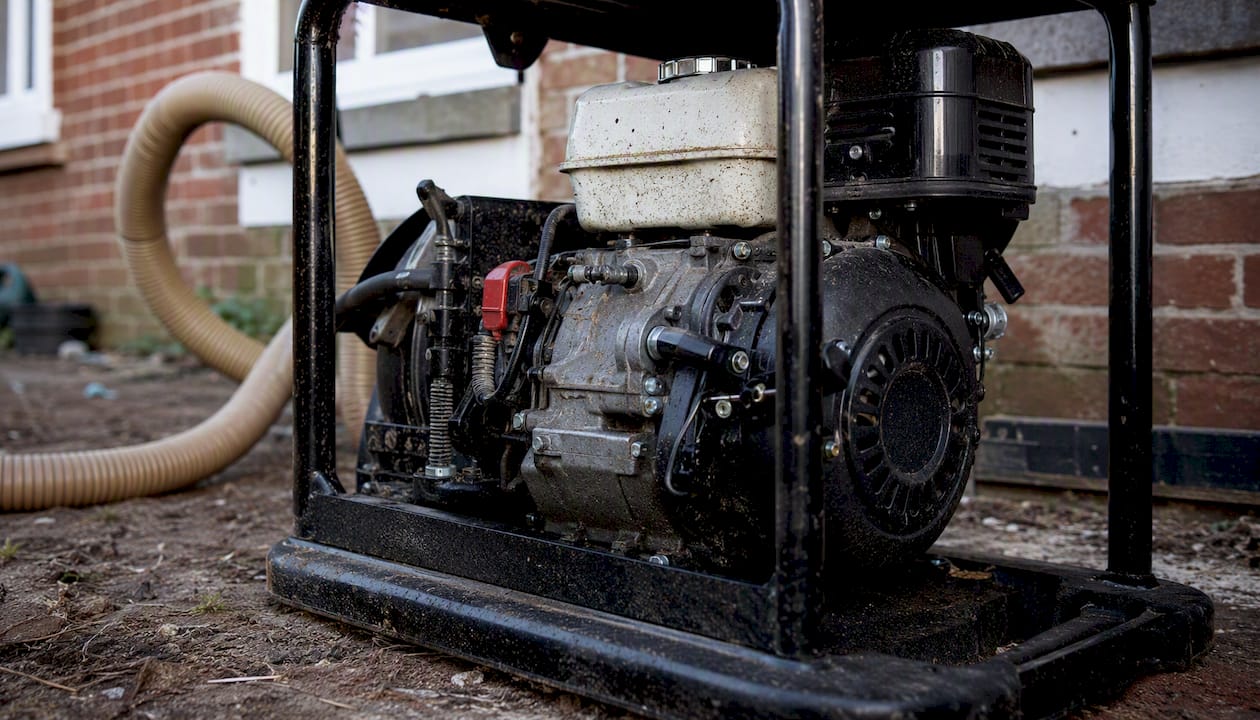
Petrol engines give site independence. Electric or diesel-hybrid truck-mounted systems suit volume programmes where a vehicle can park adjacent to the property. The Cavityvac EXT420 uses a 420cc petrol engine; that engine class is broadly typical for portable UK extraction kits. Confirm kilowatt or horsepower output in writing, not just cubic centimetres.
Airflow and suction rating
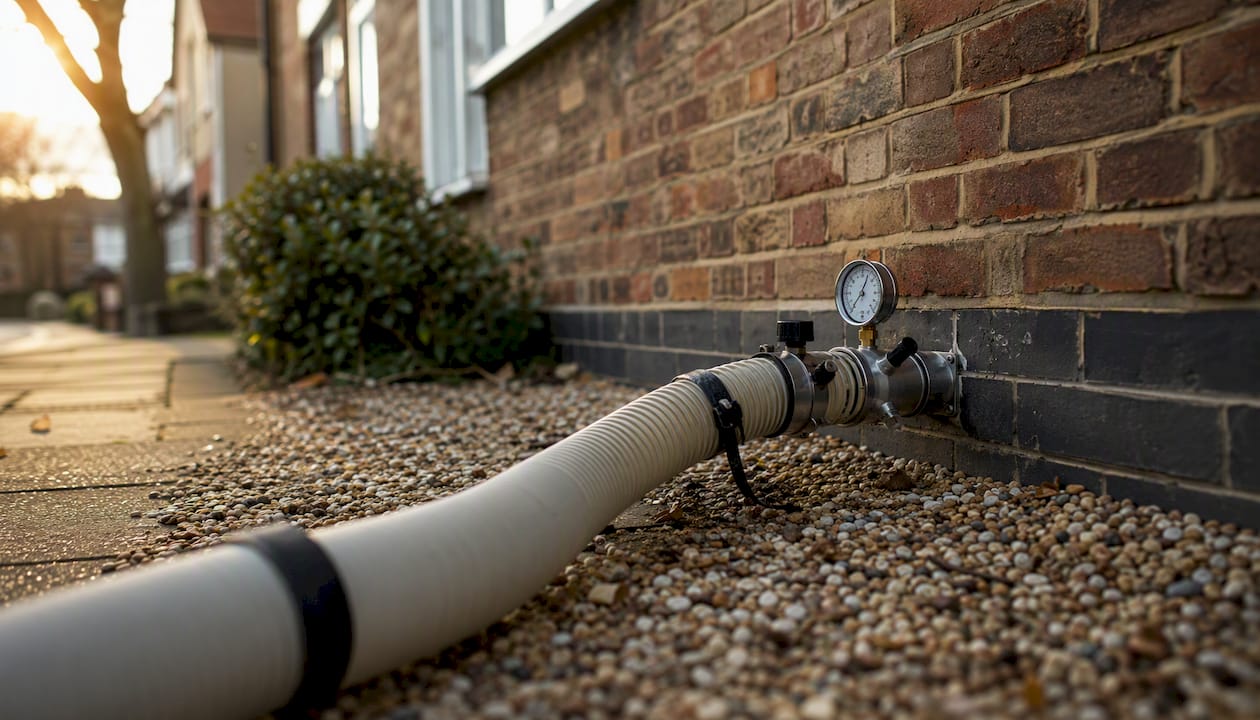
Airflow, measured in cubic metres per hour (m³/h) or cubic feet per minute (CFM), is the single most important performance indicator. A machine with a high vacuum rating but low airflow will stall on dense mineral wool or wet bead. Ask for the airflow figure at the working hose length, not at the machine inlet. Vendors who cannot supply this figure at working conditions are telling you something.
Impeller and housing durability
The impeller takes the punishment. Ask specifically whether it is steel or a composite, and whether the housing is lined. Replacement impellers are available for some UK machines, including Cavityvac models, which extends machine life considerably and reduces total cost of ownership.
Hose length and diameter
Thirty metres of usable hose reach covers the majority of UK semi-detached and terraced properties from a single parking position. Longer runs reduce airflow; ask the vendor for the airflow figure at maximum hose extension. Hose diameter affects what material can pass without blockage.
Collection capacity and dust separation
A larger bin means fewer stops to empty. Truck-mounted systems have the highest capacity and suit high-volume programmes. For portable units, confirm whether the collection system uses a bag, a cyclone separator, or a direct bin, and whether HEPA-grade filtration is fitted. Mineral wool fibres are a respiratory hazard; filtration class matters.
Minimum thresholds to include in your RFQ:
- Airflow specification at working hose length (not inlet)
- Impeller material confirmed in writing
- Filtration class (HEPA or equivalent) confirmed
- Hose reach at rated airflow
- Collection capacity in litres or m³
- Engine output in kW or HP (not just cc)
Pro Tip: Ask the vendor to demonstrate the machine on a test rig or at a live site before purchase. A supplier who declines is a red flag. Record the airflow reading yourself using a calibrated anemometer at the hose end.
Accessories, spare parts, training, and aftercare to check before buying
The machine price is only part of the cost. Downtime, consumables, and untrained operators are where margins disappear.
Essential accessories
- Borescope or inspection camera: pre-works cavity inspection is non-negotiable. OSCAR Onsite uses borescope and thermal imaging as standard; contractors buying machines should budget for a compatible camera. See the OSCAR guide on thermal imaging cameras for cavity surveys for specification guidance.
- Varied hose lengths and diameters: a single hose length rarely covers all property types. Confirm what lengths are included in the kit and what extensions cost.
- Probe kits: different probe profiles suit different cavity widths and insulation types. Confirm compatibility with the machine’s hose fittings.
- Filters and collection bags: consumable cost adds up on a busy programme. Get a per-bag and per-filter price before committing.
Spare parts and warranty
Cavityvac publishes that replacement engines and spare impeller parts are available, which is a meaningful differentiator. For any machine, ask:
- What is the warranty period and what does it cover?
- Are spare impellers, seals, and engine parts held in UK stock?
- What is the lead time for a replacement impeller?
- Is a refurbishment or upgrade programme available for older units?
A machine without a clear spare-parts policy is a liability on a multi-property programme.
Operator training and NVQ alignment
Training is not a cost; it is a compliance requirement and a liability shield. OSCAR Onsite authored the NVQ Level 2 in Cavity Wall Insulation Extraction and Clearance, the national benchmark qualification for the sector. Operators working on PAS 2030-aligned programmes should hold or be working towards this qualification. Ask every machine supplier whether their documentation supports NVQ portfolio evidence, and whether they offer or signpost formal operator training.
Typical purchase, rental, and operating costs, and what to expect on site
Purchase price ranges
The Cavityvac EXT420 complete kit is advertised from £4,350 + VAT (manufacturer quoted). Petrol towable units and truck-mounted systems sit higher; truck-mounted electric systems represent the largest capital outlay. Rental options exist for volume contracts, particularly for truck-mounted systems, and some UK suppliers offer finance. Always request a formal quote rather than relying on published list prices.
Operating costs to factor in:
- Fuel (petrol units on a full day’s extraction)
- Consumables: collection bags, filters, probe tips
- Transport: towable and truck-mounted units require appropriate vehicles and towing capacity
- Operator time: a typical extraction job uses a surveyor and two technicians
Typical job timescales
A standard semi-detached or terraced property usually requires a few days with a surveyor and two technicians, covering borescope inspection, drilled access, extraction, and reinstatement of drill holes. Timber-framed and steel-framed properties take longer because access points must be planned more carefully to avoid structural elements. Deep cavities and properties with mixed insulation types add time. For detailed timescale guidance, the OSCAR cavity wall extraction timescale guide sets out property-type breakdowns contractors can use when pricing work.
Cavity wall insulation removal costs vary significantly by property type, insulation material, and access difficulty; use the OSCAR cost guide as a cross-check when preparing client estimates.
UK regulatory and safety essentials: PAS 2035, PAS 2030, and UKAS
Contractors must follow the PAS 2035/2030 compliance pathway for any extraction work forming part of a retrofit programme. PAS 2035 covers assessment, design, and monitoring; PAS 2030:2023 covers installation, commissioning, and handover. Both apply to cavity wall extraction where the work is part of an energy efficiency measure.
PAS 2035 guidance requires documented appraisal of dwelling construction, ventilation, and moisture risk before any intervention. That means a pre-works survey is not optional; it is a specification requirement. Budget for diagnostic survey time and possible invasive investigation before extraction begins.
BRE Group references for PAS 2030 confirm that Retrofit Installers must make suitable equipment available as part of the installation process. Equipment suitability should be documented in your quality management records.
UKAS has issued a PAS 2030 scheme update (R2) requiring enhanced surveillance of Certification Bodies, including quarterly assessments and monthly audit collation for wall insulation measures. Contractors must verify that their Certification Body’s accreditation is current and ask specifically how their CB audit arrangements have been updated in response.
Insurers, housing associations, and retrofit schemes increasingly expect clearance certificates and independent technical monitoring as evidence of competent works. OSCAR Onsite recommends:
- Commission an independent CWI Condition Inspection Survey before extraction
- Use an OSCAR Onsite Accredited Member Firm for extraction
- Obtain independent Technical Monitoring and a formal clearance certificate after extraction
Safety checklist for extraction operations:
- FFP3 respiratory protection for all operatives handling mineral wool or bead
- Eye protection and disposable coveralls during drilling and extraction
- Dust containment: seal internal openings and use negative-pressure containment where required
- Safe access: scaffold or podium steps for high-level drill points; no ladders for sustained work
- Manual handling: assess machine weight and use mechanical aids for towable units
- Site environmental controls: contain and bag all extracted material; dispose as controlled waste where applicable
Pro Tip: Check your Certification Body’s UKAS accreditation status on the UKAS website before starting any PAS 2030-aligned programme. An expired or suspended CB accreditation puts your entire programme at risk of non-compliance.
How to pick the right extraction machine and vendor
Step-by-step evaluation checklist
- Commission a pre-works CWI condition inspection to confirm extraction is justified and to identify cavity type, insulation material, and access constraints
- Match machine class to site: petrol portable for tight urban access; petrol towable for rural or multi-property runs; truck-mounted electric for volume programmes
- Request airflow specification at working hose length in writing
- Confirm impeller material, filtration class, and collection capacity
- Check spare-parts availability and lead times for impeller and engine components
- Verify operator training provision and NVQ alignment
- Confirm warranty terms and what is excluded
- Check delivery lead time and whether an on-site demonstration is available
- Confirm waste removal plan and disposal documentation
- Verify the supplier’s insurance and any relevant accreditation
Sample RFQ questions
- What is the airflow output (m³/h or CFM) at 30m hose extension?
- What material is the impeller manufactured from, and what is the replacement cost?
- Is HEPA-grade filtration fitted as standard?
- What is the lead time for a replacement impeller from UK stock?
- Does the kit include a training syllabus, and does it support NVQ portfolio evidence?
- Can you provide an on-site demonstration before purchase?
- What are the warranty exclusions?
- How is extracted material classified for disposal, and who is responsible?
Red flags in vendor replies
- Airflow figures quoted at the machine inlet only, not at working hose length
- No on-site demonstration offered
- Spare parts “available on request” with no lead time given
- No operator training documentation or NVQ reference
- Vague or absent waste disposal guidance
- Certification Body accreditation not verifiable on UKAS register
Short recommendations: best overall, best budget, and best heavy-duty
Best overall for most UK contractors: a petrol towable extraction unit covers the widest range of properties and site conditions, requires no mains power, and suits the semi-detached and terraced stock that makes up the bulk of UK retrofit programmes. Pair it with a pre-works borescope survey and an NVQ-qualified operator.
Best budget route: a compact petrol portable unit, such as the Cavityvac EXT420 (from £4,350 + VAT, manufacturer quoted), suits smaller crews and tighter access jobs. Lower capital cost, but confirm spare-parts availability and training support before committing.
Best heavy-duty option: a truck-mounted electric extraction system for large retrofit programmes or commercial sites where volume and reduced downtime justify the higher capital outlay. Rental is worth exploring for one-off large contracts.
Where OSCAR Onsite fits: for any project where housing association, lender, or retrofit scheme sign-off is required, OSCAR Onsite’s accredited extraction service with independent technical monitoring and clearance certification is the strongest route. The machine is only part of the answer; the documentation trail is what protects you.
Must-have items in every supplier quote:
- Airflow spec at working hose length
- Hose reach at rated airflow
- Collection capacity (litres or m³)
- Warranty term and exclusions
- Training included or signposted
- Spare-parts lead time from UK stock
- Clearance certificate process (or confirmation that OSCAR Onsite independent monitoring will be used)
For ambiguous cases where extraction may not be justified, request an OSCAR CWI Condition Inspection Survey before committing to machine purchase or any extraction programme.
Why independent inspection matters more than the machine you choose
The industry’s persistent problem is not a shortage of capable machines. It is extraction carried out without adequate prior diagnosis, driven by sales incentives rather than evidence. A contractor with the best petrol towable unit on the market can still cause significant damage to a property if the pre-works survey was skipped or inadequate.
OSCAR Onsite’s position is straightforward: independent inspection reduces liability, avoids unnecessary extraction, and provides the evidence that lenders, housing providers, and retrofit schemes now routinely require. The NVQ Level 2 qualifications OSCAR authored for CWI Surveying and Extraction exist precisely because the sector lacked a national competence benchmark. Contractors who hold or employ NVQ-qualified operatives are demonstrably better placed when a housing association or insurer asks for proof of competence.
The UKAS scheme update on PAS 2030 surveillance is a signal, not background noise. Certification Bodies are now under quarterly scrutiny for wall insulation measures. That scrutiny flows downstream to installers. Contractors who cannot demonstrate a compliant audit trail face programme suspension, not just a paperwork query.
Book an OSCAR CWI Condition Inspection Survey before committing to machine purchase or extraction work. The survey cost is small relative to the liability of an unjustified extraction.
OSCAR Onsite services for contractors: survey, monitoring, and clearance
Buying the right machine is one decision. Building a compliant, defensible extraction programme is another. OSCAR Onsite provides the services that sit around the machine: independent CWI Condition Inspection Surveys, accredited extraction delivery, Technical Monitoring, and formal Clearance Certification after extraction.
OSCAR Onsite has trained and accredited more than 250 firms across the UK and authored the national NVQ Level 2 qualifications for the sector. Every accredited member firm operates to defined technical and ethical standards, verified through audits and continuous professional development. For contractors working on housing association, local authority, or retrofit-funded programmes, choosing an OSCAR Onsite accredited firm and commissioning independent technical monitoring is the clearest way to demonstrate compliance to clients and funders. Request a survey or ask about accredited extraction delivery at Oscaronsite.
Sources
- PAS 2030 scheme update (UKAS technical bulletin)
- PAS 2030:2019 / PAS 2035 references (BRE Group document)