The recognised qualification is the NVQ Level 2 in Cavity Wall Extraction & Clearance, a work-based award regulated by Ofqual and delivered through awarding organisations such as GQA. If you want to work as a certified technician, registering with an accredited centre is a practical route to start building the workplace evidence your portfolio will need from day one.
TL;DR:
- The NVQ Level 2 in cavity wall extraction focuses on safe extraction techniques and knowledge of wall readiness for reinsulation, relying entirely on workplace evidence.
- The qualification typically takes 6 to 12 months to complete, depending on site availability, with costs varying by provider and assessment support needed.
- Candidates must demonstrate competence through photographic records, logs, and supervisor witness testimony, as there is no formal written exam.
- Certification often supports eligibility for CSCS cards and improves prospects for employment, self-contracting, or advancing into inspection roles.
- The course is suitable for newcomers, current installers seeking formal recognition, and surveyors, with minimal prerequisites beyond practical site access and safety awareness.
Table of Contents
- What does the NVQ Level 2 in cavity wall extraction cover?
- Who is this course for?
- Course structure: units, assessment types, TQT and GLH
- How to train and get certified: study modes, timelines and cost
- What happens on assessment day, and what certification allows
- OSCAR Onsite: training authority behind the qualification
- Health and safety considerations specific to cavity wall extraction
- Tools and equipment used in cavity wall extraction
- Industry regulations and compliance related to cavity wall extraction
- Career prospects and job opportunities after training
- Common challenges faced during cavity wall extraction and troubleshooting tips
- When NVQ training is the right route versus learning on the job
- Get NVQ Level 2 certified through OSCAR Onsite Academy
- Sources
- FAQ
What does the NVQ Level 2 in cavity wall extraction cover?
The qualification exists to prove a technician can carry out safe extraction and clearance of cavity wall insulation, and know when a wall is ready for reinsulation. It is not a classroom qualification. It is built to certify what someone can already do, or is learning to do, on live sites.
Ofqual holds the qualification under reference number 603/4678/4, which is the number to check if you want to confirm a training provider’s course is genuinely regulated rather than an informal in-house scheme. According to GQA’s own qualification specification, the award carries a Total Qualification Time of 240 hours and 84 Guided Learning Hours.
There are two distinct pathways within the qualification family, and it matters which one you’re aiming for:
- Clearance and extraction pathway — covers the physical removal of failed or unsuitable insulation material from the cavity.
- Surveying and inspection pathway — covers diagnostic and assessment skills, useful for those heading towards a surveying-focused NVQ rather than hands-on extraction work.
Most technicians entering the trade take the extraction pathway first, then add surveying credentials later as their career develops.
Who is this course for?
The qualification suits three broad groups: people entering the trade with no prior insulation experience, installers who already work in the field and need formal recognition for their skills, and surveyors who want NVQ-backed evidence to support inspection work. None of these groups needs a set of A levels or a construction degree to get started.
Course providers generally list minimal formal prerequisites. SERC’s course page describes entry requirements built around practical readiness rather than academic history, though every candidate needs access to a genuine workplace where they can gather assessable evidence.
Before inquiring, it helps to check you can meet the following:
- Regular access to live extraction sites, either through an employer or a placement arranged with your training centre.
- Basic fitness for physical work involving ladders, confined access points and repeated manual handling.
- A working understanding of construction site safety, even if you haven’t yet completed formal CSCS training.
- Willingness to document your own work consistently, since photographic and written evidence underpins the whole assessment.
If you can’t yet offer employer access, raise this with a centre directly. Some providers can discuss simulated or supervised evidence routes for candidates without a current placement.
Course structure: units, assessment types, TQT and GLH
The qualification splits into mandatory units that every candidate completes, and pathway-specific units tied to either clearance or surveying work. A typical structure runs through:
- Health and safety in the workplace — mandatory for both pathways, covering site risk assessment and safe working practice.
- Preparation and access — assessing wall condition, planning extraction points, and protecting the surrounding property.
- Cavity clearance and extraction — the practical core of the extraction pathway, covering removal techniques and material handling.
- Post-extraction assessment — checking cavity condition and documenting readiness for any future reinsulation.
Statistic Callout: The GQA specification lists a Total Qualification Time of 240 hours against 84 Guided Learning Hours — meaning roughly two thirds of the learning time is expected to happen through unsupervised, on-the-job practice rather than direct instruction.
That gap between TQT and GLH is the whole point of an NVQ. Assessment leans on workplace evidence: photographs of completed extractions, borescope logs where inspection informed the work, a portfolio built over weeks or months, and witness testimony from a supervisor or assessor who has observed you working. There’s no written exam sat under classroom conditions. Competence is proven where the work actually happens.
How to train and get certified: study modes, timelines and cost
Getting certified follows a fairly predictable sequence, though the pace depends entirely on how quickly you can generate workplace evidence.
- Enrol with an accredited centre. Confirm the centre delivers the GQA-regulated qualification under reference 603/4678/4, not a similarly named in-house certificate.
- Start collecting evidence immediately. Photograph extraction work, log borescope findings where relevant, and keep dated records from your very first supervised job.
- Arrange on-site assessment. An assessor observes live work and reviews your portfolio against the unit criteria.
- Receive your certificate. Once all units are signed off, the awarding body issues the NVQ Level 2 certificate.
Study modes vary by circumstance. Employer-led assessment suits those already working for an installation or extraction firm. Apprenticeship routes combine paid work with structured NVQ evidence gathering. Blended and private on-site assessment routes, such as those run through OSCAR Onsite Academy, work well for independent tradespeople without an employer sponsoring them through.
Timelines commonly run 6 to 12 months, largely determined by how often you’re on relevant sites. Costs vary between providers and depend on the type of training or assessment support required; requesting a direct quote is recommended rather than assuming a flat national price.
Pro Tip: Start your evidence file before you’ve even had your first assessment conversation. Assessors move faster when a candidate already has six months of dated photographs and site notes rather than starting from a blank folder.
What happens on assessment day, and what certification allows
Assessors don’t just watch you work for an afternoon and sign a form. They cross-reference what they see against your accumulated evidence: extraction photographs, borescope inspection logs where used, and any witness statements from supervisors who’ve watched you work over time.
Once signed off, the certificate confirms you can independently carry out extraction and clearance work, and that a property is in a documented state suitable for a decision on reinsulation, subject to separate independent assessment of the wall’s underlying condition.
A few related credentials tend to come up alongside the NVQ itself:
- CSCS card eligibility — many sites require a valid CSCS card, and holding this NVQ typically supports the relevant card category.
- PAS 2030 awareness — while PAS 2030:2023 governs installation standards rather than extraction directly, technicians working across retrofit projects benefit from understanding how it shapes wider compliance expectations.
- Ongoing CPD — extraction techniques and material types evolve, so continuing development after certification keeps skills current.
OSCAR Onsite: training authority behind the qualification
The NVQ Level 2 curriculum used across the sector was authored by OSCAR Onsite, which also delivers on-site assessments through its academy, providing a direct route from enrolment to certified competence.
Training under OSCAR Onsite’s framework includes learning evidence-led inspection habits early: borescope checks to examine cavity contents through small access points, and thermal imaging as an indicative screening tool that flags temperature anomalies rather than seeing directly inside the wall. Both techniques inform judgement; neither replaces a full independent assessment.
Technicians who train through an accredited, audit-backed scheme carry stronger evidence into every job they do afterwards. The Member Accreditation Scheme exists precisely so that a certificate means the same thing on every site it’s used on, verified through ongoing audits rather than issued once and forgotten.
Health and safety considerations specific to cavity wall extraction
Extraction work carries risks that differ from general building trades, and training has to address them directly rather than as an afterthought.
Confined access is the first issue. Cavity walls are narrow, often obstructed by debris, wall ties or nesting material, and extraction tools need to be used without damaging the wall structure or disturbing asbestos-containing materials that may be present in older properties built before the 1980s. Anyone training for this work needs a clear procedure for identifying and handling suspect materials before extraction begins, not after.
Dust and airborne particulate is a persistent concern during extraction, particularly with degraded mineral wool or cellulose fill that’s broken down after years of moisture exposure. Respiratory protection appropriate to the material being removed isn’t optional, and training should cover how to select the right grade of protection for different insulation types.
Working at height features heavily too, since access points are frequently drilled at first floor level or higher, meaning ladder safety and, on some properties, scaffold access become part of the daily routine rather than an occasional task.
Finally, there’s a documentation and communication dimension to safety that’s easy to underestimate. Technicians need to be able to flag unexpected findings, such as signs of structural movement or unusually wet material, to a supervisor or assessor rather than pressing on regardless. Good NVQ training builds that habit of pausing and reporting into the assessment criteria itself, not just the physical technique.
Tools and equipment used in cavity wall extraction
The core toolkit for extraction work is more specialised than general building tools, and NVQ training covers both the equipment and the judgement needed to use it properly.
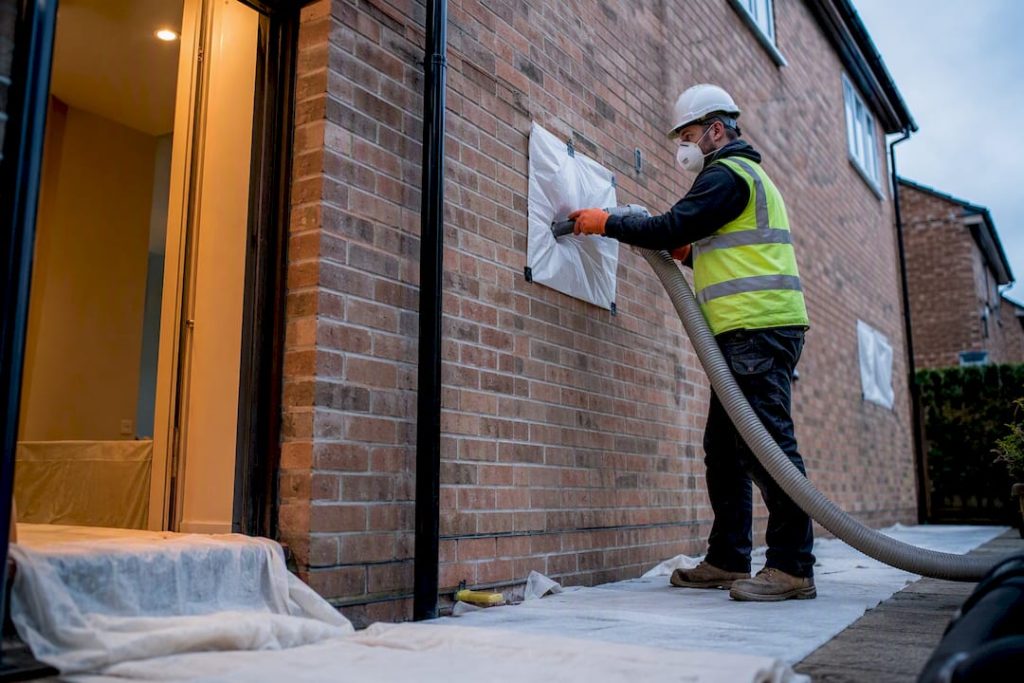
Drilling equipment forms the starting point, typically diamond-tipped or masonry core drills sized to create clean access points without excessive damage to brickwork or render. Extraction tools themselves range from mechanical vacuum systems, which draw loose fill material out through the access points, to manual extraction rods and scoops for material that’s compacted or clumped.
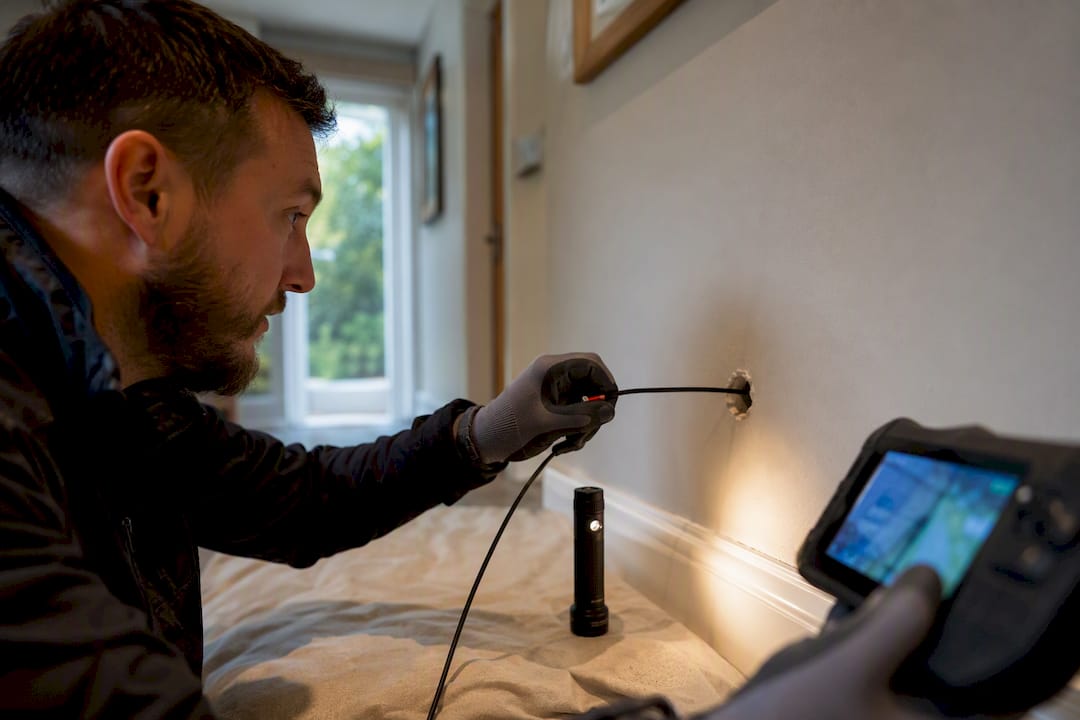
Borescope equipment plays a central role in both pre-extraction assessment and post-extraction verification. A borescope allows a technician to visually inspect the cavity through a small access point, checking for residual material, wall tie condition, or moisture staining, without opening the wall further than necessary. It’s worth being precise here: a borescope shows what’s directly in its field of view through the access point, not a full three-dimensional picture of the entire cavity, which is why thorough inspection often needs multiple access points across a wall.
Personal protective equipment rounds out the essential kit: respirators rated for the material being handled, eye protection against dust and debris, and appropriate gloves for handling potentially contaminated insulation material. Training also covers site protection equipment, such as dust sheets and debris containment systems, since minimising disruption to the property is as much a professional skill as the extraction itself.
Industry regulations and compliance related to cavity wall extraction
Cavity wall extraction sits within a wider compliance framework that technicians need to understand, even though the NVQ itself focuses on practical competence rather than legislative detail.
PAS 2030:2023 sets installation standards for energy efficiency measures including cavity wall insulation, and while it governs installation more directly than extraction, technicians working across retrofit projects encounter it regularly when properties are being prepared for reinsulation. Understanding how PAS 2030 shapes what “acceptable condition” looks like for a wall before reinstallation helps a technician produce evidence that’s actually useful to the next stage of work.
BS 8104 covers the assessment of exposure to wind-driven rain, a factor that governs whether a wall is even suitable for cavity insulation in the first place, and understanding it helps extraction technicians grasp why some properties fail and need remediation years after installation.
TrustMark registration matters for any firm carrying out retrofit work funded through government energy efficiency schemes, and while it’s a business-level accreditation rather than an individual qualification, technicians working towards employment with TrustMark-registered firms benefit from understanding what that registration actually requires.
The regulatory thread running through all of this is consistent: extraction should never be recommended or carried out until the cause and condition of the existing insulation has been independently assessed. A certified technician’s role is to execute extraction safely and competently once that assessment has established it’s the right course of action, not to make that diagnostic call from visual symptoms alone.
Career prospects and job opportunities after training
Certified technicians typically find work through three main routes: employment with established extraction and remediation firms, self-employed contracting once experience and a track record are built up, or progression into surveying and inspection roles using the complementary surveying NVQ pathway.
Demand for this work is tied directly to the scale of the UK’s existing cavity wall insulation stock, much of which was installed during large-scale retrofit programmes over the past two decades and is now reaching a point where failures, moisture ingress and material degradation are being identified. Housing associations, local authorities and insurers all commission remediation work when insulation failures are confirmed, which creates a steady flow of extraction jobs distinct from new installation work.
Career progression commonly runs from extraction technician towards site supervisor roles, then potentially into independent surveying or inspection work once the complementary NVQ pathway is completed. Some technicians move into training and assessment roles themselves once they’ve accumulated several years of site experience, becoming the assessors who sign off the next generation of candidates.
Earnings and specific job availability vary by region and employer, so it’s worth treating any figures quoted by individual recruiters with caution and instead asking prospective employers directly about pay structures during any interview process.
Common challenges faced during cavity wall extraction and troubleshooting tips
New technicians tend to hit the same handful of problems repeatedly, and knowing what they are before you encounter them on site saves time and reduces risk.
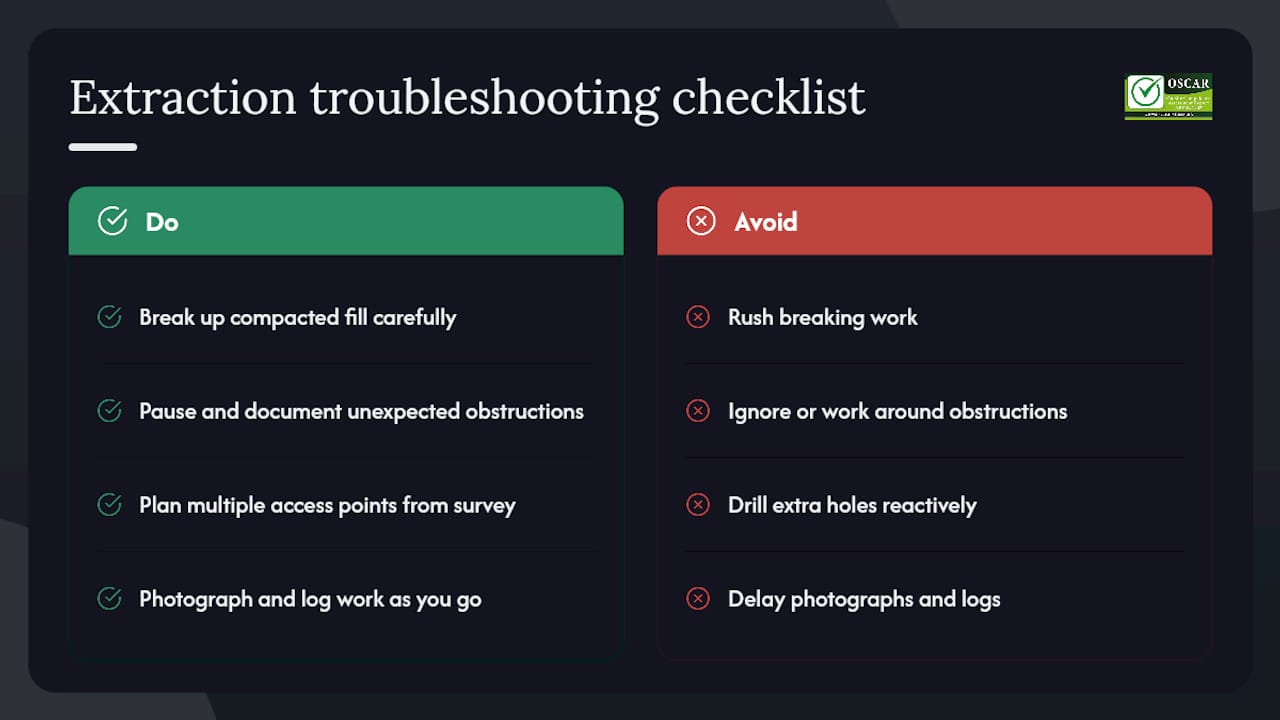
Compacted or clumped material is one of the most common practical difficulties. Loose fill that’s absorbed moisture over years can set almost solid, resisting standard vacuum extraction and requiring manual breaking up before removal. Rushing this step risks damaging wall ties or pushing debris further into inaccessible parts of the cavity rather than out.
Unexpected obstructions, such as historic debris, nesting material, or even structural elements not shown on any building plan, come up more often than newcomers expect. The right response is always to pause, document what’s been found, and consult a supervisor or assessor rather than working around it and hoping it doesn’t matter.
Access point placement causes more problems than it should. Poorly chosen drilling points can miss sections of the cavity entirely, leaving material behind that later gets flagged in a post-extraction check. Multiple, well-planned access points based on a proper pre-extraction survey solve this far more reliably than drilling extra holes reactively once a problem is discovered.
Finally, incomplete evidence gathering is a challenge that has nothing to do with the physical work and everything to do with certification. Technicians who treat photography and logging as an afterthought consistently struggle at the NVQ portfolio stage, regardless of how competent their actual extraction technique is.
When NVQ training is the right route versus learning on the job
An NVQ gives you something informal experience can’t: a regulator-recognised certificate that proves competence to employers, insurers and clients who weren’t there to watch you work. Employer mentoring builds real skill, but it rarely carries that same portable proof. The fastest route combines both, gathering evidence from genuine site work while an accredited centre assesses it formally, rather than treating training and employment as separate stages.
— Alan
Get NVQ Level 2 certified through OSCAR Onsite Academy
OSCAR Onsite Academy runs the NVQ Level 2 in Cavity Wall Extraction & Clearance with a genuine advantage over generic training providers: the courses were authored by the organisation that also carries out independent inspections and extraction work across the UK, so the evidence standards you’re trained to meet are the same ones used on live commercial and domestic projects, not a simplified classroom version.
If you’re ready to move forward, start by checking current course dates and delivery formats on the NVQ Level 2 in Cavity Wall Extraction & Clearance page. From there, you can request centre approval, discuss your access to workplace evidence, and get a clear answer on what your specific timeline and cost will look like. If you’re still weighing up whether extraction or surveying suits you better, the surveying and inspection pathway is worth a look before you commit.
Sources
- GQA NVQ Level 2 Certificate in Cavity wall extraction occupations
- Level 2 Certificate in Cavity Wall Extraction Occupations
- Ofqual register search
FAQ
What are the regulations for cavity wall construction in the UK?
Cavity wall insulation work is shaped by standards including PAS 2030:2023 for installation quality and BS 8104 for assessing exposure to wind-driven rain, alongside TrustMark registration requirements for firms carrying out publicly funded retrofit work.
How much does cavity wall extraction cost?
Extraction costs vary by property size, access difficulty and material condition, so it’s best to request a direct quote from a qualified provider such as OSCAR Onsite rather than relying on a generic national average.
What qualifications do you need to install insulation?
Extraction and clearance work is formally recognised through the NVQ Level 2 in Cavity Wall Extraction & Clearance, regulated by Ofqual under reference 603/4678/4, with separate installation-focused training and PAS 2030 compliance required for firms carrying out reinsulation.
How much does a cavity wall inspection cost?
Inspection costs depend on property type and the depth of assessment required; a CWI condition inspection survey is the most reliable way to get an accurate, property-specific figure rather than a generic estimate.
Recommended
- NVQ Level 2 in Cavity Wall Extraction & Clearance
- Cavity Wall Surveying NVQ: What Surveyors and Extractors Need to Know
- NVQ Level 2 in Cavity Wall Surveying &/or Inspection Occupations
- Certificate in Cavity Wall Surveying, Extraction &/or Inspection Occupations
Our articles are a mix of human and automated generation, and sometimes mistakes or errors appear.
If you do spot any errors please do let us know via email to: office@oscar-onsite.co.uk