TL;DR:
- Removing cavity wall insulation costs typically range from £1,500 to £4,000, but an independent survey is essential before any work. Several factors, including insulation type, property size, and access, significantly influence the price, while grants and guarantees may cover costs entirely. Always request a detailed quote and prioritize independent assessment to ensure removal is genuinely necessary.
Removing cavity wall insulation typically costs between £1,500 and £4,000 for most UK homes, though complex jobs involving urea-formaldehyde (UF) foam or significant scaffolding can push that higher. Per-square-metre figures vary considerably depending on material type, access, and the extent of contamination, so any number you see online is a starting point, not a quote. Before you commission any extraction work, the single most important step is to book an independent CWI condition inspection survey to confirm that insulation is actually causing the problem and that removal is genuinely warranted.
- Costs vary by property size, insulation material, access, and condition
- Grants and guarantee routes (ECO, CIGA) may reduce or eliminate your out-of-pocket cost
- PAS 2030:2023-compliant contractors and independent technical monitoring are non-negotiable for quality assurance
Table of Contents
- How much does cavity wall insulation removal cost?
- What factors change the price of removal?
- Are there grants or funding to help with removal costs?
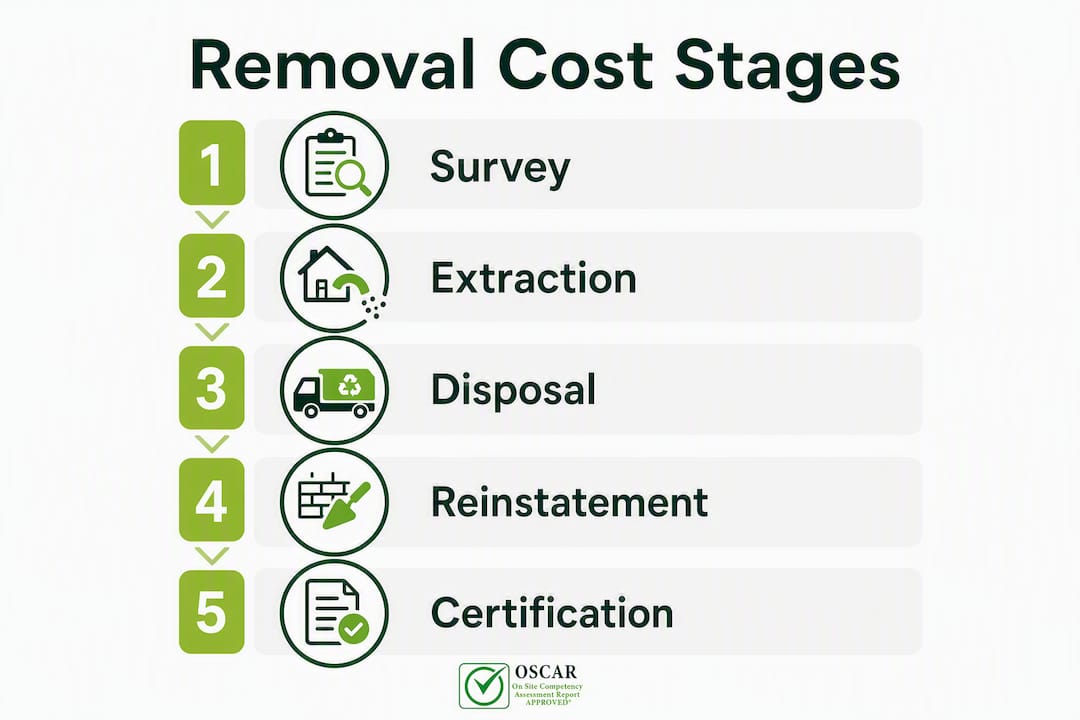
- What happens during the removal process?
- Do you actually need removal, or is something else causing the problem?
- How to choose the right contractor for the job
- Why an independent OSCAR CWI condition inspection matters
- Key takeaways
- The case for independent oversight in CWI extraction
- Book an independent OSCAR survey or accredited extraction
- Useful sources and official guidance
How much does cavity wall insulation removal cost?
Industry guidance and consumer sources report that whole-house removal ranges widely depending on scope and materials, with costs commonly cited from around £1,500 to £4,000. The table below gives realistic budget ranges by property type; treat these as planning figures until a surveyor has confirmed the actual scope.
| Property type | Insulation material | Estimated total cost (low) | Estimated total cost (high) | Notes |
|---|---|---|---|---|
| Terraced (2-bed) | Mineral wool / blown mineral | Costs vary significantly based on access and scope | Costs vary significantly based on access and scope | Straightforward access, no scaffolding generally cheaper |
| Semi-detached (3-bed) | Mineral wool / blown mineral | Costs vary significantly based on access and scope | Costs vary significantly based on access and scope | Scaffold requirements influence cost |
| Detached (4-bed) | Mineral wool / blown mineral | Costs vary significantly based on access and scope | Costs vary significantly based on access and scope | Larger wall area increases cost |
| Any size | UF foam | Often higher due to specialist disposal required | Specialist disposal required | Hazardous waste rules apply |
| Any size | Scaffolding surcharge | Additional cost depending on height and access | Depends on height and access | Usually quoted separately by contractors |
Additional costs to budget for:
- UF foam specialist disposal: UF foam is classed as a hazardous material and requires licensed waste carriers; this adds meaningfully to the cavity wall extraction cost and should be itemised in any quote
- Mortar reinstatement: After extraction holes are drilled, colour-matched mortar reinstatement is standard practice; poor-quality reinstatement is a red flag
- Cavity drying and remedial works: If damp has penetrated the inner leaf, drying equipment hire and plastering repairs add to the total
- Re-insulation: If you plan to re-insulate after clearance, budget this separately; it is not included in extraction quotes
Pro Tip: Ask every contractor to break their quote into distinct line items: extraction, disposal, reinstatement, and any drying or remedial works. A single lump-sum quote makes it impossible to compare like for like.
What factors change the price of removal?
No two extraction jobs are identical. Several variables shift the cavity wall insulation removal price significantly, and understanding them helps you spot both fair quotes and inflated ones.
Insulation material type is the single biggest driver after property size. Blown mineral wool and polystyrene bead are relatively straightforward to extract. UF foam is a different matter: it sets hard inside the cavity, requires mechanical breaking, and must be disposed of as hazardous waste. Expect the cavity cleaning cost to be noticeably higher for foam-filled properties.
Property size and wall area determine how long the job takes and how many extraction points are needed. A large detached house may have two to three times the external wall area of a terraced property, which scales both labour and disposal costs directly.
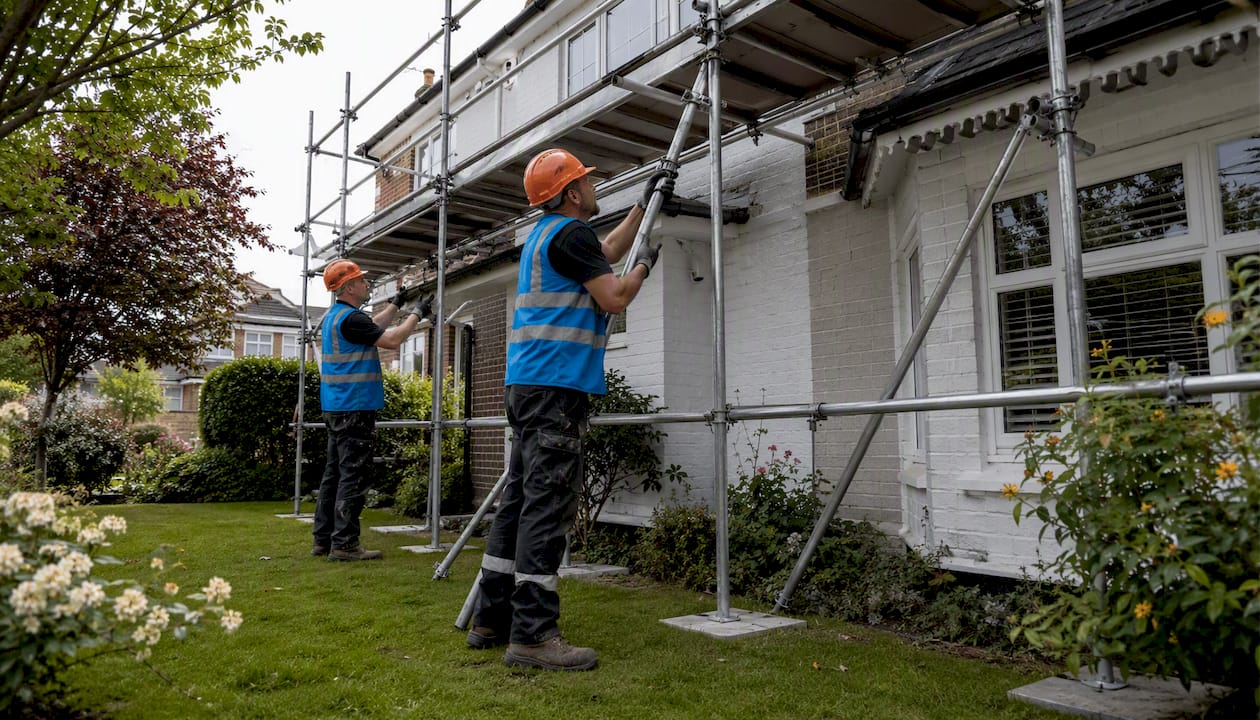
Access and scaffolding add a fixed overhead that has nothing to do with the insulation itself. Upper-storey walls, gable ends, and properties near busy roads or with restricted access all push the cavity wall clearance cost upward. Always ask whether scaffolding is included or quoted separately.
Extent of contamination and damp matters too. Saturated insulation is heavier, harder to extract, and may require additional drying time before the cavity can be certified as clear. If wall ties are corroded or the inner leaf is damaged, remedial structural work adds further cost.
Guarantee and warranty status can shift who pays. If your insulation was installed under the Energy Company Obligation (ECO) scheme or the Green Deal, government guidance advises contacting the original installer first. A CIGA-backed guarantee may cover remedial work at no cost to you.
Pro Tip: A thorough independent condition survey often costs less than £300 and can prevent you spending thousands on unnecessary extraction. If the survey shows the damp has another cause, such as a failed DPC or leaking guttering, you have saved the entire extraction bill.
Are there grants or funding to help with removal costs?
Funding is available in some circumstances, and checking these routes before paying out of pocket is always worth doing.
ECO (Energy Company Obligation): The ECO scheme, administered by Ofgem, funds energy efficiency measures for eligible households. If your original installation was carried out under ECO and has failed, the scheme’s complaint and remediation routes may apply. Contact Ofgem at eco@ofgem.gov.uk or visit their publications for guidance on complaints about CWI installed under ECO.
CIGA guarantee: The Cavity Insulation Guarantee Agency (CIGA) issues 25-year guarantees for CWI fitted in the UK and Channel Islands. If your installation is CIGA-registered, raise concerns directly at concerns@ciga.co.uk. A valid CIGA guarantee may cover the cost of remedial work or extraction where the installation has failed.
Local authority and home improvement loans: Welsh Government guidance notes that local loan schemes may assist homeowners with remedial costs where extraction is necessary. Check your local authority’s home improvement loan programme; similar schemes exist in England and Scotland.
Grant eligibility routes for cavity wall insulation removal are also collated by specialist advisers who can walk you through ECO and local options.
Your first actions, in order:
- Locate your original installation paperwork and check whether a CIGA guarantee was issued
- Contact the original installer; government guidance requires them to investigate and rectify defects as the first step
- If the installer has ceased trading or is unresponsive, contact the guarantee provider (CIGA or the relevant ECO guarantee body listed on Ofgem’s website)
- If no guarantee applies, check ECO eligibility through your energy supplier or an ECO delivery body
- Contact your local authority to ask about home improvement loans or grant schemes
Documents to have ready:
- Original installation certificate and CIGA guarantee (if issued)
- Installer name, company number, and installation date
- Any correspondence with the installer or guarantee provider
- An independent CWI condition inspection report confirming the failure and its cause
What happens during the removal process?
Understanding the sequence helps you hold contractors to account and know what evidence you should receive at each stage.
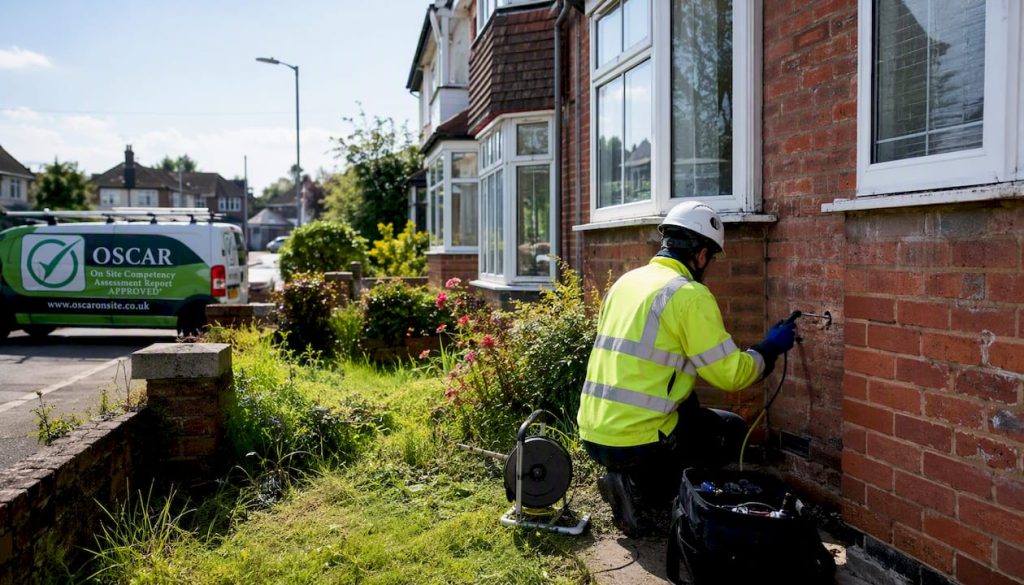
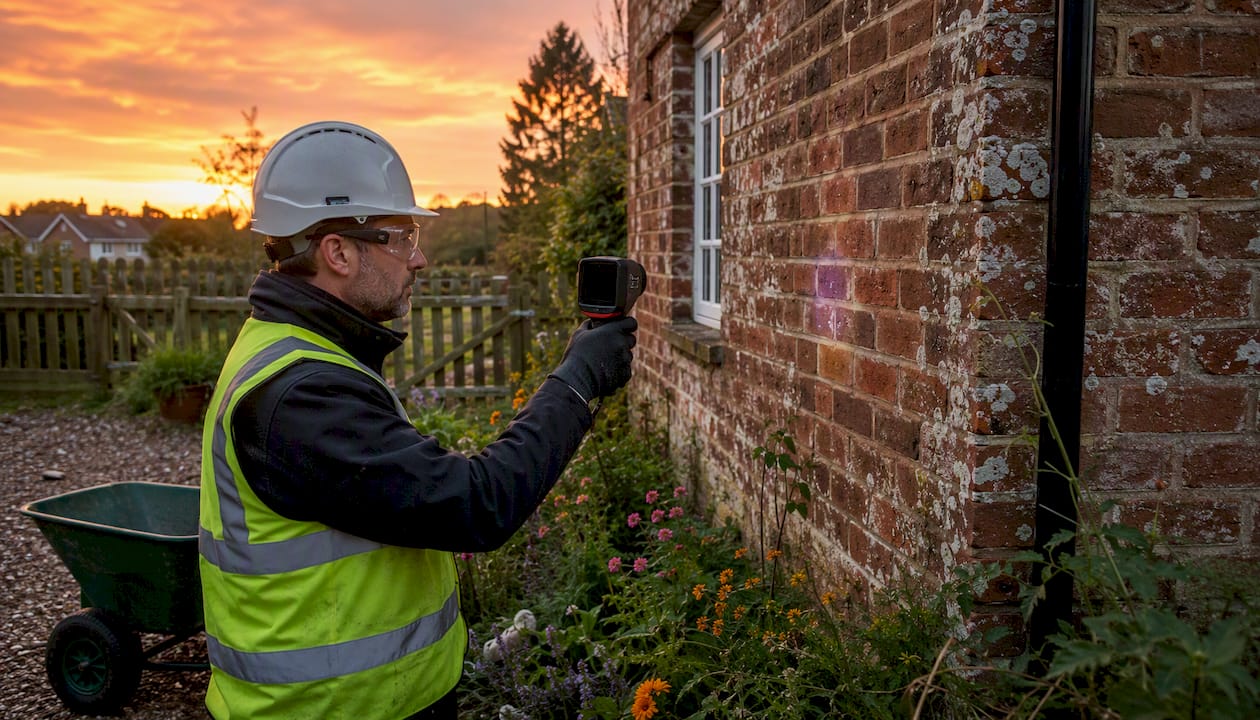
- Independent CWI condition inspection survey: Before any extraction is agreed, an independent surveyor assesses the cavity using borescope and thermal imaging. This confirms whether insulation is the root cause of any damp or damage, and scopes the extraction correctly.
- Diagnostic checks: A borescope inspection accesses the cavity through mortar joints (8–12mm holes) rather than through brick, avoiding cosmetic or structural damage. Thermal imaging identifies cold bridging and moisture patterns across the wall face.
- Decision and scope: The survey report sets out whether extraction is warranted, which walls require treatment, and the appropriate method. This document protects you if there is any later dispute.
- Extraction: Contractors drill access points, typically through mortar joints, and use high-powered vacuum equipment to remove the insulation material. UF foam requires mechanical breaking before extraction.
- Clearance, drying, and repairs: Once extraction is complete, the cavity is inspected again to confirm it is clear. Drying equipment may be deployed if moisture is present. Mortar holes are reinstated with colour-matched mortar.
- Clearance certification and technical monitoring: An independent technical monitor verifies that the cavity has been cleared to the required standard. A cavity clearance certificate is issued as formal evidence of compliant completion.
Typical timescales:
| Phase | Typical duration |
|---|---|
| Independent condition survey | Usually less than a day |
| Small terraced house extraction | Varies from one to a few days |
| Whole-house extraction (semi/detached) | May take several days |
| Drying period (if required) | Can last several weeks depending on moisture levels |
| Reinstatement and snagging | Typically a few days |
| Clearance certification | Generally issued soon after final inspection |
PAS 2030:2023 places specific requirements on pre-installation inspection, independent monitoring, and evidence-based clearance for all fabric measures. Contractors who cannot demonstrate compliance with this standard should not be carrying out extraction work on your property.
Pro Tip: Never allow a contractor who also sells extraction to carry out the condition survey. The commercial incentive to recommend extraction is a direct conflict of interest. Commission the survey independently first.
Do you actually need removal, or is something else causing the problem?
Extraction is frequently over-prescribed. Welsh Government guidance specifically warns that removal may not always be the correct remedy and recommends professional advice to determine appropriate action before any work is commissioned.
Signs that removal may be genuinely justified:
- Persistent damp or mould on internal walls that appeared after CWI installation and has not responded to ventilation improvements
- Borescope inspection confirming saturated, slumped, or bridging insulation
- UF foam contamination causing ongoing moisture problems
- Structural survey evidence linking wall tie corrosion to insulation failure
Common misdiagnoses to rule out first:
- Failed or absent damp-proof course (DPC)
- Leaking or blocked guttering directing water onto the wall face
- Porous or spalled brickwork allowing direct water ingress
- Condensation caused by inadequate ventilation rather than insulation failure
An independent survey distinguishes between these causes. Without one, you risk paying for extraction that leaves the actual problem untouched. For blown insulation removal specifically, the same principle applies: confirm the root cause before committing to extraction.
Interim steps while you wait for a survey:
- Improve internal ventilation (trickle vents, extractor fans) to reduce condensation
- Check and clear gutters, downpipes, and external drainage
- Inspect window and door seals for gaps that allow water ingress
- Avoid applying internal waterproof coatings, which can trap moisture and worsen the problem
How to choose the right contractor for the job
The credentials you ask for matter as much as the price. Sales-led extraction, where a contractor diagnoses the problem and sells you the remedy in the same visit, is a known risk in this sector.
Credentials to insist on:
- PAS 2030:2023 compliance for all fabric and insulation measures
- TrustMark registration or equivalent consumer protection scheme
- Evidence of independent technical monitoring during extraction
- Ability to provide a cavity clearance certificate on completion
- OSCAR Onsite accreditation, which confirms the firm has been trained and audited against national occupational standards
Questions to ask when collecting quotes:
- Can you provide a written method statement for the extraction?
- How will you dispose of the extracted material, and can you provide a waste transfer note?
- How will mortar reinstatement holes be colour-matched?
- Who will carry out independent technical monitoring, and are they separate from your company?
- What clearance certificate will I receive, and from whom?
- Are you PAS 2030:2023 compliant, and can you show evidence?
Red flags:
- Pressure to sign up on the day without an independent survey
- Refusal to separate the survey and extraction into distinct, independently priced services
- No mention of clearance certification or technical monitoring
- Vague or verbal-only quotes with no written method statement
- Claims management companies offering to arrange extraction as part of a compensation claim without independent verification
A contractor who welcomes scrutiny and answers these questions clearly is one worth considering. One who deflects or rushes you is not.
Why an independent OSCAR CWI condition inspection matters
OSCAR Onsite is the UK’s leading authority in CWI surveying, extraction, and clearance. The organisation authored the UK’s first NVQ Level 2 in CWI Surveying and Inspection and the NVQ Level 2 in CWI Extraction and Clearance, establishing the national occupational standards that define competence in this sector. Over the past decade, OSCAR Onsite has trained and accredited more than 250 independent firms across the UK.
An OSCAR CWI Condition Inspection Survey uses borescope access through mortar joints and thermal imaging to produce a detailed condition report. The report covers moisture ingress, wall tie condition, insulation distribution, and any evidence of failure. Critically, it is carried out independently of any extraction contractor, removing the commercial conflict of interest that distorts so many diagnoses in this sector.
What the OSCAR survey delivers:
- A written condition report with photographic evidence from borescope inspection
- Thermal imaging data identifying moisture patterns and cold bridging
- A clear recommendation on whether extraction is warranted, and if so, the scope
- Documentation suitable for use in guarantee claims (CIGA), ECO remediation routes, or insurance claims
- A basis for comparing contractor quotes on a like-for-like scope
OSCAR Onsite also offers technical monitoring during extraction, providing independent verification that the work meets PAS 2030:2023 requirements, and issues cavity clearance certificates as formal evidence of compliant completion. The OSCAR Onsite CWI Surveyor Awareness Course is also available for RICS surveyors, building surveyors, DEAs, retrofit professionals, housing providers, mortgage lenders, and conveyancing solicitors who need to understand CWI condition assessment in their professional work.
Pro Tip: If your survey confirms a failed installation under ECO or a CIGA-backed scheme, the OSCAR condition report provides the independent evidence needed to support a guarantee claim. This can mean the cost of extraction is covered rather than paid out of pocket.
Key takeaways
Cavity wall insulation removal costs between £1,500 and £4,000 for most UK homes, but an independent condition survey is the essential first step before any extraction is commissioned.
| Point | Details |
|---|---|
| Typical whole-house cost | Budget £1,500–£4,000; UF foam and scaffolding push costs higher |
| Survey before extraction | Commission an independent CWI condition inspection before agreeing to any removal work |
| Grants and guarantees | Check CIGA guarantee and ECO routes first; these may cover remedial costs entirely |
| Contractor credentials | Insist on PAS 2030:2023 compliance, TrustMark registration, and a cavity clearance certificate |
| OSCAR Onsite | Book an independent OSCAR CWI Condition Inspection Survey as the recommended first step |
The case for independent oversight in CWI extraction
The cavity wall insulation sector has a well-documented history of poor workmanship, failed installations, and inadequate oversight. What concerns me most, having worked in this field for years, is not the failed insulation itself but the pattern that follows: a homeowner notices damp, a contractor arrives, and extraction is recommended and sold in the same conversation. That sequence is the problem.
Extraction is sometimes the right answer. But it is not always the right answer, and the only way to know is through an independent assessment by someone with no financial stake in the outcome. PAS 2030:2023 exists precisely because the industry needed a framework that separates diagnosis from delivery. The requirement for independent pre-installation inspection and evidence-based clearance is not bureaucracy; it is the minimum a homeowner deserves before thousands of pounds of work is carried out on their property.
The clearance certificate matters too. Without independent technical monitoring and a formal certificate, you have no evidence that the cavity was actually cleared to the required standard. That gap becomes a serious problem if you sell the property, make an insurance claim, or need to re-insulate in the future.
My advice is straightforward: never let the person selling you extraction be the same person diagnosing the need for it. Commission the survey first, get the report in writing, and use it to hold every subsequent contractor to account.
Book an independent OSCAR survey or accredited extraction
If you have damp, mould, or concerns about your cavity wall insulation, the right starting point is an independent assessment, not a sales call.
OSCAR Onsite offers three services that protect you at every stage. A CWI Condition Inspection Survey gives you an independent, evidence-based diagnosis before any extraction is agreed. Where extraction is confirmed as necessary, OSCAR Onsite’s accredited member network delivers compliant cavity wall insulation extraction to PAS 2030:2023 standards, with independent technical monitoring throughout. On completion, a formal cavity clearance certificate provides the written evidence you need for guarantee claims, insurance, or re-insulation. OSCAR Onsite has trained and accredited more than 250 firms nationwide and authored the national NVQ qualifications that define competence in this sector. To book an independent condition survey or request a quote for accredited extraction, visit oscaronsite.co.uk or contact the team directly.
Useful sources and official guidance
The following sources provide authoritative guidance on CWI issues, standards, and funding routes:
- GOV.UK consumer guide: Cavity wall insulation: consumer guide to issues arising from installations — the primary reference for homeowners on installer obligations, guarantee routes, and ECO complaints. Start here if your installation was carried out under ECO or the Green Deal.
- Welsh Government guidance: Consumer guide to CWI issues in Welsh properties — covers when extraction is and is not appropriate, and local loan scheme options for Welsh homeowners.
- PAS 2030:2023 standard (BSI): PAS 2030:2023 brochure — the technical benchmark for retrofit installers and auditors; use this to verify contractor compliance claims.
- The IAA guide to PAS 2035/2030:2023: A guide to PAS 2035/2030:2023 standards — plain-language explanation of the updated standards, including independent monitoring requirements.
- CIGA (Cavity Insulation Guarantee Agency): Visit ciga.co.uk to check whether your installation carries a guarantee and to raise concerns. For ECO-specific guarantees, the list of approved providers is on Ofgem’s website.
- OSCAR Onsite condition survey service: CWI Condition Inspection Survey — book an independent survey before committing to extraction.
- Loft insulation removal guidance: For homeowners also dealing with loft insulation removal, specialist disposal considerations apply in a similar way to cavity work.