
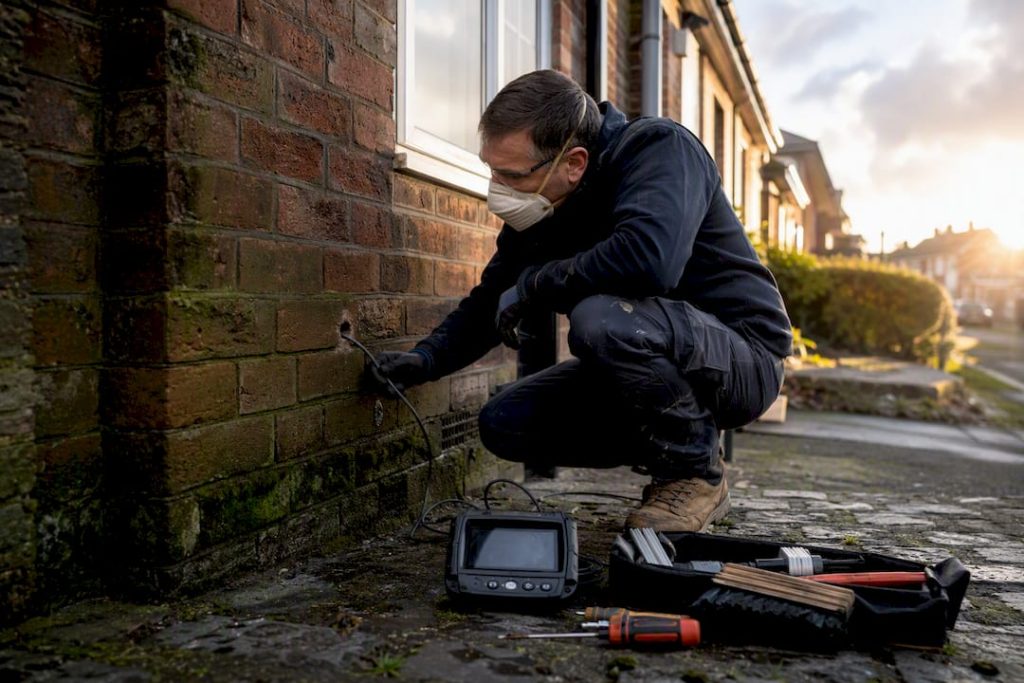
If your cavity insulation was exposed to floodwater, commission an accredited condition survey before assuming drying alone will fix it. Floodwater rarely leaves damage you can judge by eye. It can pass through brickwork into the cavity, saturate the insulation and inner leaf, and leave contaminants behind long after the surface looks dry, as Approved Document C sets out.
In the first 24 to 48 hours:
- Remove standing water and ventilate affected rooms.
- Photograph every visible sign of damage, including waterline marks and debris.
- Log dates, depth of flooding and duration for your records.
- Contact your insurer or loss adjuster before any remedial work begins.
Once notified, expect a survey to be scheduled, temporary drying measures put in place, and a written record built that will support any claim.
Pro Tip: Don’t fill skips or scrub down walls before a surveyor attends. Disturbed evidence is the single biggest reason insurers query claims later.
Key Takeaways
Flood damaged cavity insulation should be diagnosed through an accredited condition survey combining thermal imaging, borescope inspection and moisture mapping before any extraction or reinstatement decision is made.
| Point | Details |
|---|---|
| Survey before you act | Commission a condition survey rather than assuming visible drying means the cavity is fine. |
| Thermal imaging has limits | It flags temperature anomalies only; borescope checks confirm what is actually inside the cavity. |
| Drying can take a very long time, potentially over a year without dehumidification. | Saturated masonry may take up to two years to dry naturally without dehumidification. |
| Extraction needs evidence | Contamination, displaced insulation or sustained high moisture readings justify removal, not flood duration alone. |
| OSCAR Onsite provides the audit trail | Its NVQ-trained surveys and clearance certificates give insurers documented evidence throughout the process. |
Table of Contents
- How condition surveys identify flood damaged cavity insulation
- What a professional cavity wall survey involves
- When should flooded cavity insulation be removed?
- How extraction works and how long it takes
- Contamination, health risks and drying considerations
- Managing your insurance claim after cavity flood damage
- Choosing the right insulation when reinstating a flooded cavity
- Why accredited inspection and certification protect property value
- Getting help with flood damaged cavity insulation
- Sources
How condition surveys identify flood damaged cavity insulation
Photographs of damp patches or discoloured plaster tell you something happened, not what is happening inside the cavity. Symptoms on the inner leaf lag behind the real condition of the insulation, sometimes by weeks.
A defensible survey typically combines:
- Thermal imaging — flags temperature anomalies across the wall surface. It cannot see water or debris inside the cavity; it only indicates where thermal performance looks abnormal, which then guides where to look further.
- Borescope inspection — a camera inserted through small drilled access points confirms what thermal imaging can only suggest: whether insulation has slumped, whether debris or silt has settled, and whether the cavity is clear.
- Moisture mapping — calibrated moisture meters record readings across multiple points, building a pattern rather than relying on a single spot check.
Combining these methods, rather than relying on any one of them, is what turns an inspection into evidence an insurer can act on. Pairing thermal scans with targeted invasive checks is standard practice precisely because thermal readings alone are not proof of what is inside the wall, as OSCAR Onsite’s condition inspection survey methodology sets out.
What a professional cavity wall survey involves
A structured survey follows a consistent sequence, whether it is commissioned by a homeowner, a loss adjuster or a housing provider.
- Pre-survey briefing — the scope is agreed in advance: which elevations, what evidence is needed, and who the report is for.
- Non-invasive stage — external inspection, a thermal scan of the affected elevations, and borescope checks through small access points.
- Invasive stage where necessary — small inspection cores or additional cavity bores, with samples taken where contamination is suspected.
- Reporting — the finished document sets out observed evidence, measured moisture readings, a recommended remedial route and a provisional timescale.
This is the same structure behind OSCAR Onsite’s OSCAR methodology (On Site Cavity Assessment Report), designed so the findings stand up to scrutiny from an insurer or a second opinion later on.
When should flooded cavity insulation be removed?
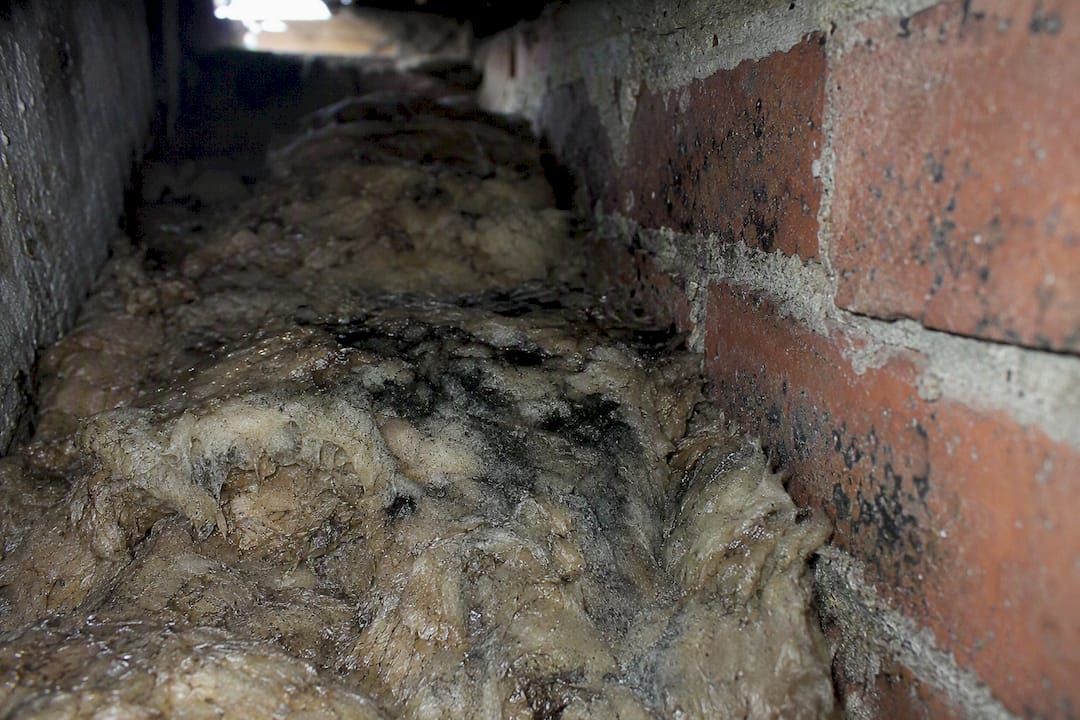
Not every flooded cavity needs extraction. The decision should rest on evidence gathered during the survey, not on how long the property was flooded or how the walls look from outside.
Extraction is generally justified where a survey confirms:
- Contamination — sewage, silt or hydrocarbons visible in the cavity, which RICS notes is common because cavity systems collect debris that is difficult to remove without opening the wall.
- Physical displacement — insulation slumping, collapse or gaps confirmed by borescope, leaving parts of the wall uninsulated.
- Sustained high moisture — readings that stay elevated after a reasonable drying period, or evidence that wall ties or the inner leaf are at risk.
- Manufacturer or warranty requirements — some insulation guarantees specify removal after particular flood exposure thresholds.
Pro Tip: Ask any contractor recommending extraction to show you the borescope footage or moisture log behind that recommendation, not just a verbal assessment.
How extraction works and how long it takes
Extraction technique depends on the insulation type. Blown mineral fibre is typically removed through vacuum extraction via drilled access points; bonded bead or foam systems often need mechanical breaking-up before removal. Whichever method applies, the cavity is left clean and open before any reinstatement is considered.
- Containment sheeting and dust control protect the property during removal.
- Contaminated material is bagged and disposed of in line with waste regulations, not tipped into general household waste.
- Once extracted, the cavity is left to dry and monitored before reinstatement, and an independent clearance inspection confirms the wall is fit for the next stage.
- For an average semi-detached property, survey through to clearance certificate commonly runs from a few days to a few weeks, depending on the extent of flooding, whether contamination is present, and access to affected walls.
Properties with restricted access, multiple elevations affected, or confirmed contamination will sit at the longer end of that range.
Contamination, health risks and drying considerations
Clean rainwater ingress and contaminated floodwater are not the same problem. Floodwater that has passed through drains, farmland or roads can carry sewage and chemical residue, which changes what remediation is required and who should carry it out.
- Where contamination is suspected, microbiological sampling or specialist decontamination may be needed before any drying strategy is agreed.
- Mould takes hold where moisture persists, not simply because spores are present; the trigger is sustained dampness, not the flood event itself.
- Occupants should avoid disturbing visibly contaminated material and bring in a competent remediation team where sewage contamination is confirmed.
- Laboratory tests on mineral wool batts found they can tolerate immersion, but drying a saturated cavity naturally may take up to two years without active dehumidification, according to Glasgow Caledonian University research sponsored by MIMA.
Managing your insurance claim after cavity flood damage
- Notify your insurer promptly and keep every piece of evidence: photographs, flood depth records, and access arrangements for the surveyor.
- Commission an independent condition survey so the scope of works is based on measured evidence, not a verbal estimate that risks under-specifying the job.
- Understand what insurers typically fund: extraction, drying, decontamination and reinstatement are usually covered; cosmetic upgrades or unrelated pre-existing damage usually are not.
- Keep the clearance certificate and survey report on file. Both matter for future resale, warranty claims, or if a dispute arises later.
Choosing the right insulation when reinstating a flooded cavity
Reinstatement should balance thermal performance against how the cavity will cope if flooding happens again, an approach RICS frames as property flood resilience.
- Mineral wool full-fill performs well thermally, though drying after future exposure can still be slow without help.
- Self-draining mineral wool slabs are designed to shed water rather than hold it, better suited to flood-prone walls.
- Closed-cell boards resist water uptake well but cost more and need careful installation to avoid cold bridging.
- In some cases, leaving the cavity clear or upgrading external wall insulation instead may be the more resilient choice.
- Repair brickwork, pointing and guttering before reinstating insulation, and confirm the cavity has an independent clearance certificate first. Energy Saving Trust advises checking exposure and cavity width before any insulation goes back in.
Why accredited inspection and certification protect property value
OSCAR Onsite authored the UK’s Level 2 NVQ qualifications in cavity wall insulation surveying and in extraction and clearance, the national benchmark for technical competence in this work. That matters because it means a surveyor’s findings and a contractor’s extraction work follow a documented, auditable standard rather than informal judgement.
- Accredited, NVQ-trained delivery gives insurers a trail of evidence they can trust rather than query.
- A clearance certificate records the pre-work condition, the scope of extraction, decontamination steps taken, and independent confirmation the cavity is fit for reinstatement.
A clearance certificate that documents condition, scope and post-work confirmation limits the disputes that surface months later, when a warranty claim or resale survey reopens the question of what was actually done.
Expert perspective: assess first, act second
Every dispute we see traces back to the same mistake: someone skipped the evidence and went straight to a fix. Inspection first, then a decision. Anything else is a guess dressed up as a repair.
Getting help with flood damaged cavity insulation
OSCAR Onsite exists for exactly the situation this article describes: floodwater in the cavity, uncertainty about what is inside, and a decision that needs to be defensible to an insurer. Rather than a contractor pushing straight to extraction, OSCAR Onsite’s approach starts with an independent CWI condition inspection survey, so the recommendation that follows is built on borescope footage and moisture readings, not a guess from the pavement.

Booking one means a site survey, a written report setting out observed evidence and a recommended scope, and where extraction proves necessary, work carried out by NVQ-trained, accredited teams finishing with an independent clearance inspection. If extraction turns out to be the right route, the cavity wall insulation extraction service follows the same evidence-led process through to a certificate an insurer can rely on. Get in touch to arrange a survey and find out exactly what your cavity needs, not what a quick look suggests it might.
Sources
- Approved Document C: Site preparation and resistance to moisture
- What makes modern buildings less resilient to flooding? — RICS
- Flooding and its implications for property professionals — RICS (C790 referenced)
- Cavity wall insulation — Energy Saving Trust
Recommended
- Wet cavity insulation removal: when to extract and who to call
- Blown insulation removal: when to act and how to get it right
- Cavity Wall Insulation Risk Check – Oscar Onsite
- Cavity wall insulation causing condensation: what to do
Our articles are a mix of human and automated generation, and sometimes mistakes or errors appear.
If you do spot any errors please do let us know via email to: office@oscar-onsite.co.uk