
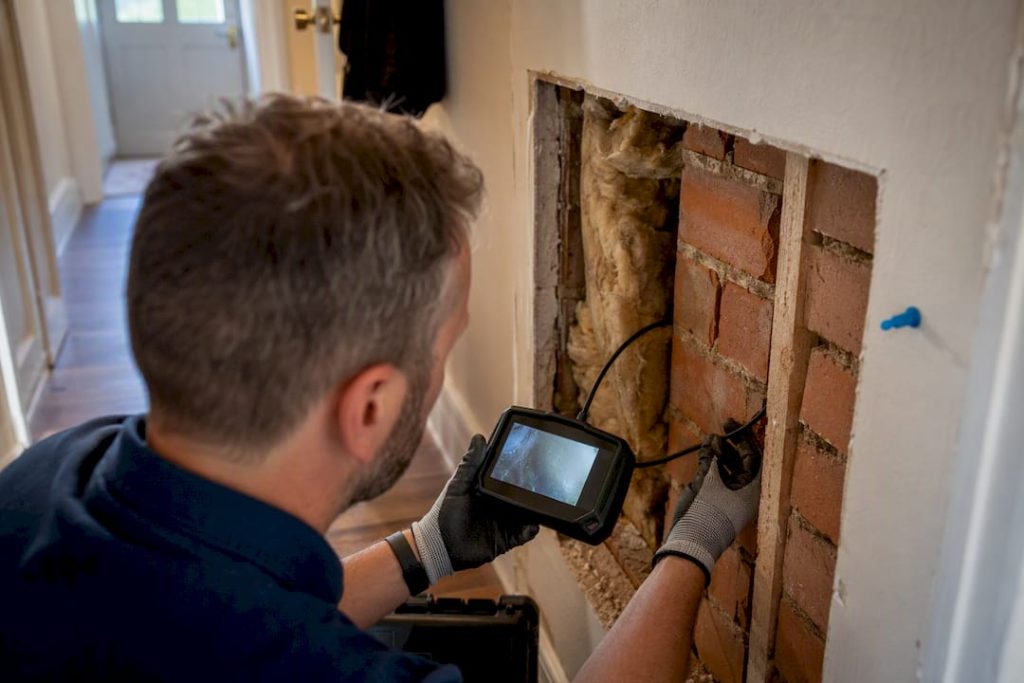
Landlords, not tenants, carry legal responsibility for damp and structural faults caused by failed cavity wall insulation, under both Section 11 of the Landlord and Tenant Act 1985 and the Homes (Fitness for Human Habitation) Act 2018. The moment a tenant reports damp, you must acknowledge it, commission an evidence-led inspection, and act on what it finds. Keep every report, photo and message on file. That paper trail is what separates a landlord who complied from one who guessed.
TL;DR:
- Landlords are legally responsible for repairing failed cavity wall insulation if it causes damp or structural issues, regardless of when installed or who fitted it.
- Evidence-led inspections, including moisture profiling and bore scope views, are essential before deciding on remedial action, not assumptions based on symptoms alone.
- A hazard of damp or mold from insulation failure can lead to enforcement action by local authorities or tenant claims for damages, emphasizing thorough documentation.
- Exemptions for wall insulation under energy standards do not protect landlords from habitability claims if current insulation fails and makes the property unfit for habitation.
- Using qualified, independent surveyors and maintaining detailed reports provides the best defense against legal and enforcement risks related to cavity wall issues.
Table of Contents
- What the law requires: Section 11, fitness for habitation and insulation-related damp
- How failed cavity wall insulation causes or worsens damp
- What to do when a tenant reports damp linked to cavity wall insulation
- MEES and the wall-insulation exemption: what landlords need to prove
- What a competent cavity wall inspection report should include
- Enforcement, tenant remedies and what happens if you don’t act
- Practical perspective: compliance as protection, not paperwork
- How OSCAR Onsite supports landlord compliance
- Sources
- FAQ
What the law requires: Section 11, fitness for habitation and insulation-related damp
Section 11 of the Landlord and Tenant Act 1985 obliges landlords to keep the structure and exterior of a rental property in repair. It applies to virtually every private residential tenancy granted for less than seven years, which covers the vast majority of assured shorthold tenancies in England and Wales. Crucially, this duty cannot be signed away. A clause telling tenants they are responsible for “structural maintenance” or “insulation upkeep” carries no legal weight. If the cavity wall system is part of the structure, and it is, repairing it sits with you.
The Homes (Fitness for Human Habitation) Act 2018 goes further. It requires rented homes to be free from hazards, including damp and mould, serious enough to make the property unfit to live in. Where a hazard like this persists, tenants can bring a claim for damages or a court order requiring you to fix it. That’s a direct financial exposure that sits alongside the reputational cost of a disrepair dispute.
Local authorities enforce a separate but overlapping standard: the Housing Health and Safety Rating System (HHSRS). Inspectors assess hazards, including damp and excess cold, and categorise them by severity.
- Category 1 hazards trigger a mandatory duty for the council to act, often through an improvement notice.
- Category 2 hazards give the authority discretion to intervene, but they can still do so.
- Excess cold linked to poor insulation performance can itself register as a hazard, meaning MEES and HHSRS obligations frequently overlap.
None of this means every damp patch is automatically a landlord’s fault by default. It means the investigation has to happen, and it has to happen properly. Our guide to landlord damp duties sets out where tenant behaviour ends and structural responsibility begins.
How failed cavity wall insulation causes or worsens damp
Cavity wall insulation is designed to sit dry, undisturbed, and fully filling the gap between the two skins of a wall. When it fails, it usually fails in one of a handful of recognisable ways.
- Saturation: insulation material absorbs water from a defect elsewhere (a cracked render, a leaking gutter, a missing weep vent) and then transmits moisture across the cavity to the inner leaf.
- Bridging: debris, mortar snots, or poorly installed fill create a path across the cavity that lets water track from outside to inside.
- Partial fills or gaps: settlement or substandard installation leaves voids, and cold spots form where insulation should be, encouraging condensation on the internal wall.
- Blocked cavities: debris or collapsed material blocks drainage at the base of the wall, so any moisture that does get in has nowhere to go.
Distinguishing a structural cause from tenant behaviour matters, and it is not something you can do by eye. Damp confined to a corner near a badly ventilated bathroom, worsening after cold spells with no rain, points towards condensation from lifestyle factors. Damp that tracks in a horizontal band, follows a pattern across several rooms on the same external wall, or worsens noticeably after heavy or wind-driven rain is a stronger indicator of a CWI-related problem, though it still needs verification rather than assumption. Failed insulation is more commonly reported in properties where the fill was installed in the 1990s or 2000s, when quality control across the retrofit sector was less consistent than it is under current standards.
The legal principle that trips up most landlords: it does not matter who installed the insulation, or when. If a previous owner had it fitted twenty years ago and it has since failed, the repair obligation sits with whoever is the landlord today. There is no grandfather clause for structural defects. This is a common misunderstanding of “tenant-like manner” duties, which cover things like changing light bulbs and keeping drains clear, never structural failure.
Pro Tip: Don’t diagnose damp from symptoms alone. A cold external wall and peeling wallpaper can mean condensation, a leaking cavity, or both at once. Only an evidence-led inspection distinguishes the cause reliably enough to justify remedial spend.
What to do when a tenant reports damp linked to cavity wall insulation
- Acknowledge the report in writing, immediately. Ask the tenant to photograph the affected areas, note when the damp appears worse, and flag anything relevant, like recent heavy rain or a nearby leak.
- Commission an evidence-led inspection. A competent survey should specify its scope in advance: borescope access into the cavity, moisture readings at multiple points, and a photographic record. Don’t accept a verbal opinion in place of a written report.
- Interpret the findings before deciding on remedial action. A report showing localised condensation might point to ventilation improvements or targeted repointing. A report confirming saturated or bridged insulation across a wider area points towards extraction. Extraction should never be the default response before independent assessment confirms it is warranted.
- Set a realistic timeline and communicate it. There’s no statutory timescale for private landlords investigating damp in the way Awaab’s Law sets for social housing, but its triage principles are a sound benchmark. Awaab’s Law phase 2 guidance expects social landlords to assess ventilation, insulation and thermal performance promptly once a significant hazard is suspected, and private landlords who apply the same discipline are far better placed if a dispute ever reaches a court or tribunal.
- Escalate where needed. Notify your insurer if the damp may relate to a structural defect covered under your policy, and involve the local authority’s environmental health team if you cannot resolve the matter promptly or the tenant raises a formal complaint.
Awaab’s Law does not yet apply to private tenancies, but its underlying triage logic—assess quickly, escalate significant hazards, and don’t leave a health risk unaddressed while you deliberate—is the standard a court is likely to expect from any responsible landlord regardless of tenure type.
If communication with a tenant has already turned formal, a well-structured response matters. Guidance on drafting a measured complaint response can help keep that exchange professional and on the record.
MEES and the wall-insulation exemption: what landlords need to prove
Minimum Energy Efficiency Standard (MEES) rules generally require rental properties to meet a minimum EPC rating, but a specific exemption exists for wall insulation measures. If the only outstanding improvement recommended for your property is cavity, external or internal wall insulation, you can register an exemption, provided you hold written expert advice confirming the insulation would negatively affect the fabric of the building.
That written opinion cannot come from just anyone. Acceptable sources include:
- Architects, chartered engineers, chartered building surveyors or chartered architectural technologists, particularly those on conservation-accredited registers where the property has traditional or solid-wall characteristics.
- Installers meeting the competency standards set out in Schedule 3 to the Building Regulations 2010.
Once registered on the PRS Exemptions Register, the exemption lasts for a limited period after which it will expire. It does not renew automatically, and a new landlord must register their own exemption if applicable.
An exemption on the register solves an energy-efficiency compliance problem. It solves nothing about a hazardous damp problem. If failed cavity insulation is making a property unfit to live in under the 2018 Act, holding a MEES exemption gives you no defence against a habitability claim. The two obligations run on entirely separate tracks, and treating one as a substitute for the other is the single most common compliance mistake landlords make in this area. Our MEES-focused guide to surveying before insulating covers this distinction in more depth.
What a competent cavity wall inspection report should include
An inspection is only as useful as its methodology, and a landlord commissioning one should know what to expect before the surveyor arrives.
- Borescope access: a small camera inserted through a drilled port lets a surveyor view the cavity’s actual condition, fill density, moisture staining, debris. It gives direct visual evidence, not an inference.
- Thermal imaging: this identifies surface temperature variation across a wall, which can indicate cold spots consistent with voids or moisture. It does not see inside the cavity itself, it flags surface anomalies worth investigating further with direct access methods.
- Moisture profiling: readings taken at multiple heights and locations build a pattern that either supports or rules out cavity-related saturation.
- Wall-tie checks and sampling: corroded wall ties or degraded fill samples add physical evidence to the visual and thermal findings.
A credible report states its scope, lists every method used, and presents findings as evidence rather than certainty, phrases like “consistent with” or “indicates a probability of” are appropriate; a flat diagnosis from photographs alone is not. It should include a photographic archive, a clear set of remedial options with rough timescales, and enough detail that a second surveyor could reach the same conclusion independently. OSCAR Onsite’s condition inspection survey is built around this evidence-first structure.
Pro Tip: If remedial work does go ahead, insist on independent post-remediation inspection and certification, not just a contractor’s own sign-off. Work carried out to PAS 2030:2023 and BS 8104, by a TrustMark-registered installer, gives you a certificate you can produce years later if a dispute or a sale ever raises the question again.
Enforcement, tenant remedies and what happens if you don’t act
Where a local authority identifies a category 1 hazard under HHSRS, it must act. In practice, that usually starts with an improvement notice giving you a set period to carry out specified works, which can extend to requiring insulation or heating improvements where excess cold is the hazard. Ignore a notice and the council can carry out the work itself and recover the cost from you, or in more serious cases, prosecute.
Tenants have their own separate route. Under the Homes (Fitness for Human Habitation) Act 2018, they can bring a disrepair claim directly, seeking damages or a court order compelling repairs, without waiting for the council to intervene at all.
- Improvement notices and prohibition orders sit with the local authority.
- Disrepair claims, damages and court-ordered works sit with the tenant, independently of any council action.
- Compensation becomes more likely where a landlord has been notified, given reasonable time to act, and has still failed to remedy a confirmed hazard.
The strongest protection against either route is the paperwork you generate along the way: the tenant’s original report, your written acknowledgement, the inspection report, and evidence of remedial work completed. A landlord who can show a reasoned, evidenced process is in a fundamentally different position from one who can only show they ignored a complaint.
Practical perspective: compliance as protection, not paperwork
Too many landlords treat damp reports as a nuisance to manage rather than a signal to investigate. That’s backwards. An early, evidence-led inspection is cheaper than a disrepair claim, and it protects the asset as much as it protects the tenant.
The habit worth building is simple: don’t guess, and don’t let a MEES exemption lull you into thinking a habitability question has been answered. Use independent, accredited surveyors, keep every report, and treat the triage discipline behind Awaab’s Law as a sensible private-sector standard even though it isn’t yet a legal requirement for you. It costs little now and it’s the difference that matters if a claim ever lands on your desk.
— Alan
How OSCAR Onsite supports landlord compliance
OSCAR Onsite is the option for landlords who want the diagnosis done properly before spending a penny on remediation, not a contractor guessing from the outside. Independent surveyors use borescope access and moisture profiling to establish what’s actually happening inside the cavity, rather than a sales-driven recommendation to extract everything on sight.

The service range covers the full compliance chain: a CWI condition inspection survey to establish the evidence base, extraction and clearance where the survey confirms it’s warranted, and clearance certification you can retain as proof of compliant remedial work if a tenant, insurer, or buyer’s solicitor ever asks. Every stage follows PAS 2030:2023 and BS 8104 standards, with TrustMark-aligned practice behind the accreditation. Landlords managing several properties, or contractors wanting to build this expertise in-house, can also explore NVQ training and accreditation through OSCAR Onsite’s academy. If a tenant has already raised a damp report, book a condition survey now, before deciding what, if anything, needs to come out of the wall.
This article is general information, not a substitute for advice from a qualified lawyer. Consult a qualified legal professional about your own circumstances before acting on anything here.
Sources
FAQ
What is the legal requirement for cavity wall insulation?
There’s no legal requirement to install cavity wall insulation, but where it exists and fails, Section 11 of the Landlord and Tenant Act 1985 requires the landlord to repair the resulting structural defect.
What are the new rules for landlords in 2026?
There’s no single new statute changing cavity insulation duties directly, but Awaab’s Law’s phase 2 hazards guidance continues to shape expectations around damp investigation timescales, and private landlords who apply its triage logic voluntarily are better protected against disrepair claims.
What do landlords legally have to provide?
Landlords must keep the structure and exterior in repair under Section 11, and keep the property free from hazards like damp and mould under the Homes (Fitness for Human Habitation) Act 2018; an evidence-led inspection survey is a practical way to meet that duty when insulation failure is suspected.
What are the regulations for insulation in the UK?
Insulation itself isn’t separately regulated for existing rented homes, but MEES sets a minimum energy efficiency standard, with a specific wall-insulation exemption available where written expert advice confirms insulation would harm the building’s fabric.
Can a tenancy agreement make the tenant responsible for cavity wall insulation?
No. Structural repair duties under Section 11 cannot be transferred to a tenant by contract, regardless of what a tenancy agreement states.
Recommended
- Avoid MEES Risk: Survey First Cavity Wall Insulation for UK Landlords
- Avoid Legal Risk: UK Landlords’ Damp Duties and Cavity Wall Guidance
- Failed cavity insulation insurance claim: what to do first
- Check UK Cavity Wall Installer Accreditation and When to Order a Survey
Our articles are a mix of human and automated generation, and sometimes mistakes or errors appear.
If you do spot any errors please do let us know via email to: office@oscar-onsite.co.uk