TL;DR:
- If mold is behind wallpaper on external walls, an independent cavity wall insulation condition inspection is essential before any work begins. Simply attempting surface treatments without verifying the cause risks ongoing health hazards and property damage.
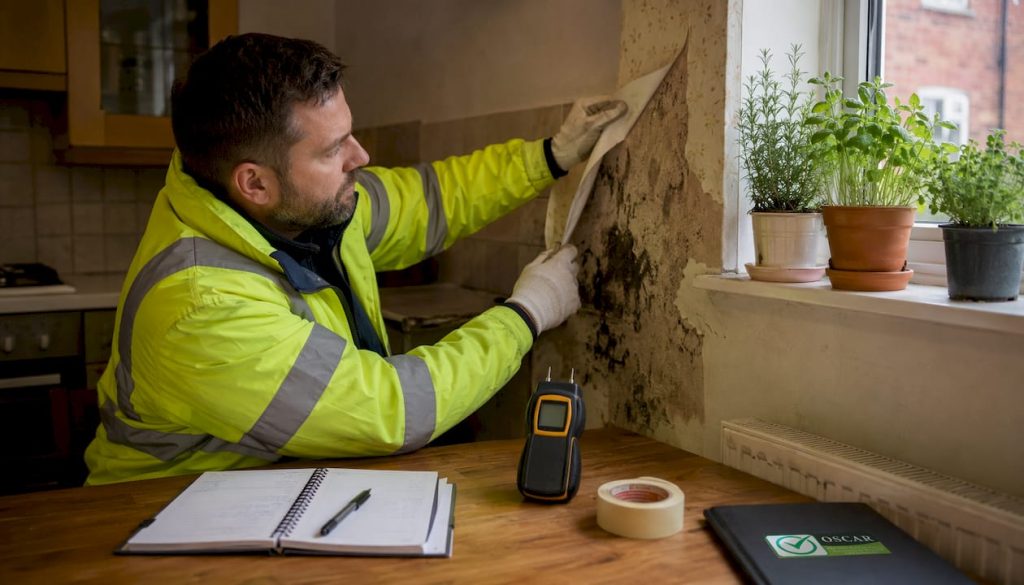
If you find mould behind wallpaper, stop all redecoration immediately, ventilate the room where safe, and arrange an independent CWI condition inspection before touching anything further. GOV.UK guidance is explicit: disturbing concealed mould releases spores and should only be done with appropriate protective equipment or by a trained professional. When the affected wall is external, cavity wall insulation (CWI) failure is a credible cause and must be ruled out by evidence before any remedial work begins.
Immediate steps:
- Stop stripping wallpaper or sanding surfaces near the affected area.
- Close the room off from the rest of the property where possible.
- Open a window for ventilation, but avoid creating a draught that carries spores through the building.
- If you must briefly inspect the area, wear an FFP2 or FFP3 respirator, nitrile gloves, and disposable overalls.
- Photograph the affected area, including edges, scale, and the external elevation, before anything is disturbed.
- Book an independent OSCAR CWI Condition Inspection Survey, or find an accredited member firm to carry out the assessment.
Pro Tip: Do not accept a same-day extraction quote from the contractor who first inspects your wall. Independent diagnosis must come before any decision to extract.
Table of Contents
- Why mould behind wallpaper is a serious health and building risk
- How to check whether mould is surface-level or caused by deeper damp
- Signs that cavity wall insulation failure is causing the mould
- What a professional CWI condition inspection involves
- Remediation options: from surface treatment to full extraction
- Typical costs and how long remediation takes in the UK
- How to choose a contractor or surveyor: questions to ask
- Key takeaways
- Why independent surveying is the only safe starting point
- OSCAR Onsite: independent inspection, accredited extraction, and clearance certification
- Authoritative UK sources and further reading
Why mould behind wallpaper is a serious health and building risk
Concealed mould is not a cosmetic problem. Around one in three homes in England experience damp and mould, and exposure is linked to thousands of asthma and chest infection cases each year. Children living in a damp home are up to three times more likely to develop breathing problems. Airborne spores can trigger aspergillosis and other respiratory conditions, particularly in children under 14, older people, pregnant women, and anyone immunocompromised.
Beyond health, persistent moisture behind wall coverings degrades plaster, weakens timber joinery, and spreads mould spores to adjacent rooms if the moisture source is not resolved. Wallpaper slows evaporation, so damage accumulates silently for months before it becomes visible.
Vulnerable groups to prioritise:
- Children and infants
- People with asthma, COPD, or other lung conditions
- Older adults and pregnant women
- Anyone on immunosuppressant medication
Pro Tip: If anyone in the household has asthma triggered by mould, do not attempt cleaning yourself. Contact a mould remediation specialist and, if the wall is external, commission a CWI condition inspection first.
How to check whether mould is surface-level or caused by deeper damp
Use a staged diagnostics approach before commissioning any work. The goal is to distinguish condensation mould from penetrating damp or CWI failure, because the remedies differ completely.
- Visual inspection. Look for peeling or lifting wallpaper, bubbling paint, dark speckling through the paper, yellow-brown tide marks, and blown or hollow-sounding plaster. Pay particular attention to external walls, cold corners, and areas behind furniture.
- Smell. A persistent musty or earthy odour in one part of a room, even without visible growth, can indicate concealed mould behind surfaces.
- Moisture meter. A pinless meter gives a quick surface reading; a pin meter gives depth. Readings consistently above 20% moisture content on an external wall warrant further investigation.
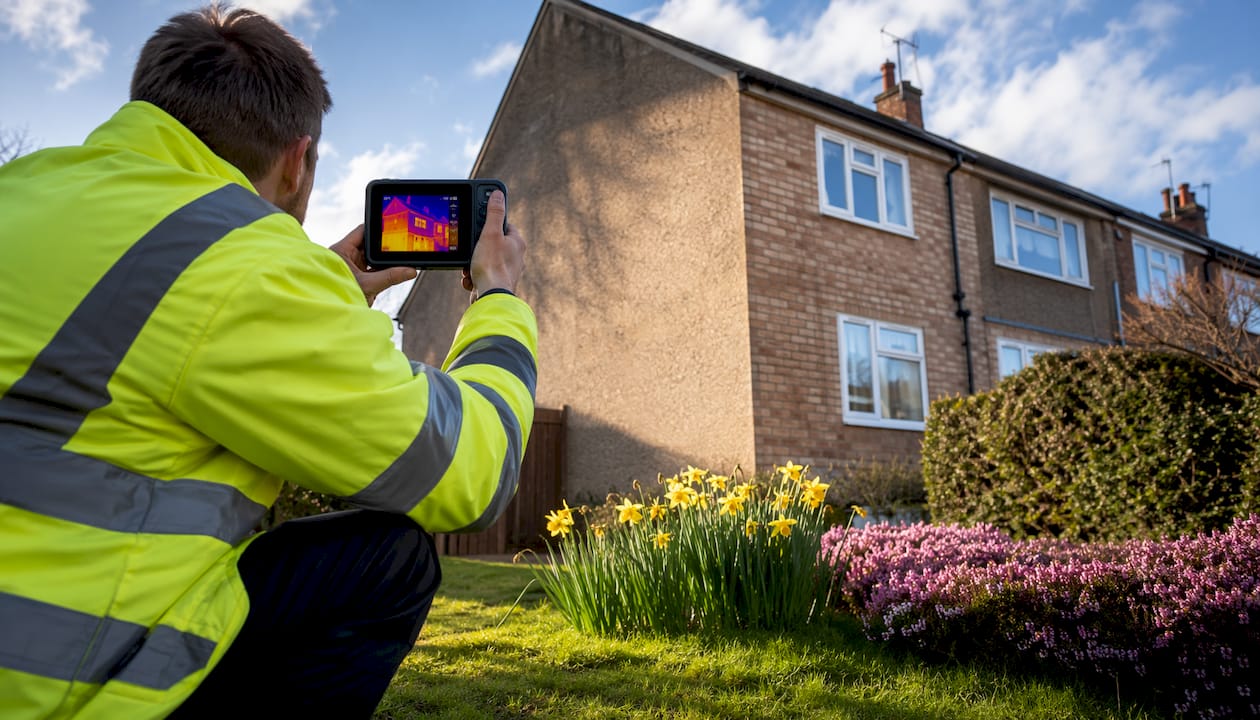
- Thermal imaging. A thermal camera identifies cold spots on the inner leaf where insulation has failed or moisture is bridging. Cold bridging is a strong indicator of CWI involvement.
- Borescope inspection. A borescope-led cavity inspection is the clearest way to confirm whether insulation is wet, compressed, or debris-bridged. This should be part of any formal CWI condition inspection.
- Hygrometer reading. Measure relative humidity in the room. Sustained readings above 70% RH create conditions where condensation mould is likely; lower RH with persistent wall damp points toward penetrating damp or CWI failure.
- Lab sampling. Where the mould species matters for health decisions, a trained professional can take swab or tape-lift samples for laboratory analysis.
Photograph the pattern: capture the edges, scale, and the corresponding external elevation. A dated photographic record supports both surveyor assessment and any subsequent insurance claim.
Pro Tip: Never brush or dry-wipe mould to get a better look. It releases spores. Use a damp cloth if you must touch the surface, and bag it immediately.
Signs that cavity wall insulation failure is causing the mould
CWI involvement is likely when mould appears on external walls regardless of how well the room is ventilated, when damp patches sit higher than skirting level, or when symptoms emerged shortly after insulation was installed or topped up. Mould from insulation-related damp will not resolve with internal surface treatments while the moisture source remains active.
Characteristic signs of CWI failure:
- Damp patches spread across large areas of an external wall, not concentrated at one point.
- Damp appears higher up the wall, not just near the floor.
- Cold inner leaf surfaces detected by hand or thermal camera.
- The pattern of damp mirrors the external elevation, including areas above window lintels.
- Symptoms began or worsened after cavity insulation work.
- Efflorescence (white salt deposits) on internal plaster, indicating water movement through the wall.
Common failure mechanisms include moisture bridging from wind-driven rain saturating mineral fibre insulation, compression or settlement of insulation over time, debris bridging across the cavity, and missing cavity trays or weep holes that allow water to track inward.
An independent borescope-led cavity inspection is the only reliable way to confirm whether insulation is wet, bridged, or contaminated. Without that evidence, any extraction decision is guesswork — and unnecessary extraction is both costly and disruptive.
Pro Tip: If your property had CWI installed under a government scheme before 2015, check whether the installation was appropriate for your wall exposure zone. Many failures stem from insulation being fitted in walls too exposed for the material used.
What a professional CWI condition inspection involves
A proper inspection is staged, evidence-led, and non-destructive wherever possible. It culminates in a condition report that supports a clear, defensible decision on whether extraction is warranted.
- Survey history and initial assessment. The surveyor reviews the property’s insulation history, any previous works, and the occupant’s account of when symptoms began.
- Visual inspection and moisture mapping. Systematic recording of damp indicators across all external elevations, with moisture meter readings at defined grid points.
- Thermal imaging. Identifies cold bridging, insulation voids, and areas of suspected moisture ingress.
- Targeted borescope inspection. Small-diameter camera access through the outer leaf to view cavity conditions directly.
- Sample taking. Where contamination or specific material identification is needed, cavity samples are taken for laboratory analysis.
- Condition report. The written report includes moisture readings, thermal images, borescope imagery, cavity sample findings, a risk rating, and recommended next steps.
What the report should contain:
- Dated moisture readings and thermal images
- Borescope photographs with location references
- Cavity sample analysis results where applicable
- A clear recommended risk rating
- Recommended next steps: surface treatment, drying, or extraction
OSCAR Onsite’s CWI Condition Inspection Survey delivers exactly this evidence base. Independent inspection matters for consumer protection and for insurance claims: insurers and housing providers commonly require a documented inspection report and a clearance certificate before accepting a claim or approving redecoration.
Remediation options: from surface treatment to full extraction
Surface remediation only succeeds if the moisture source is resolved first. When CWI is wet or bridging moisture to the inner leaf, extraction is usually required before any surface treatment will hold.
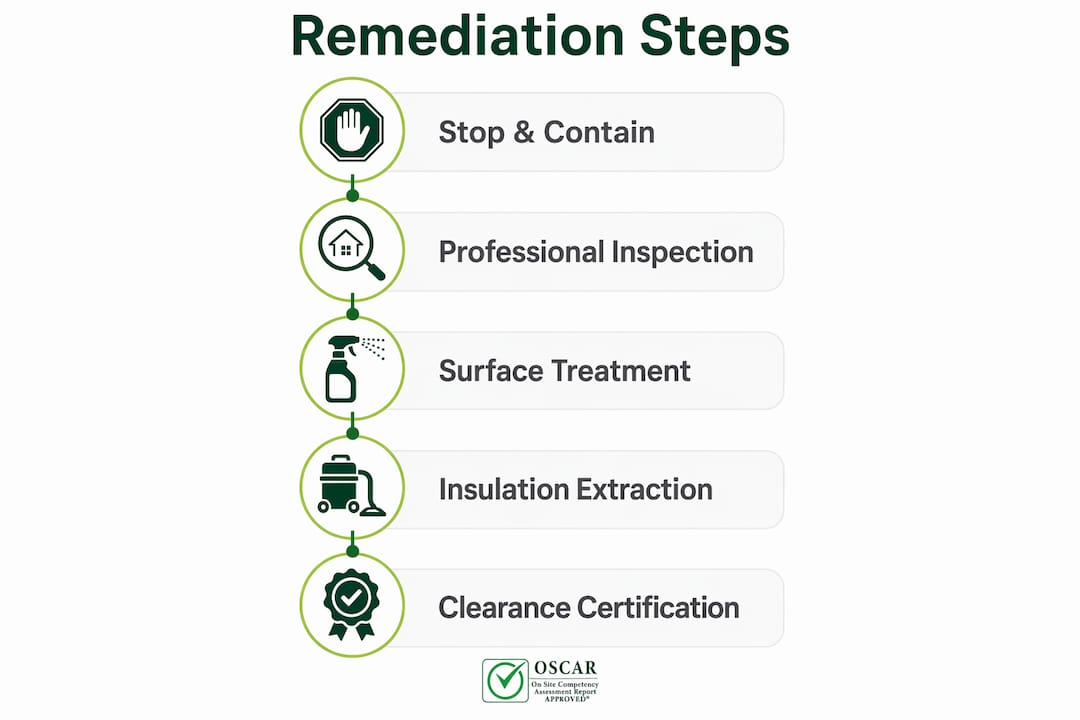
- Contain and protect. Seal the affected room, use PPE, and do not disturb the wallpaper further.
- Surface mould treatment. A biocide wash or encapsulation product treats visible surface growth as a temporary measure only. It does not address the moisture source.
- Drying strategy. Industrial dehumidifiers, targeted heating, and controlled ventilation reduce moisture content in the wall structure. This is a prerequisite for any lasting repair.
- Extraction (where required). Removal of saturated insulation by an OSCAR Onsite Accredited Member Firm, followed by cavity cleaning and drying. This is the only permanent solution when CWI is the moisture source.
- Clearance testing and certification. Independent technical monitoring confirms drying is complete and the cavity is clear before redecoration begins.
| Stage | Typical duration | Notes |
|---|---|---|
| Surface biocide treatment | 1–3 days | Temporary; moisture source must be resolved separately |
| Drying after surface treatment | 4–8 weeks | Depends on wall construction and ambient conditions |
| Extraction works | 1–3 days per elevation | Varies by property size and access |
| Drying after extraction | 6–8 weeks | Longer in winter or north-facing walls |
| Clearance certification | 1 day (post-drying) | Required before redecoration |
Pro Tip: Do not redecorate until a clearance certificate confirms the wall has dried to acceptable moisture levels. Decorating over residual moisture guarantees the problem returns.
Typical costs and how long remediation takes in the UK
Costs vary considerably depending on whether extraction is needed, the size of the affected elevation, and the property type. Precise costs require a survey.
Finance and insurance tips:
- OSCAR Onsite offers extraction finance options for homeowners who cannot fund extraction upfront.
- Notify your buildings insurer before commissioning extraction; some policies cover CWI failure damage.
- Keep all survey reports, moisture readings, and clearance certificates. Insurers and letting agents require this documentation.
- Allow 8–20 weeks from extraction to redecoration, depending on season and wall orientation.
Pro Tip: An independent condition inspection typically costs a fraction of an unnecessary extraction. Always get the survey first.
How to choose a contractor or surveyor: questions to ask
Choose providers who offer independent condition inspections, evidence-led reports, and independent clearance certification. Do not accept a sales-first extraction quote from a contractor who has not produced a written inspection report.
Questions to ask before appointing anyone:
- Do you provide an independent written condition report before recommending extraction?
- Are your surveyors qualified to NVQ Level 2 in CWI Surveying and Inspection?
- Will you carry out borescope inspection and provide photographic evidence?
- Do you offer independent technical monitoring during extraction?
- Will you issue an independent clearance certificate after works are complete?
- Are you an OSCAR Onsite Accredited Member Firm?
- Can you provide proof of professional indemnity and public liability insurance?
Red flags:
- Pressure to agree to extraction on the same day as the initial visit.
- Refusal to allow an independent inspection before works begin.
- No written condition report, moisture map, or borescope imagery.
- Vague or verbal-only clearance confirmation with no certificate.
- No mention of PAS 2030, TrustMark, or NVQ-qualified operatives.
If a contractor cannot show you a borescope image of your cavity and a written moisture map, they have not inspected your wall — they have guessed. Do not pay for extraction on the basis of a guess.
Guidance on healthier building practices also recommends selecting materials and detailing that minimise moisture retention behind finishes, which is relevant when specifying reinstatement after extraction.
Key takeaways
Mould behind wallpaper on an external wall requires an independent CWI condition inspection before any extraction or invasive works are commissioned.
| Point | Details |
|---|---|
| Stop and contain first | Do not strip wallpaper or disturb mould; ventilate safely and use PPE if you must inspect briefly. |
| CWI failure is a credible cause | Damp on external walls regardless of ventilation, or damp higher than skirting level, warrants a borescope-led cavity inspection. |
| Independent inspection before extraction | An OSCAR CWI Condition Inspection Survey produces the evidence needed to justify extraction and protects against unnecessary works. |
| Clearance certificate is non-optional | Insurers and housing providers require documented drying evidence and an independent clearance certificate before redecoration. |
| OSCAR Onsite pathway | Independent condition inspection → OSCAR Onsite Accredited Member Firm for extraction → independent technical monitoring and clearance certification. |
Why independent surveying is the only safe starting point
The industry has a well-documented problem: sales-led extraction. A contractor who profits from removing insulation has an obvious interest in recommending removal, regardless of whether the evidence supports it. Borescope evidence and moisture mapping, carried out independently, are what distinguish a wall that genuinely needs extraction from one that needs improved ventilation and a biocide wash.
OSCAR Onsite authored the UK’s first NVQ Level 2 qualifications in CWI Surveying and Inspection and in CWI Extraction and Clearance, raising National Occupational Standards across the sector. The CWI Surveyor Awareness Course is recognised by RICS surveyors, building surveyors, DEAs, retrofit professionals, housing providers, mortgage lenders, and conveyancing solicitors. That training framework exists precisely because too many extraction decisions have been made without adequate evidence.
The recommended pathway is straightforward: independent condition inspection first, extraction only where the evidence supports it, and independent technical monitoring and clearance certification before the wall is redecorated. Skipping any step in that sequence leaves occupants at risk and property owners without the documentation they need for insurance or lettings compliance.
OSCAR Onsite: independent inspection, accredited extraction, and clearance certification
When mould appears on an external wall and cavity wall insulation is a possible cause, OSCAR Onsite provides the independent starting point the situation requires.
A CWI Condition Inspection Survey from OSCAR Onsite delivers a full evidence base: moisture mapping, thermal imaging, borescope photography, and a written condition report with a clear risk rating and recommended next steps. Where extraction is justified, OSCAR Onsite connects you with an accredited member firm operating to PAS 2030:2023 and TrustMark standards. After extraction, an independent clearance certificate confirms the cavity is dry and the wall is ready for redecoration. For professionals seeking formal qualifications, OSCAR Onsite’s NVQ training courses set the national benchmark for the sector.
Book your independent CWI Condition Inspection Survey at oscaronsite.co.uk or use the find-a-member directory to locate an accredited firm in your area.
Authoritative UK sources and further reading
- GOV.UK: Understanding and addressing the health risks of damp and mould — primary guidance for landlords and housing providers on legal responsibilities and safe practice.
- GOV.UK: Respiratory conditions caused by airborne allergens — clinical context for mould-linked respiratory illness.
- NHS Manchester Foundation Trust: Damp and mould in the home — public-health information on prevalence and vulnerable groups.
- Healthier Together NHS: Damp and mould — guidance on children’s health risks in damp homes.
- OSCAR Onsite: CWI Condition Inspection Survey — independent survey and condition reporting service.
- OSCAR Onsite: Cavity Wall Extraction Clearance Certificate — independent clearance certification after extraction.
- OSCAR Onsite: Property Condition Report — wider property condition reporting for insurance and lettings compliance.
Keep all survey reports, moisture readings, thermal images, and clearance certificates. They are the evidence base for insurance claims, lettings compliance under the Homes (Fitness for Human Habitation) Act 2018, and any future sale or remortgage of the property.