
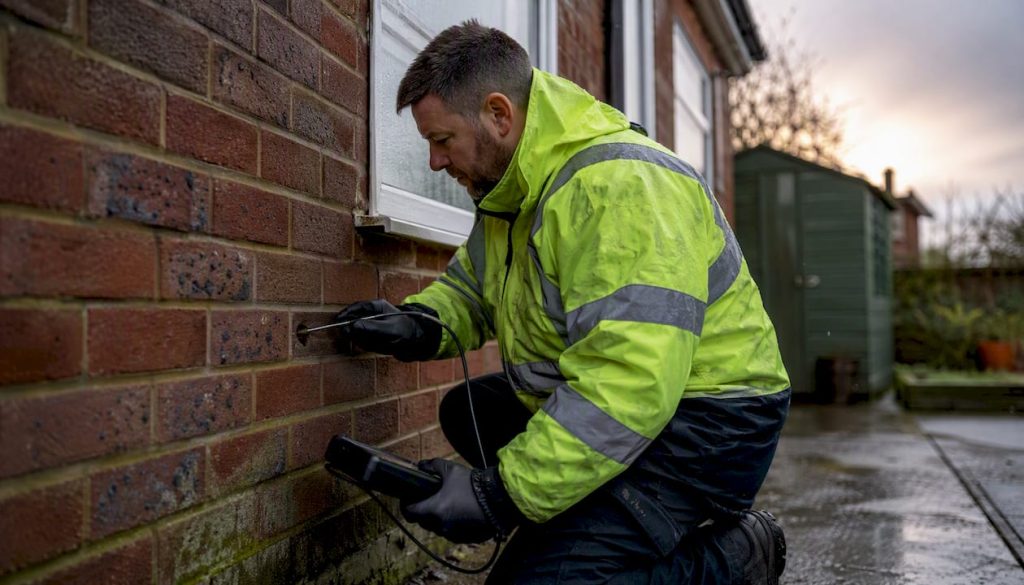
For most UK new-build and low-exposure retrofit projects, full-fill mineral wool is the simpler, more forgiving choice; partial-fill PIR boards are the better option where cavity width is limited, thermal targets are demanding, or where a residual clear cavity is required for moisture management in moderate-to-severe exposure zones. Before committing to either method, or to any extraction of existing insulation, commission an independent CWI Condition Inspection Survey from OSCAR Onsite.
Three quick checks you can do right now:
- Cavity width: measure or confirm from build records. A 100mm cavity typically suits full-fill mineral wool; 125mm or 150mm cavities open up both options.
- Exposure zone and building height: check your postcode against BS 8104 or NHBC exposure maps. Buildings over 12m or in severe/very severe zones generally require partial fill with a 50mm+ residual cavity.
- Fire risk: confirm whether the building requires non-combustible or limited-combustibility materials under Approved Document B, which affects whether PIR boards are appropriate.
Table of Contents
- What is full-fill cavity wall insulation?
- What is partial-fill cavity wall insulation?
- Head-to-head: how the two methods compare
- Practical installation requirements and how to avoid common errors
- What regulations and certifications should you check?
- How to choose between partial fill and full fill
- How to assess an existing cavity wall and when extraction is needed
- Why an OSCAR Onsite CWI Condition Inspection matters
- Key takeaways
- The survey-first principle: a perspective from the field
- Independent cavity wall surveys from OSCAR Onsite
- Useful sources and verification references
What is full-fill cavity wall insulation?
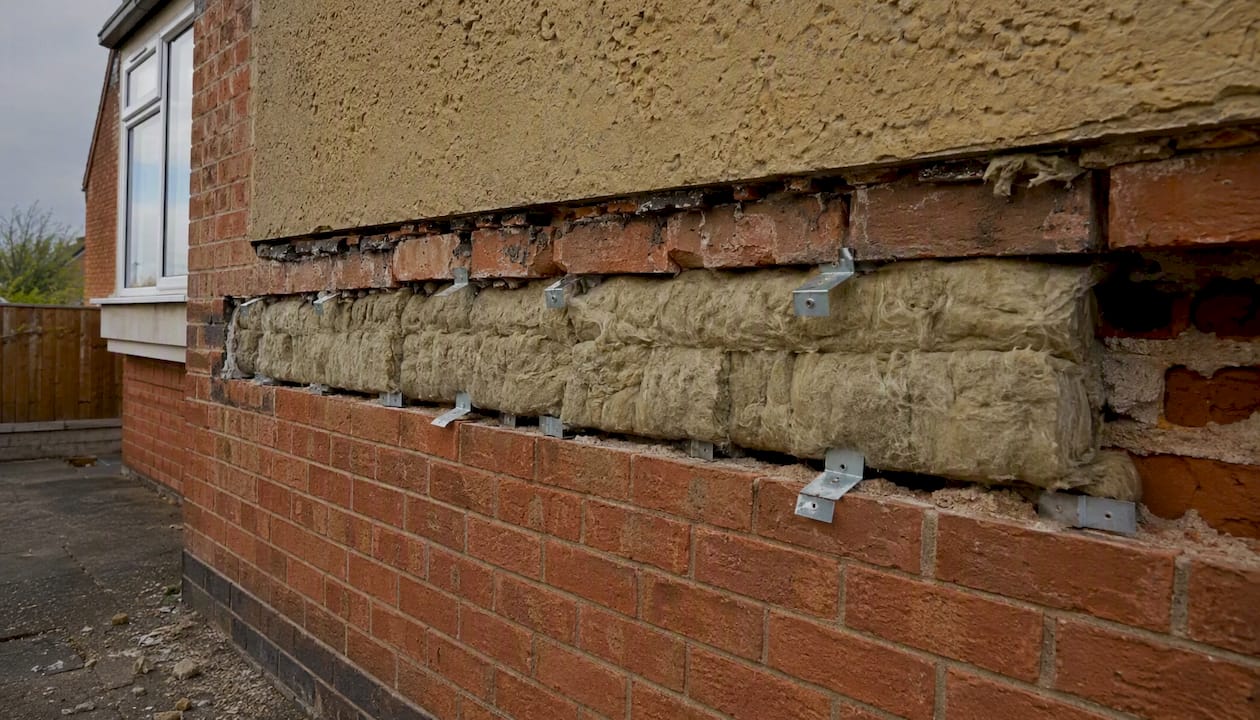
Full-fill cavity wall insulation means the insulation material occupies the entire width of the cavity, leaving no residual clear gap between the insulation and the outer leaf. The cavity is completely filled, wall tie to wall tie.
Common materials
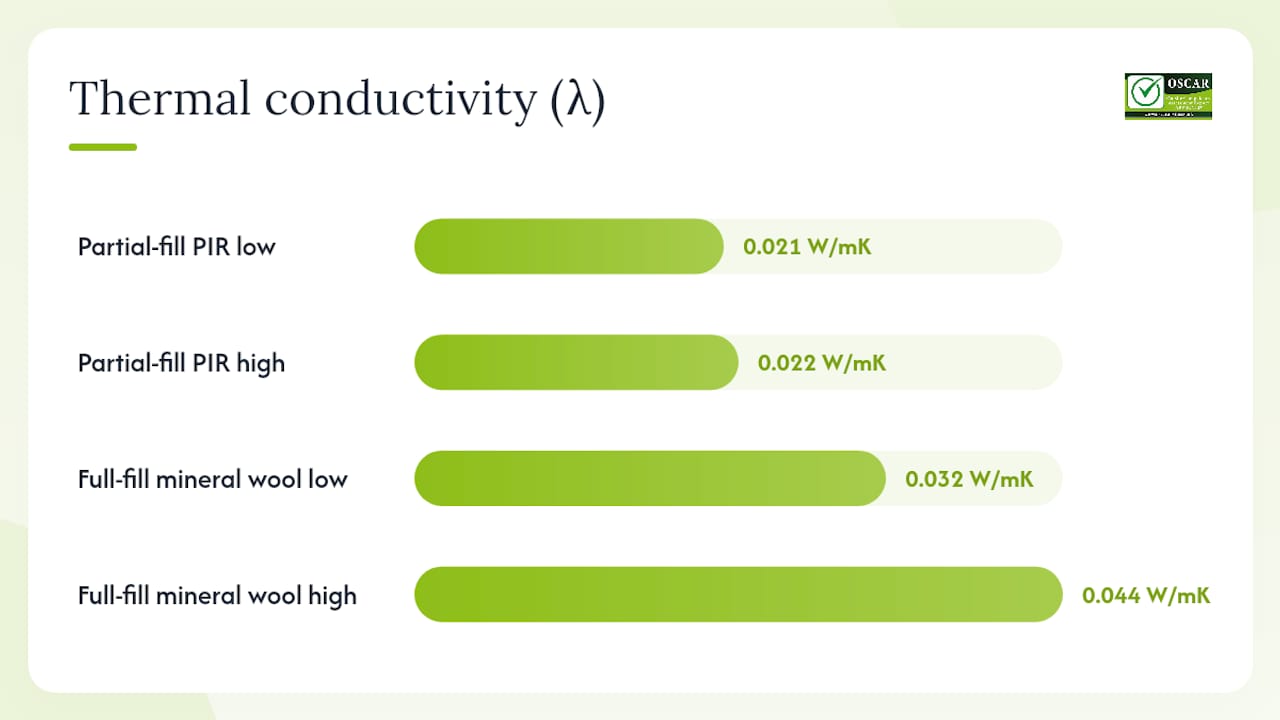
The most widely used full-fill products in the UK are mineral wool batts, available as glass wool (such as Isover CWS 32) or stone wool (such as Knauf DriTherm). Both are friction-fitted between the inner and outer leaves during construction or, in retrofit situations, blown or injected into the cavity. Mineral wool is non-combustible, classified Euroclass A1 or A2, and carries BBA certification for cavity wall use. Manufacturers publish Declarations of Performance (DoP) confirming declared thermal conductivity (lambda) values, typically in the range of 0.032–0.044 W/mK depending on product grade and density.
More recently, manufacturers have developed rigid full-fill PIR boards with rebated or tongue-and-groove edge profiles designed to fill the cavity completely while maintaining board-to-board continuity. These are a different product category from partial-fill PIR boards and must be verified against their own DoP and BBA certificate scope before use.
How full-fill is installed
For mineral wool batts, installation during new build involves placing friction-fit slabs between the leaves as the outer skin rises, with wall ties set to the correct length for the cavity width. The batts should be cut accurately to avoid compression or voids, and wall ties must be positioned to pass through the batt without displacing it. In retrofit, blown mineral wool or polystyrene beads are injected through drilled holes in the outer leaf, though blown products carry a different risk profile and are outside the scope of this guide.
- Verify wall-tie length matches total cavity width (inner leaf + insulation + outer leaf).
- Use only products with a current BBA certificate and a DoP confirming the declared lambda.
- Check Euroclass rating: mineral wool is non-combustible (A1/A2); full-fill rigid foam boards are not, and their fire classification must be confirmed separately.
- Confirm exposure zone suitability before specifying full fill: Approved Document C and NHBC guidance restrict full-fill use in severe and very severe exposure zones.
Advantages and limitations
Mineral wool full-fill is tolerant of minor site imperfections. Small gaps or slightly uneven batt placement are less catastrophic than in partial-fill systems because there is no residual cavity to protect. Installation is straightforward for a competent bricklayer, and the non-combustible nature of mineral wool simplifies compliance with Approved Document B.
The significant limitation is moisture management. Removing the residual clear cavity means rain-driven moisture that penetrates the outer leaf has a direct path to the insulation and potentially to the inner leaf. Full-fill is therefore restricted to sheltered and moderate exposure zones under NHBC and building control guidance. In exposed coastal or upland locations, it is frequently not permitted at all.
Pro Tip: Always verify the Euroclass rating and BBA certificate scope before specifying any full-fill product. Rigid full-fill PIR boards and mineral wool batts are not interchangeable from a fire or moisture perspective, even when they fill the same cavity width.
What is partial-fill cavity wall insulation?
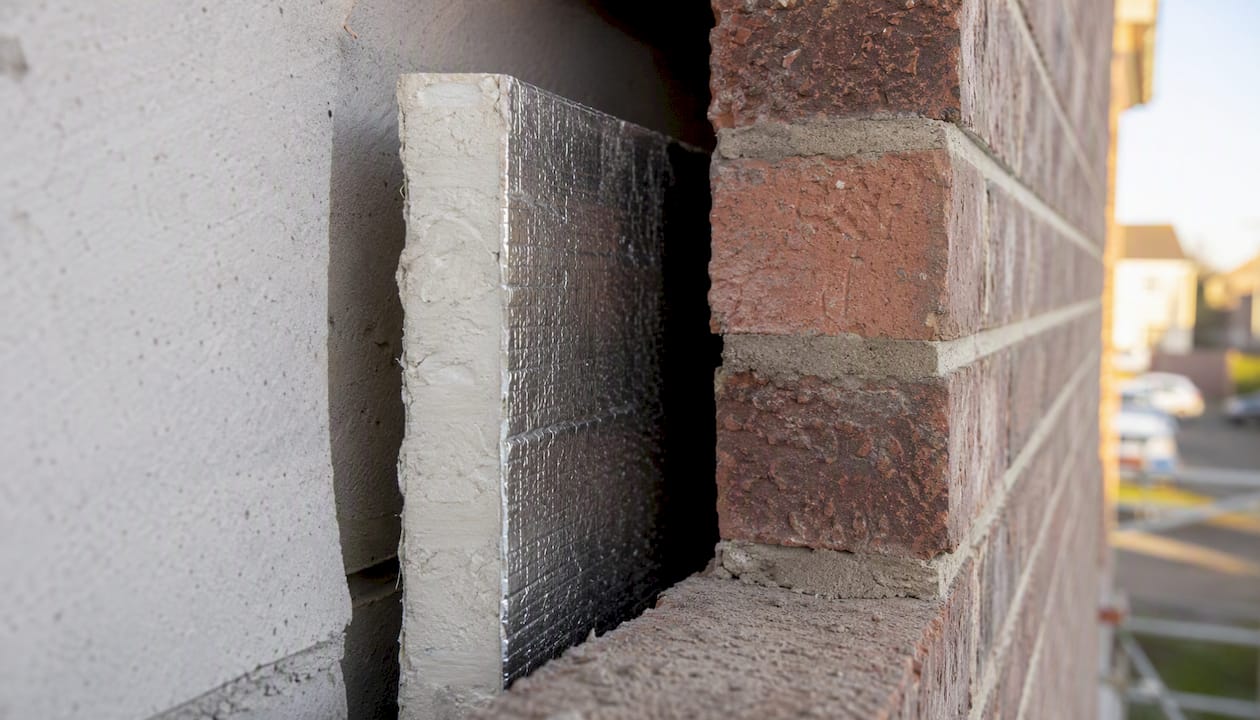
Partial-fill cavity wall insulation uses rigid boards fixed to the inner leaf, leaving a clear residual cavity between the outer face of the board and the inner face of the outer leaf. That gap is the system’s moisture defence: any water that penetrates the outer leaf runs down the clear cavity face and drains away at the DPC, rather than being absorbed into the insulation.
PIR boards and why they are chosen
Polyisocyanurate (PIR) rigid boards are the dominant partial-fill product in UK new build. Products such as Recticel Eurowall+ are specifically designed for this application, with aluminium foil facings on both sides. The foil facing facing into the residual cavity provides a low-emissivity surface that improves the effective thermal resistance of the clear cavity, boosting overall wall performance beyond what the board’s lambda alone would suggest.
PIR boards typically achieve low thermal conductivities, about half that of standard mineral wool. That means a 60mm PIR board can deliver comparable thermal resistance to a 100mm mineral wool slab, making partial fill attractive where cavity width is limited or where Approved Document L targets demand very low U-values. All PIR cavity boards must comply with BS EN 13165 and carry a current BBA certificate.
Installation requirements
The IMA Best Practice Guide (Version 3, November 2024) sets out the key installation requirements in detail:
- Boards must be fixed tight to the inner leaf with no air gap between board and blockwork.
- Retaining clips are required at a frequency specified by the manufacturer and BBA certificate; under-clipping is one of the most common installation failures.
- Board joints should be staggered in both horizontal and vertical directions to avoid continuous cold bridges.
- Low vapour resistance tape should be used to seal board joints and improve airtightness at the inner face.
- The foil facing must face outward into the residual cavity, not inward toward the blockwork. Fitting boards the wrong way round eliminates the low-emissivity benefit and can create condensation risk.
- Residual cavity width: Residual cavity widths vary with exposure; larger cavities are required in more severe exposure zones or for taller buildings
Advantages and limitations
The thermal efficiency of PIR per millimetre of thickness is the headline advantage. Where a developer is working with a 100mm cavity and needs to hit a 0.18 W/m²K U-value target under Approved Document L, partial-fill PIR is often the only practical route without widening the cavity.
The limitation is sensitivity to detailing. A partial-fill system that is poorly clipped, incorrectly oriented, or has boards that are not tight to the inner leaf will underperform significantly and may create moisture pathways. The system depends on every board being correctly placed and every joint being sealed. That demands a higher level of installer competence and site supervision than full-fill mineral wool.
Pro Tip: Check the manufacturer’s print on the foil face before fixing. Most PIR boards mark the correct outward-facing side on the board itself. Confirm orientation against the product DoP and BBA guidance before the first board goes in.
Head-to-head: how the two methods compare
The choice between partial fill and full fill is rarely about one factor in isolation. Exposure zone, cavity width, fire requirements, and the skill level of the installation team all interact. The table below sets out the key dimensions side by side.
| Dimension | Full-fill mineral wool | Partial-fill PIR boards |
|---|---|---|
| Typical thermal conductivity (λ) | 0.032–0.044 W/mK | 0.021–0.022 W/mK |
| Fire classification (Euroclass) | A1 or A2 (non-combustible) | E or F typically; check DoP |
| Moisture behaviour | No residual cavity; restricted in exposed zones | Residual cavity protects inner leaf; suitable for moderate-severe exposure |
| Buildability / site tolerance | High; tolerant of minor imperfections | Lower; sensitive to fixing, orientation and joint sealing |
| Soundproofing | Good; mineral wool absorbs sound effectively | Lower; rigid boards transmit more sound than mineral wool |
| Residual cavity required | None (full fill) | 25–50mm minimum; 50mm+ in severe zones or >12m height |
| Suitability: new build | Yes, widely used | Yes, dominant in performance-led new build |
| Suitability: retrofit | Yes, in sheltered/moderate zones | Yes, where cavity width allows and exposure is managed |
| Suitability: exposed locations | Restricted or not permitted | Preferred, with correct residual cavity |
| Certification required | BBA, DoP | BBA, DoP, BS EN 13165 (PIR) |
| Long-term risk | Settling possible in blown products; batts generally stable | Slumping if under-clipped; degradation if moisture reaches board |
Typical performance by cavity width
Indicative U-values for masonry cavity walls vary depending on product and cavity width; exact values should be calculated from product documentation for each project
| Cavity width | Full-fill mineral wool (λ ≈ 0.032–0.044 W/mK) | Partial-fill PIR (λ = 0.022 W/mK) | Residual cavity (partial fill) |
|---|---|---|---|
| 100mm | — | — | 25mm |
| 125mm | — | — | 50mm |
| 150mm | — | — | 50mm |
As cavity width guidance confirms, common practice links cavity width to insulation choice and thickness to meet thermal targets under building regulations
Two illustrative scenarios
100mm retrofit cavity, semi-detached house, moderate exposure zone. The cavity is too narrow for partial-fill PIR with a meaningful residual gap. Full-fill mineral wool at 100mm is the practical choice, subject to confirming the exposure zone is sheltered or moderate. A borescope check before installation is advisable to confirm the cavity is clear of debris and mortar droppings.
150mm new-build cavity, detached house, severe exposure zone. A 100mm PIR partial-fill board leaves a 50mm residual cavity, meeting the minimum requirement for severe exposure. The PIR board’s lower lambda allows a U-value well below 0.18 W/m²K. Full-fill mineral wool at 150mm would also achieve a good U-value but would not be permitted in a severe exposure zone without specific building control agreement.
Long-term performance risks
Blown mineral wool and polystyrene bead products can settle over time, creating voids at the top of the cavity that reduce thermal performance. Rigid mineral wool batts in new build are generally stable if correctly installed. Partial-fill PIR boards can slump if retaining clips are insufficient or if the boards were not tight to the inner leaf from the outset. Moisture reaching a PIR board through a failed residual cavity can degrade the foil facing and reduce thermal performance. Both systems require the correct product type for the application; mixing partial-fill and full-fill product profiles in the same cavity is a documented cause of gaps and moisture paths.
Practical installation requirements and how to avoid common errors
Getting the installation right matters more than product selection. A correctly specified product installed badly will underperform a simpler product installed well.
Pre-installation checks
Before any insulation goes in, confirm:
- Cavity width at multiple points (top, middle, bottom of each elevation) using a probe or borescope.
- Wall-tie type, condition and spacing; ties must be the correct length for the total cavity width with insulation.
- Mortar droppings: any significant accumulation on ties or at the base of the cavity must be cleared before insulation is placed.
- Wall dryness: existing moisture in the blockwork should be resolved before sealing the cavity.
- Exposure zone: check BS 8104 wind-driven rain index for the site postcode and confirm against NHBC or building control requirements.
- DPC position: insulation must not bridge the DPC; the cavity should extend at least 150mm below DPC where insulation crosses that line.
Installing partial-fill PIR boards
Follow the IMA Best Practice Guide step by step:
- Fix the first course of boards tight to the inner leaf, foil face outward, using retaining clips at the frequency specified in the BBA certificate.
- Stagger vertical joints by at least half a board length on each course.
- Seal all board joints with low vapour resistance tape to maintain airtightness at the inner face.
- Position wall ties to pass through the board without displacing it; ties must have a drip positioned in the residual cavity, not embedded in the board.
- Maintain the specified residual cavity width throughout; check with a gauge at each course.
- At reveals, sills and junctions, cut boards accurately and tape all cut edges to prevent moisture ingress into the board core.
Installing full-fill mineral wool batts
- Place batts as the outer leaf rises, friction-fitting each slab between the leaves.
- Cut batts cleanly to avoid compression; a compressed batt has a higher effective lambda than its declared value.
- Ensure wall ties pass through the batt without creating a void; use ties designed for full-fill applications.
- At the top of the wall, ensure the last course of batts is cut to fill the cavity completely up to the wall plate or roof junction.
Common detailing mistakes
The most frequent failures seen in practice are:
- Wrong board orientation: PIR boards installed with foil facing inward, eliminating the low-emissivity benefit.
- Insufficient retaining clips: boards that are under-clipped can bow or slump, creating air gaps and cold bridges.
- Mortar droppings left in cavity: these bridge the residual cavity and create moisture paths to the inner leaf.
- DPC bridging: insulation taken below DPC level without the correct detailing allows ground moisture to wick into the wall.
- Unsealed board joints: air movement through unsealed joints reduces effective thermal resistance and can cause interstitial condensation.
Buildings over 12m in height and those in severe or very severe exposure zones require specific design input and, in many cases, building control or NHBC sign-off before installation proceeds. If there is any doubt, escalate to a building control officer or an OSCAR Onsite technical monitor before work starts.
Pro Tip: Airtightness at the inner face of a partial-fill system is often overlooked. Low vapour resistance tape on board joints costs very little but measurably improves both thermal performance and moisture management. Make it a non-negotiable part of the specification.
What regulations and certifications should you check?
Regulatory compliance for cavity wall insulation in the UK sits across several documents and standards. Knowing which ones apply to your project prevents costly rework.
Essential documents to obtain before installation
- Declaration of Performance (DoP): every insulation product placed on the UK market must have a DoP confirming its declared performance characteristics, including thermal conductivity (lambda), reaction to fire (Euroclass), and dimensional stability. Check the DoP against the specific product batch being delivered to site.
- BBA certificate: the British Board of Agrément certificate confirms the product has been independently assessed for its intended application. Check the certificate is current (not expired), that the scope covers the specific cavity width and exposure zone, and that the installer is working within the certificate’s conditions of use.
- Product data sheet and installation guide: these contain the manufacturer’s fixing requirements, retaining clip frequencies, residual cavity widths, and any limitations on use.
Relevant standards and regulations
- BS EN 13165: the harmonised European standard for factory-made rigid polyisocyanurate (PIR) thermal insulation products. Any PIR board used in a UK cavity wall must comply with this standard; the DoP will reference it.
- Euroclass fire classifications: under BS EN 13501-1, products are classified A1 to F. Mineral wool is typically A1 or A2 (non-combustible); PIR boards are typically E or F. Approved Document B and building control requirements for buildings over 11m or 18m may restrict or prohibit combustible insulation in the cavity.
- Approved Document L: sets the thermal performance targets (U-values) for new build and major renovation. The 2021 edition tightened targets significantly; check the current version applicable to your project.
- Approved Document C: covers moisture resistance and exposure. It requires that the residual cavity for partial-fill systems is adequate for the site’s exposure classification, and that the cavity extends below DPC correctly.
Practical compliance checklist
Before work starts, the installer or specifier should hold:
- Current DoP for the specific product and batch.
- Current BBA certificate number and expiry date, confirmed against the BBA website.
- Manufacturer’s installation guide, version-matched to the product being used.
- Exposure zone assessment for the site (BS 8104 wind-driven rain index).
- Wall-tie specification confirming correct length and drip position.
- Photographic record of cavity condition before insulation is placed.
After installation, retain:
- Borescope or thermal imaging evidence confirming insulation continuity and absence of voids.
- Retaining clip count and spacing records for partial-fill installations.
- Building control or NHBC sign-off documentation.
Where to verify
- BBA certificate search: bbacerts.co.uk
- IMA best practice guidance: insulationmanufacturers.org.uk
- Approved Document L and C: gov.uk/government/collections/approved-documents (England); devolved equivalents apply in Wales, Scotland and Northern Ireland.
- OSCAR Onsite CWI Condition Inspection for independent verification of installed systems.
How to choose between partial fill and full fill
The decision is not primarily about which product has the better lambda. It is about which system is appropriate for the specific building, site, and regulatory context.
Decision questions to work through
- What is the cavity width? Measure it. A 100mm cavity with a 25mm residual gap leaves only 75mm for PIR board, which may not reach the required U-value. A 150mm cavity provides genuine flexibility.
- What is the exposure zone? Check the BS 8104 wind-driven rain index for the postcode. Severe or very severe zones require partial fill with a 50mm+ residual cavity. Full fill is not appropriate in these locations.
- What is the building height? Buildings over 12m require a minimum 50mm residual cavity for partial fill and may have additional fire classification requirements for the insulation material.
- What U-value is required? Check Approved Document L (or the devolved equivalent). If the target is 0.18 W/m²K or lower and the cavity is 100mm, partial-fill PIR is likely the only option without widening the cavity.
- Are there fire classification requirements? Confirm whether Approved Document B or building control requires non-combustible or limited-combustibility materials. If so, mineral wool full fill or a non-combustible partial-fill product is required.
- Is this retrofit or new build? Retrofit adds constraints: existing wall-tie condition, mortar droppings, possible prior insulation, and limited access for borescope checks. A condition inspection before specifying is strongly recommended.
- What is the budget and programme? Full-fill mineral wool is generally faster to install and lower in material cost. Partial-fill PIR boards cost more per square metre but may reduce overall wall thickness or eliminate the need for a wider cavity.
Suggested routes
- Choose partial-fill PIR when: cavity width is 100mm or less and performance targets demand a low U-value; the site is in a moderate, severe, or very severe exposure zone; the building is over 12m; or the design requires a residual cavity for moisture management.
- Choose full-fill mineral wool when: the cavity is 100mm or wider in a sheltered or moderate exposure zone; fire classification requirements demand non-combustible materials; the installation team has limited experience with PIR detailing; or cost and programme are the primary drivers.
- Consider a specialist or hybrid solution when: the cavity is unusually narrow (under 75mm), the building is listed or in a conservation area, or there is evidence of prior insulation that needs extraction before reinstallation.
Survey checks before deciding
For any retrofit project, mandate the following before specifying a product:
- Borescope inspection to confirm cavity condition, presence of mortar droppings, and any existing insulation.
- Thermal imaging survey to identify cold bridges, voids, or moisture-affected areas.
- Wall-tie inspection and isolation check.
- DPC and damp history review.
- Exposure zone confirmation against BS 8104.
Cost and time ballpark
For a typical UK semi-detached house (approximately 60–70m² of cavity wall):
- Full-fill mineral wool retrofit (blown): generally lower material cost, one-day installation for a two-person team.
- Partial-fill PIR new build: higher material cost per square metre; installation time depends on cavity width and board size, typically one to two days for the same area.
- Extraction and remediation costs for failed installations are substantially higher than the original installation cost; getting the specification right first time is the most cost-effective approach.
When uncertainty exists about the existing cavity condition, or when extraction might be needed, commission an OSCAR Onsite CWI Condition Inspection before committing to a specification.
How to assess an existing cavity wall and when extraction is needed
A cavity wall that was insulated ten or twenty years ago may not be performing as originally specified. Settled fill, moisture ingress, or a product installed outside its certification limits are all common findings in condition surveys.
Survey toolkit
A thorough condition inspection uses:
- Borescope camera: inserted through a small drilled hole in the mortar joint, it provides direct visual evidence of insulation condition, voids, mortar droppings, moisture staining, and wall-tie condition.
- Thermal imaging camera: used from the exterior on a cold day with heating on inside, it maps heat loss patterns and identifies voids, cold bridges, and areas of moisture-affected insulation. OSCAR Onsite surveyors use calibrated thermal imaging equipment; if you are selecting your own equipment, the best thermal imaging cameras for cavity wall surveys guide covers the key specifications.
- Moisture meter: readings at the inner face of the external wall confirm whether moisture is bridging from the outer leaf.
- Probe checks: physical probing at drill holes confirms insulation type, density, and whether the cavity is fully or partially filled.
- Photographic records: timestamped photographs at each drill location form part of the formal condition report.
Signs that remediation or extraction may be needed
- Settled or voided cavities visible on borescope or thermal imaging, indicating loss of thermal performance.
- Damp patches on internal walls, particularly at low level or around window reveals, suggesting moisture bridging.
- Evidence that the installed product is not appropriate for the exposure zone (for example, full-fill mineral wool in a severe exposure location).
- Insufficient retaining clips on partial-fill boards, confirmed by borescope, causing boards to have bowed or slumped.
- Products installed outside their BBA certificate scope (wrong cavity width, wrong exposure zone, or expired certification at time of installation).
- Wall-tie corrosion or failure, which can displace insulation and create voids.
When extraction is justified
Extraction is not always the right answer. An independent condition survey should establish whether the problem is localised and remediable, or whether the full installation has failed. OSCAR Onsite’s extraction and clearance service is built around this principle: the condition inspection comes first, and extraction is recommended only when the evidence supports it.
Extraction is justified when:
- Moisture ingress is documented and attributable to the insulation bridging the cavity.
- The insulation is contaminated, degraded, or saturated beyond remediation.
- The product was installed outside its certification limits and cannot be brought into compliance by partial rework.
- A new insulation system cannot be installed safely without clearing the existing fill.
Remediation routes
Not every problem requires full extraction. Options include:
- Targeted extraction of affected areas, followed by reinstatement with a correctly specified product.
- Topping-up settled blown fill where voids are confirmed but moisture is not present.
- Full cavity clearance followed by reinstatement with a new system, with independent technical monitoring throughout.
Where extraction is justified, OSCAR Onsite recommends using an accredited member firm for the extraction work, followed by independent technical monitoring and clearance certification to confirm the cavity has been fully cleared and is ready for reinstatement.
Pro Tip: Retain all thermal imaging and borescope photographs as part of the formal condition report. These records are often required for warranty claims, insurance purposes, and building control sign-off on reinstatement work. A condition report without photographic evidence carries significantly less weight.
Why an OSCAR Onsite CWI Condition Inspection matters
The decision between partial fill and full fill is straightforward when the building is new and the specification is clean. It becomes considerably more complex when there is an existing installation of unknown condition, a history of damp, or a property that has changed hands without documentation of the original insulation work.
OSCAR Onsite provides the independent, evidence-led services that sit between the product specification and the installation decision:
- CWI Condition Inspection Surveys: using borescope and thermal imaging, OSCAR Onsite surveyors produce a formal condition report identifying moisture ingress, wall-tie condition, insulation voids, debris, and evidence of product misuse. The report includes a clear recommendation on whether extraction is required.
- Extraction oversight and technical monitoring: where extraction is justified, OSCAR Onsite technical monitoring provides independent verification that the work is carried out correctly, with clearance certification issued on completion.
- NVQ training and accreditation: OSCAR Onsite authored the UK’s NVQ Level 2 qualifications in CWI Surveying and Inspection and CWI Extraction and Clearance, the national benchmark qualifications for the sector. Over 250 independent firms have been trained and accredited through the OSCAR Onsite member scheme.
- CPD and awareness training: the OSCAR CWI Surveyor Awareness Course is designed for RICS surveyors, building surveyors, DEAs, retrofit professionals, housing providers, mortgage lenders, and conveyancing solicitors who need to understand cavity wall condition as part of their professional practice.
What an OSCAR Onsite inspection delivers:
- A formal written condition report with photographic and thermal imaging evidence.
- A clear recommendation: whether the existing installation is performing, whether remediation is possible, or whether extraction is required.
- Where extraction is recommended, a referral to an OSCAR Onsite Accredited Member Firm, followed by independent technical monitoring and clearance certification.
- Documentation suitable for building control, mortgage lenders, insurers, and conveyancing solicitors.
To book a CWI Condition Inspection or to find an accredited member firm, visit oscaronsite.co.uk/services/cwi-condition-inspection-survey.
Key takeaways
Full-fill mineral wool suits sheltered and moderate exposure zones where non-combustibility and installation simplicity are priorities; partial-fill PIR boards are the right choice where exposure is severe, cavity width is limited, or Approved Document L demands a U-value below what mineral wool can achieve in the available space.
| Point | Details |
|---|---|
| Exposure zone determines the method | Full fill is restricted in severe and very severe zones; partial fill with a 50mm+ residual cavity is required. |
| PIR boards offer lower lambda | At around 0.021–0.022 W/mK, PIR achieves better U-values in narrower cavities than mineral wool can. |
| Detailing errors are the main risk | Wrong board orientation, insufficient retaining clips, and unsealed joints cause the majority of partial-fill failures. |
| Verify DoP and BBA before installation | Check the current BBA certificate scope and the product DoP for declared lambda, Euroclass, and cavity width limits. |
| OSCAR Onsite surveys before extraction | Commission an independent CWI Condition Inspection to establish whether extraction is genuinely needed before any work begins. |
The survey-first principle: a perspective from the field
The most persistent problem in cavity wall insulation is not the product. It is the assumption that because insulation was installed, it is performing correctly and is appropriate for the building. That assumption is wrong more often than the industry has historically been willing to admit.
What experienced surveyors find repeatedly is a mismatch between what was specified and what was installed. Full-fill mineral wool in a severe exposure zone. Partial-fill PIR boards with half the required retaining clips. Boards installed foil-face inward. Mortar droppings bridging a residual cavity that was supposed to be clear. None of these failures are visible from the outside. None of them show up on an energy performance certificate. They only become apparent when moisture starts appearing on internal walls, or when a borescope goes in.
The partial fill versus full fill decision is genuinely technical. It requires knowing the exposure zone, the cavity width, the fire classification requirements, and the target U-value. But the more important question, particularly for retrofit, is what is actually in the cavity right now, and is it doing what it is supposed to do? A thermal imaging survey on a cold day will answer that question in an hour. A borescope inspection will confirm it. Without that evidence, any specification decision is partly guesswork.
The survey-first approach is not a commercial position. It is the only defensible technical position. Extraction without a condition survey is as likely to cause problems as it is to solve them. Reinstallation without understanding why the previous installation failed will produce the same outcome. The condition report is the foundation. Everything else follows from it.
Independent cavity wall surveys from OSCAR Onsite
When the question is not just which insulation to specify but whether the existing installation is safe, performing, and appropriate for the building, OSCAR Onsite provides the independent expertise to answer it properly.

OSCAR Onsite’s CWI Condition Inspection Survey uses borescope and thermal imaging to produce a formal condition report covering insulation continuity, moisture evidence, wall-tie condition, and product suitability for the exposure zone. The report gives you a clear, evidence-based recommendation: whether the installation is performing, whether targeted remediation is possible, or whether extraction is required.
Where extraction is the right course of action, OSCAR Onsite connects you with an accredited member firm from its network of over 250 trained contractors, followed by independent technical monitoring and clearance certification to confirm the cavity is clean and ready for reinstatement.
Why OSCAR Onsite:
- Authored the UK’s NVQ Level 2 qualifications in CWI Surveying and Extraction, the national benchmark for the sector.
- Over 250 accredited member firms trained to defined technical and ethical standards.
- Independent of installation contractors: no financial interest in recommending extraction.
- Formal condition reports accepted by building control, mortgage lenders, insurers, and conveyancing solicitors.
Book your CWI Condition Inspection at oscaronsite.co.uk/services/cwi-condition-inspection-survey.
Useful sources and verification references
The sources below are the primary references for verifying product claims, certification status, and regulatory requirements for cavity wall insulation in the UK.
Standards and regulatory documents
- Version 3 November 2024
- Partial fill and full fill cavity wall insulation guide
- Polyisocyanurate (PIR), glass mineral wool and blown insulation products may be specified as full and partial fill insulation solutions to improve the U-value of a masonry cavity wall.
- The cavity can be fully filled with insulation or partially filled (consult the manufacturer’s before proceeding).
- The width of your cavity (100mm, 125mm, 150mm etc.)
- Cavity Wall Insulation Batts: Partial Fill, Full Fill, and the Mistake That Costs Thousands | BuildWiz UK
- Full Fill vs Partial Fill Cavity Wall Insulation
- Cavity Wall Insulation Extraction – Oscar Onsite
Product certification
- BBA certificate search: bbacerts.co.uk. Search by product name or manufacturer. Check the certificate is current, confirm the scope covers your cavity width and exposure zone, and note any conditions of use.
- Manufacturer DoP pages: available on manufacturer websites for Isover CWS 32, Knauf DriTherm, Recticel Eurowall+, and other named products. The DoP confirms declared lambda, Euroclass, and dimensional stability class.
Best practice installation guidance
- IMA Best Practice Guide for partial-fill PIR cavity boards: Version 3, November 2024. The definitive UK installation reference for partial-fill systems; covers residual cavity widths, retaining clip frequencies, foil orientation, and wall-tie requirements.
- Celotex cavity wall guide: Partial fill and full fill cavity wall insulation guide. Explains the distinction between partial-fill and full-fill systems, including modern rigid full-fill boards and edge profile requirements.
- Celotex PIR options guide: Full and partial fill insulation options for masonry cavity walls. Covers PIR thermal conductivity, foil facing design, and suitability for partial or full fill use.
- Welsh Government / Approved Document C guidance: Building regulations: external walls, thermal resistance. Confirms residual cavity and DPC requirements for partial-fill systems.
- BuildWiz UK installation warnings: Cavity Wall Insulation Batts: Partial Fill, Full Fill, and the Mistake That Costs Thousands. Practical warnings on retaining clip frequency, exposure-zone requirements, and product mixing errors.
OSCAR Onsite services
- CWI Condition Inspection Survey: oscaronsite.co.uk/services/cwi-condition-inspection-survey
- Cavity wall insulation extraction and clearance: oscaronsite.co.uk/services/cavity-wall-insulation-extraction
- Clearance certification: oscaronsite.co.uk/service/cavity-wall-extraction-clearance-certificate
- NVQ and CPD training: oscaronsite.co.uk/course
- Cavity wall insulation types explained: oscaronsite.co.uk/cavity-wall-insulation-types-explained