
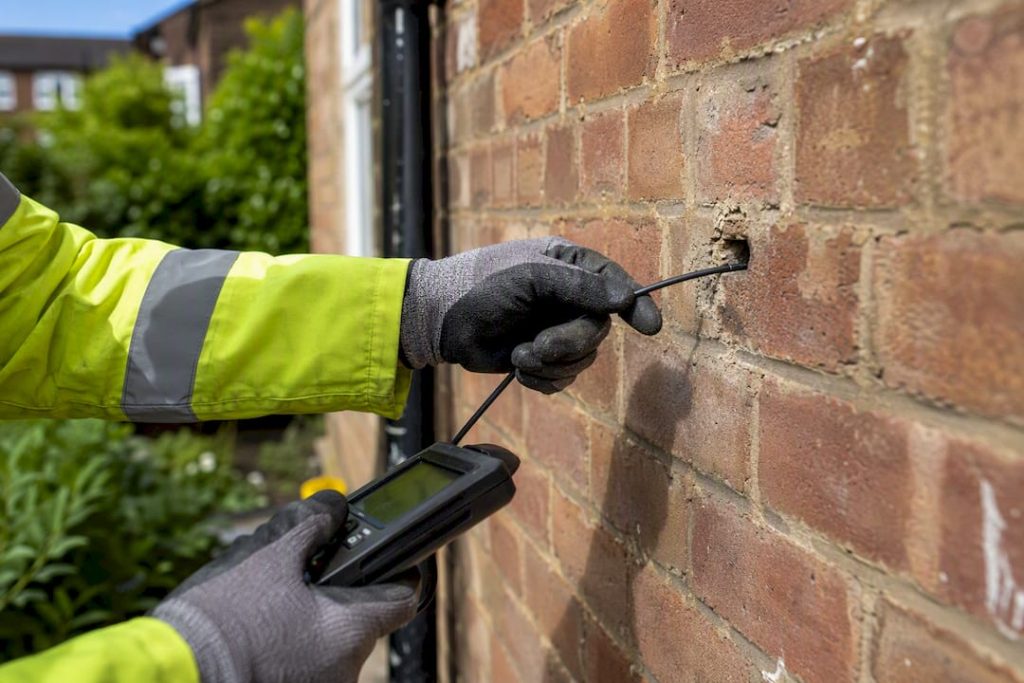
Reinstallation after extraction cost typically runs to £500–£2,500 on its own, but budget £3,000–£7,000 if you’re paying for extraction, reinstallation and making good together on a standard UK home. Where you land in that range depends on property size, access, and the material going back into the cavity.
Two names matter here. The Energy Saving Trust publishes the install-cost and savings figures that most quotes get benchmarked against, and PAS 2030:2023 is the compliance standard any reinstallation should be measured against. Before you commit to either extraction or refill, get an independent condition survey.
- Reinstallation only: £500–£2,500
- Extraction + reinstallation + making good: £3,000–£7,000
- Book an OSCAR CWI Condition Inspection Survey before signing any contract
Pro Tip: Never let a contractor quote reinstallation without first showing you a written condition survey. If they can’t produce one, that’s your cue to walk.
Key Takeaways
Reinstallation after extraction cost typically totals £3,000–£7,000 combined with extraction and making good, and independent condition inspection before any work remains the single biggest safeguard against overpaying or repeat failure.
| Point | Details |
|---|---|
| Combined cost range | Extraction, reinstallation, and making good typically cost £3,000–£7,000 for a standard home. |
| Reinstallation alone | Re-insulation after extraction runs £500–£2,500 depending on size, material and access. |
| Biggest cost drivers | Access and scaffolding, material choice, and cavity condition determine where you land in the range. |
| Drying time matters | Walls must be verified dry before refill; skipping this stage risks repeat insulation failure. |
| Get an independent survey first | Book an OSCAR CWI Condition Inspection Survey before committing to extraction or reinstallation work. |
Table of Contents
- What does reinstallation after extraction cost cover?
- How much does reinstallation cost for different property types?
- What pushes reinstallation costs up or down?
- What’s the recommended process and how long does it take?
- How do you compare quotes and spot a bad contractor?
- Why independence in cavity wall surveying matters
- Get an independent survey before you pay for reinstallation
- Frequently asked questions
- Sources
What does reinstallation after extraction cost cover?
A single lump-sum quote for reinstallation after extraction cost hides a lot of moving parts, and that’s exactly why prices vary so much between contractors. Breaking the job into its components lets you compare quotes properly instead of guessing whether one firm’s £4,000 figure means the same thing as another’s £5,500.
The typical line items are:
- Pre-extraction survey and borescope inspection
- Extraction and clearance of the old material
- Drying time and moisture monitoring before refill
- New insulation material and installation labour
- Drilling, patching and render repairs to the outer wall
- Internal replastering or making good where needed
- Scaffolding or access equipment
- Waste disposal, including any hazardous material surcharge
- Independent certification and guarantee documentation
Re-insulation after extraction alone typically costs £500 to £2,500 depending on property size and material. Extraction and clearance can add anywhere from £150–£300 for straightforward jobs up to £1,500 or more where the property is larger or the cavity condition is poor.
Some firms will quote extraction and reinstallation together to reduce your overall bill, which is worth asking about directly. Watch for VAT treatment and hazardous-waste surcharges on older foam insulation. These rarely show up on the headline number.
How much does reinstallation cost for different property types?
Property type is the single biggest driver of your final bill, more so than almost any other factor bar access. The Energy Saving Trust’s unsubsidised install figures give a useful baseline, even though they cover fresh installation rather than reinstallation specifically.
The install-only figures come from the Energy Saving Trust, based on July 2025 fuel prices, and they also publish estimated annual bill savings for each property type. Extraction removal rates average around £21.50 per m², with whole-house removal for a typical semi running £1,680–£2,520.
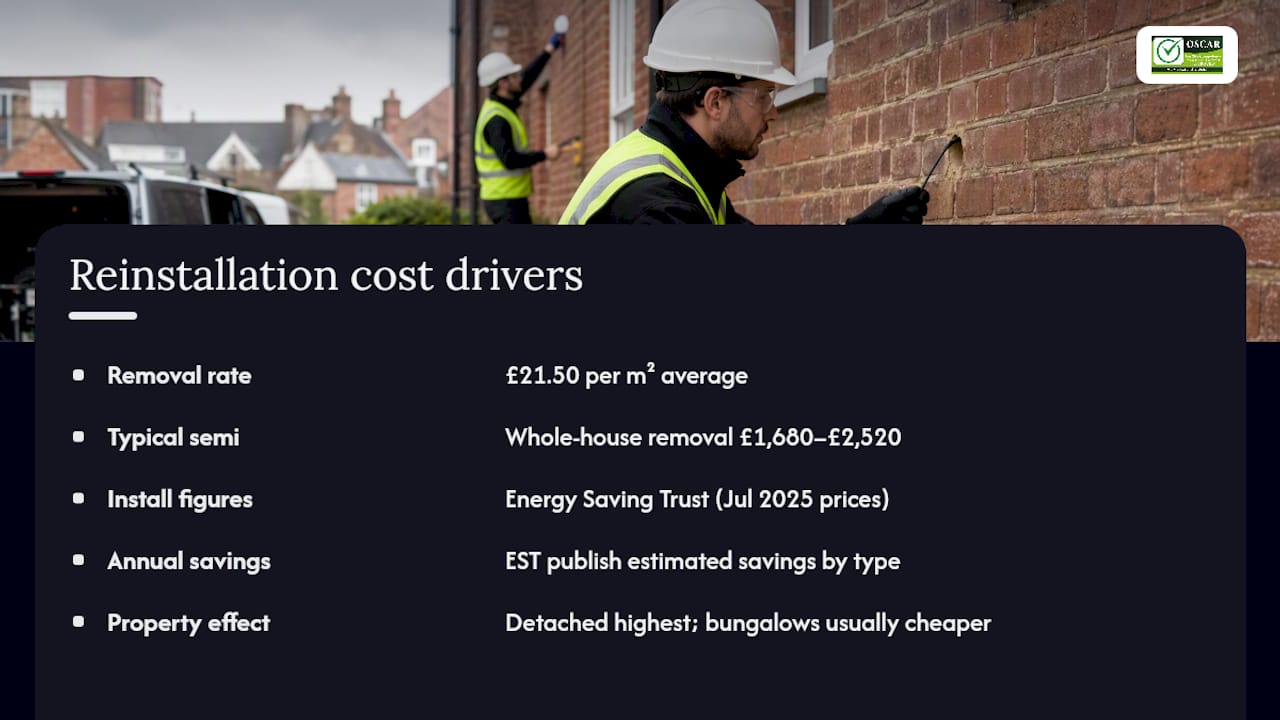
Detached and larger properties climb fastest because of extra wall area and, often, scaffolding across two storeys instead of one. A bungalow with straightforward access will usually beat a two-storey terrace with a tight side return, even at similar floor area.
What pushes reinstallation costs up or down?
Access is usually the first thing that separates a cheap quote from an expensive one. A detached house with clear garden access on all sides costs far less to scaffold than a mid-terrace on a narrow street, and roofline complexity (dormers, bay windows, multiple gable ends) adds time regardless of floor area.
Material choice matters almost as much. Polystyrene beads are commonly preferred over mineral wool because they resist moisture better, install faster, and reduce the need for extensive patching. Practitioners generally agree that EPS beads perform better than mineral wool in damp or exposed conditions, though the right call always depends on what your surveyor finds in the cavity, not on habit.
Other cost drivers include:
- Cavity condition: failing wall ties or cracked mortar need repair before refill
- Drying time: walls must dry fully and be verified before re-insulation starts, which can stretch a project from days into weeks
- Partial fill versus full fill: full refills usually mean more drilling and more making good
- Hazardous material: older foam insulation sometimes needs specialist disposal, adding to the bill
Pro Tip: If your quote doesn’t mention drying time or moisture verification at all, ask why. Refilling a cavity before it’s dry is one of the most common causes of repeat insulation failure.
What’s the recommended process and how long does it take?
Reinstallation after extraction cost is only worth paying if the work follows the right sequence. Skipping steps to save time almost always costs more later, either in remedial repairs or in insulation that fails again within a few years.
- Independent condition survey. Borescope inspection, moisture readings and a wall tie check identify whether extraction is even necessary.
- Extraction and clearance. Physical removal of failed material, typically completed within a day or two for an average semi.
- Drying and verification. Walls need time to dry, and a surveyor should confirm moisture levels before anyone touches the cavity again; this stage can take several weeks depending on wall construction and weather.
- Reinstallation. New material goes in, usually completed in a single day for a standard house.
- Making good and certification. Patching, redecoration and issuing of clearance documentation.
Trust signals worth checking at every stage:
- Work carried out under PAS 2030:2023
- Installer is TrustMark-registered
- Installers hold NVQ Level 2 qualifications in CWI Surveying & Extraction
- Independent technical monitoring and clearance certification confirm the job was done properly, not just claimed to be
Skipping the drying and verification stage is the most common shortcut taken by sales-led contractors, and it’s the one most likely to cause a repeat failure.
How do you compare quotes and spot a bad contractor?
Compare quotes by insisting each one separates survey, extraction, drying and monitoring, reinstallation, making good, and certification into distinct lines. A single lump sum makes it impossible to tell whether you’re paying a fair price for each stage or overpaying for one to subsidise another.
Ask every contractor:
- Can you show evidence of PAS 2030 or TrustMark accreditation?
- Are your installers NVQ Level 2 qualified in CWI Extraction & Clearance?
- Can I see a sample independent clearance certificate from a previous job?
- What insurance do you carry, and have you worked on properties like mine?
Red flags to walk away from:
- Vague scope with no breakdown of stages
- A price well below every other quote you’ve received
- Pressure to extract immediately, before any condition inspection
- No written guarantee, and no mention of independent clearance certification
The safest route is an OSCAR CWI Condition Inspection Survey first, followed by an OSCAR Onsite Accredited Member Firm if extraction turns out to be justified.
Why independence in cavity wall surveying matters
I’ve watched this industry for a long time, and the pattern repeats: a homeowner gets a “free survey” from the same firm that wants to sell them extraction, and somehow extraction is always the answer. That’s not surveying, it’s sales dressed up as diagnosis.
OSCAR Onsite exists because we wrote the UK’s first Level 2 NVQs in CWI Surveying & Inspection and CWI Extraction & Clearance, and we run a Member Accreditation Scheme precisely to separate evidence-led inspection from sales-led extraction. An independent survey costs far less than a wrongly diagnosed extraction, every time.
Get an independent survey before you pay for reinstallation
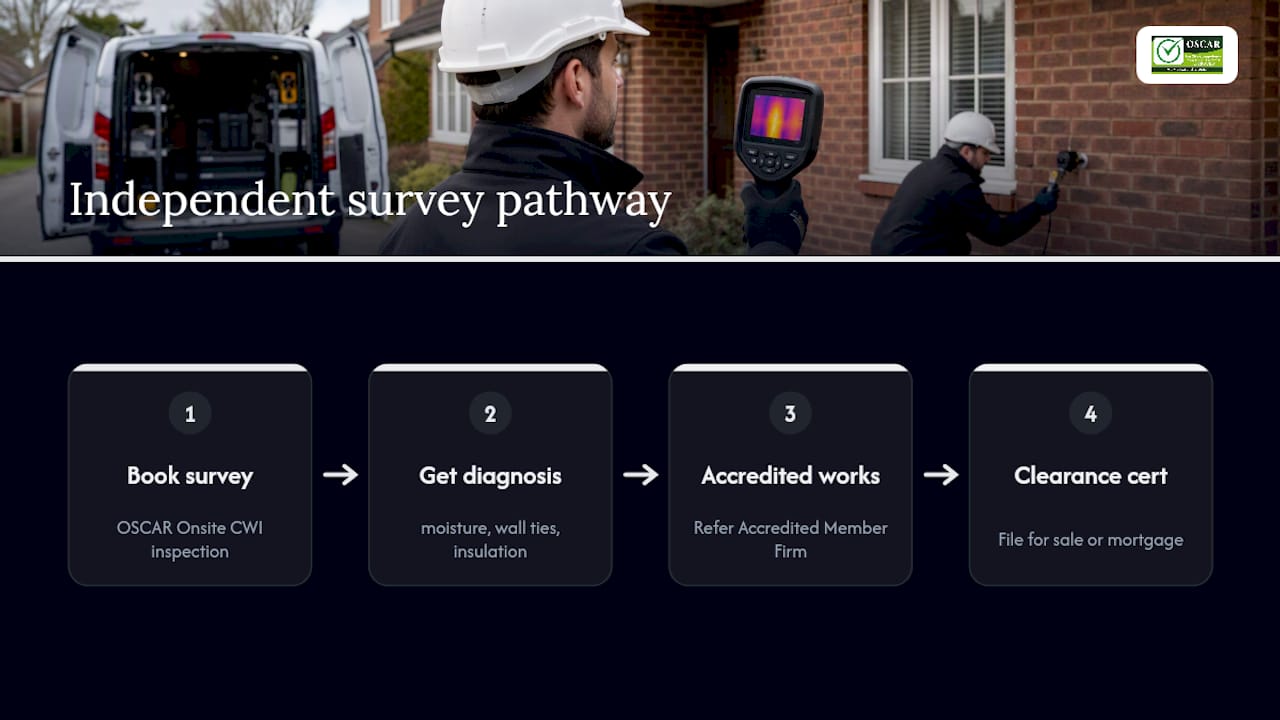
OSCAR Onsite is the alternative to a sales-led quote for reinstallation after extraction. We don’t sell extraction, so there’s no incentive to tell you your cavity needs emptying when it doesn’t. Our CWI Condition Inspection Survey gives you an independent read on moisture, wall ties and insulation condition before you spend a penny on removal or refill.
Where extraction is genuinely needed, we point you to an OSCAR Onsite Accredited Member Firm, then follow the job through with independent technical monitoring and a clearance certificate once the work is verified. That certificate is what you’ll want on file if you sell the property or need to satisfy a mortgage lender’s surveyor later.
The next step is straightforward: book your condition inspection, get a clear diagnosis, then decide on extraction and reinstallation with real evidence in hand rather than a contractor’s sales pitch.
Frequently asked questions
What is a typical reinstallation cost after extraction in the UK?
Reinstallation alone typically costs £500–£2,500, while the combined figure with extraction and making good runs £3,000–£7,000 for a standard home.
Does reinstallation cost more than the original installation?
Usually, yes. Fresh installation costs from £1,100 for a flat to £4,300 for a detached house, whereas reinstallation adds extraction, drying time and making good on top of the material and labour cost.
Do I need a survey before extraction?
Always get an independent condition survey before extraction. It confirms whether removal is genuinely necessary and avoids paying for work that a competent inspection might rule out entirely.
Are there grants for reinstallation after extraction?
Some schemes support new cavity wall insulation installs, but reinstallation after a failed job typically falls outside standard grant criteria. Check current eligibility with your local authority or energy supplier before assuming support applies.
What happens if the cavity isn’t fully dry before refilling?
Moisture trapped behind new insulation can cause the same damp problems that led to extraction in the first place, which is why verified drying time matters as much as the reinstallation itself.
Sources
- What Does Cavity Wall Insulation Removal Cost in 2026? | Checkatrade
- Cavity wall insulation cost 2026 | Less
- Cavity wall insulation – Centre for Sustainable Energy
- Cavity wall insulation – Energy Saving Trust
- Cavity wall insulation removal cost | MyJobQuote