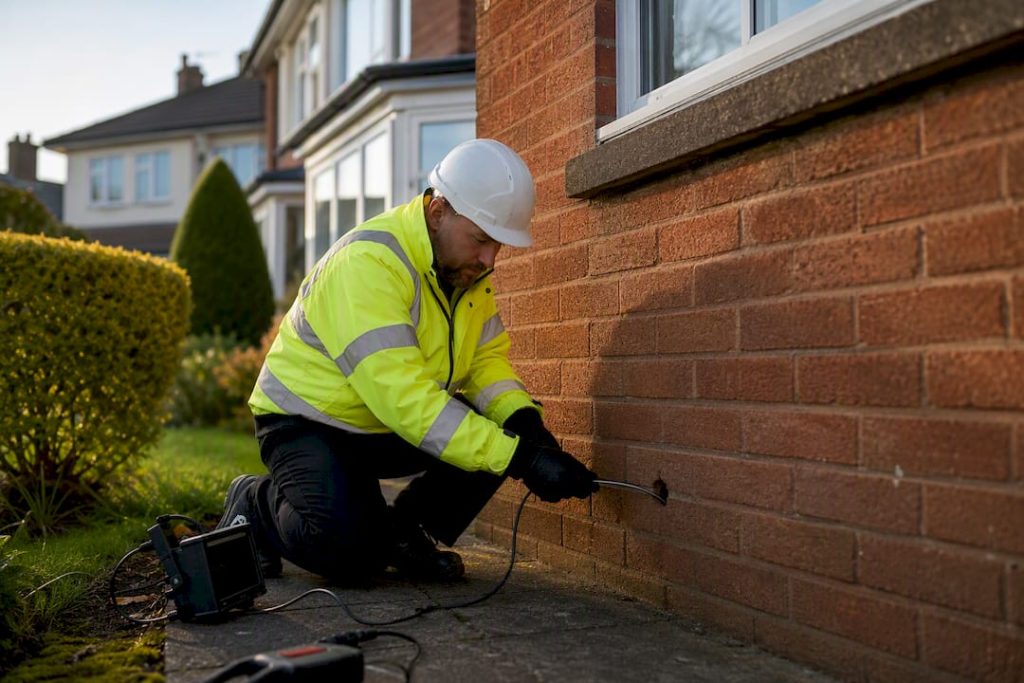
A site audit for PAS 2030 insulation work verifies that your installation, your records and your operatives all comply with PAS 2030:2023, the relevant PAS 2035:2023 retrofit design and current building regulations. Certification bodies do not take your word for it. They want documented, evidence-led proof, checked against what is actually on the wall or in the loft.
On the day, expect auditors to ask for:
- A signed pre-installation survey matching the property’s actual condition
- Operative competency records mapped to the specific measure installed
- Method statements and manufacturer installation instructions
- Photographic evidence covering before, during and after stages
- Commissioning, testing and handover documentation
Pro Tip: Build your job folder as you go, not after the CB calls. Retrospective paperwork is the single biggest tell that raises an auditor’s suspicion.
A PAS 2030 audit is really asking one question: can you prove, with evidence, that the job on paper matches the job on the wall? Bodies like UKAS and schemes such as TrustMark exist because that question used to go unanswered far too often.
Firms like OSCAR Onsite work with contractors and compliance officers precisely at this pressure point, helping them build the evidence trail before a certification body ever asks for it.
Key Takeaways
A PAS 2030 site audit succeeds when documentation, operative competency records and the physical installation all tell the same story, verified against PAS 2035 design and manufacturer instructions.
| Point | Details |
|---|---|
| Audits check two things | Desktop documentation review and live on-site checks must both align with the PAS 2035 design. |
| Certification is measure-specific | Being certified for one building fabric measure does not cover any other measure type. |
| Competency records need mapping | Each operative’s NVQ, SVQ or manufacturer certificate must match the exact measure they installed. |
| Non-conformances are time-bound | You get eight weeks to rectify a finding before further action follows within twelve weeks. |
| Surveillance runs on a strict clock | Certification bodies must complete surveillance within 12 months, or 16 in exceptional cases. |
| Independent surveys reduce risk | An OSCAR Onsite CWI condition inspection survey before extraction gives auditors independent evidence the work was justified. |
Table of Contents
- What a PAS 2030 site audit covers
- Step-by-step: the audit journey from application to surveillance
- Measures in scope: building fabric and measure-specific rules
- Competency, training and operative records auditors inspect
- Common non-conformances and how to resolve them
- Surveillance cycle, timelines and what triggers extra checks
- Practical pre-audit checklist: documents and site practices
- When an independent condition survey matters most
- Frequently asked questions
- Sources
What a PAS 2030 site audit covers
Certification bodies run two parallel checks: a desktop review of your paperwork and a live on-site assessment of the actual installation. The desktop review looks at your pre-installation survey, your PAS 2035 design, method statements, installation records, commissioning data, the handover pack, your complaints log and your health and safety file. The site visit tests whether that paperwork reflects reality.
Auditors typically request a specific job folder for each sampled installation, and acceptable evidence tends to follow a pattern:
- Dated, timestamped photographs at each installation stage
- Signed checklists confirming each stage was completed and checked
- Test certificates for airtightness, moisture or thermal performance where relevant
- A method statement that matches what was actually installed, not a generic template
Auditors compare all of this against the PAS 2035 design, manufacturer installation instructions and Building Regulations Part L. A mismatch between the design brief and the installed measure is one of the fastest routes to a non-conformance.
Pro Tip: Keep manufacturer instructions on file for every product batch you install, not just one master copy. Specifications change between production runs, and auditors do check dates.
Step-by-step: the audit journey from application to surveillance
Getting certified, and staying certified, follows a fairly predictable sequence:
- Application and office audit. The certification body reviews your quality management system, procedures, training records and pre-installation survey templates before any site visit happens.
- Initial live site assessment. A sample of your actual installations is checked against PAS 2035 design and PAS 2030 measure-specific annexes.
- Certification decision. If documentation and site checks align, you receive PAS 2030 certification for the specific measures assessed.
- TrustMark registration. This links your certification to funded schemes including ECO4, the Warm Homes Local Grant and the Great British Insulation Scheme.
- Ongoing surveillance. The certification body samples further live installations on a rolling basis.
Surveillance activities must be completed within a 12-month cycle, stretching to 16 months only where exceptional, justified circumstances apply. Miss the window and you risk your certificate lapsing, particularly if you cannot offer a site sample within three months of certification being issued.
- Keep a rolling pipeline of recently completed jobs ready to offer as a sample
- Never let your only “audit ready” job be one that finished six months ago
Pro Tip: Diarise your surveillance anniversary the day you get certified. Waiting for the certification body to chase you is how firms end up scrambling for evidence at month eleven.
Measures in scope: building fabric and measure-specific rules
PAS 2030 certification is granted per measure, not as a blanket badge covering everything you do. A firm certified for cavity wall insulation is not automatically certified for internal wall insulation, and auditors check this distinction closely.
Measures commonly audited under PAS 2030:2023 include:
- Cavity wall insulation
- Loft and pitched roof insulation
- Room-in-roof insulation
- Underfloor insulation
- Internal and external wall insulation
- Draught-proofing
- Park home insulation
Each measure carries its own annex within PAS 2030:2023, setting out installation steps and the evidence expected for that specific measure. External wall insulation and internal wall insulation both interact heavily with PAS 2035 obligations around airtightness, moisture risk and ventilation upgrades, so a design that ignores those interactions will fail review before the site visit even happens.
Competency, training and operative records auditors inspect
Every operative on site must be demonstrably competent for the specific measure they installed, and PAS 2030:2023 made this an explicit, checkable requirement rather than a general assumption. Acceptable evidence includes NVQ or SVQ qualifications, City & Guilds retrofit awards, manufacturer-issued certificates and documented CPD.
Auditors want each operative mapped to the exact measures they are certified to install, with dates, assessor names and clear scope, not a generic “trained in insulation” note.
Fields your competency records should hold for every operative:
- Qualification type and awarding body
- Expiry date or most recent CPD activity
- Measure types covered by that qualification
- On-site verification notes confirming the operative worked within scope
Documentation gaps here are one of the most frequently flagged issues during surveillance, particularly where training records fail to map an operative to the measure they were actually installing, according to Brighter Compliance’s audit findings. A robust NVQ pathway, such as the Diploma in Insulation and Building Treatments, closes this gap before it ever reaches an audit.
Common non-conformances and how to resolve them
Most non-conformances trace back to a handful of recurring failures rather than exotic technical errors. The usual suspects are a missing or mismatched pre-installation survey, thin photographic evidence, operative competence records that do not map to the measure installed, absent method statements, and handover packs that were clearly assembled after the fact.
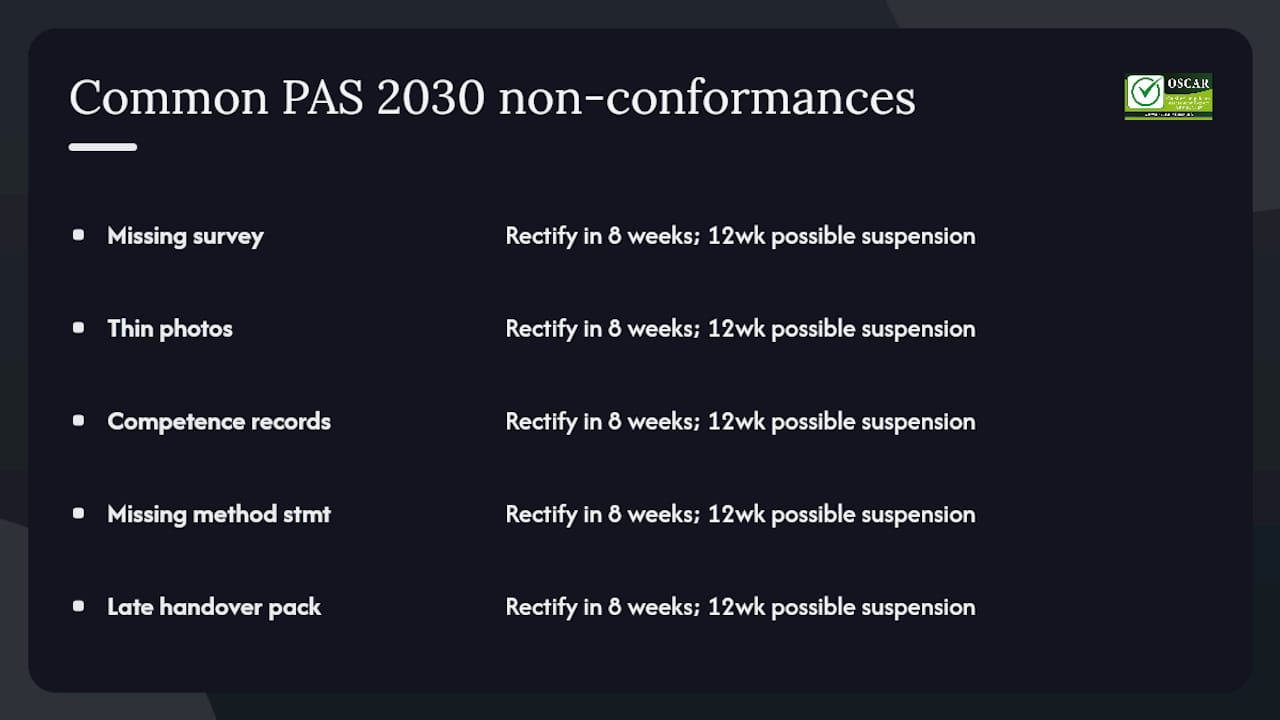
When a certification body raises a non-conformance, the process is time-bound. You have eight weeks to rectify the issue in writing, with a documented corrective action plan naming who is responsible and by when. If the issue remains unresolved, the certification body must take further action within twelve weeks, which can extend to suspending or withdrawing certification entirely.
A workable action template covers four fields: what was found, the corrective step, who owns it, and the deadline. Keep that record even after you close the non-conformance out.
Pro Tip: Run your own internal spot checks using the same photographic checklist your certification body uses. Catching a gap yourself costs you an hour; catching it during surveillance costs you eight weeks.
Surveillance cycle, timelines and what triggers extra checks
Routine surveillance runs annually, and certification bodies must complete that cycle within 12 months, extending to 16 only in genuinely exceptional circumstances. Beyond the routine cadence, certain conditions trigger intensified sampling.
Installers running high volumes of a single measure, those with a history of non-conformances, and firms working on external wall insulation have all faced heightened scrutiny recently. In 2025, UK ministers directed certification bodies to audit 20% of identified external wall insulation installations, with UKAS increasing quarterly oversight of the certification bodies covering that measure.
- If you install more than 100 units of the same measure in a period, expect a larger sample size
- Firms with recent findings should assume the next surveillance visit will be closer, not further away
Keep an audit-ready pipeline of job files at all times rather than treating documentation as a once-a-year exercise before your CB calls.
Practical pre-audit checklist: documents and site practices
Before any certification body assessment, your job folder should already contain everything an auditor might ask for, in a format they can check without chasing you for extras.
Documents to have ready for every sampled job:
- Signed pre-installation survey
- Measure-specific method statement
- Manufacturer instructions matching the product batch used
- Photographs from before, during and after installation
- Commissioning and testing records
- Completed handover pack
- Complaints log, even if it shows no entries
On-site practices that demonstrate genuine quality control:
- Supervisor sign-off at each key installation stage
- Intermediate inspections logged with date and inspector name
- Airtightness or air leakage testing where the measure requires it
- Manufacturer site sign-off for products that require it
Build a simple job-folder template you reuse for every installation, and store the evidence in a timestamped, searchable system rather than loose folders on someone’s laptop. A CWI condition inspection survey before work starts gives you an independently verified starting point that strengthens every document that follows.
When an independent condition survey matters most
Not every cavity wall job should proceed straight to extraction or remediation on the strength of a visual check alone. An independent CWI condition inspection using borescope and thermal imaging routinely reveals moisture ingress, debris or wall tie corrosion that changes the entire scope of work, and that evidence protects both the installer and the property owner.
The workflow worth following is straightforward: an independent condition inspection first, then technical monitoring during any extraction or reinstatement, then clearance certification once the work is complete. Each stage generates its own evidence trail, which is exactly what a PAS 2030 auditor wants to see.
Independent surveying isn’t paperwork for its own sake. It’s the evidence that tells you, and later tells an auditor, whether extraction was ever justified in the first place.
- Independent condition surveys reduce the risk of downstream non-conformances during surveillance
- OSCAR Onsite authored the UK’s first Level 2 NVQ Diplomas in CWI Surveying & Inspection and CWI Extraction & Clearance, and runs a member accreditation scheme built on the same evidence-led standards auditors expect
Author’s perspective: quick notes from the field
Good photographic sequencing and clear supervisor sign-offs prevent more non-conformances than any single training course. Auditors have shifted from tolerating ad-hoc fixes to expecting documented CPD and evidence-led corrective action as standard practice. My one field note: keep a live, running register of every job’s audit-readiness status. A folder you update weekly beats one you rebuild in a panic.
How OSCAR Onsite helps installers stay audit-ready
Preparing for a PAS 2030 site audit gets considerably easier when your evidence trail starts before installation, not after. OSCAR Onsite provides independent CWI condition inspection surveys, technical monitoring during extraction and reinstatement, clearance certification on completion, and NVQ and CPD training that maps directly to the competency records auditors want to see.
If cavity wall work is on the table, the sequence worth following is a CWI Condition Inspection Survey first, so you have independent evidence of whether extraction is genuinely justified before anyone touches the wall. Where extraction does prove necessary, engaging an OSCAR Onsite Accredited Member Firm followed by independent clearance certification gives you a documented, auditable chain from diagnosis to completion. Book a condition inspection survey and start building the evidence file your next audit will actually need.
Frequently asked questions
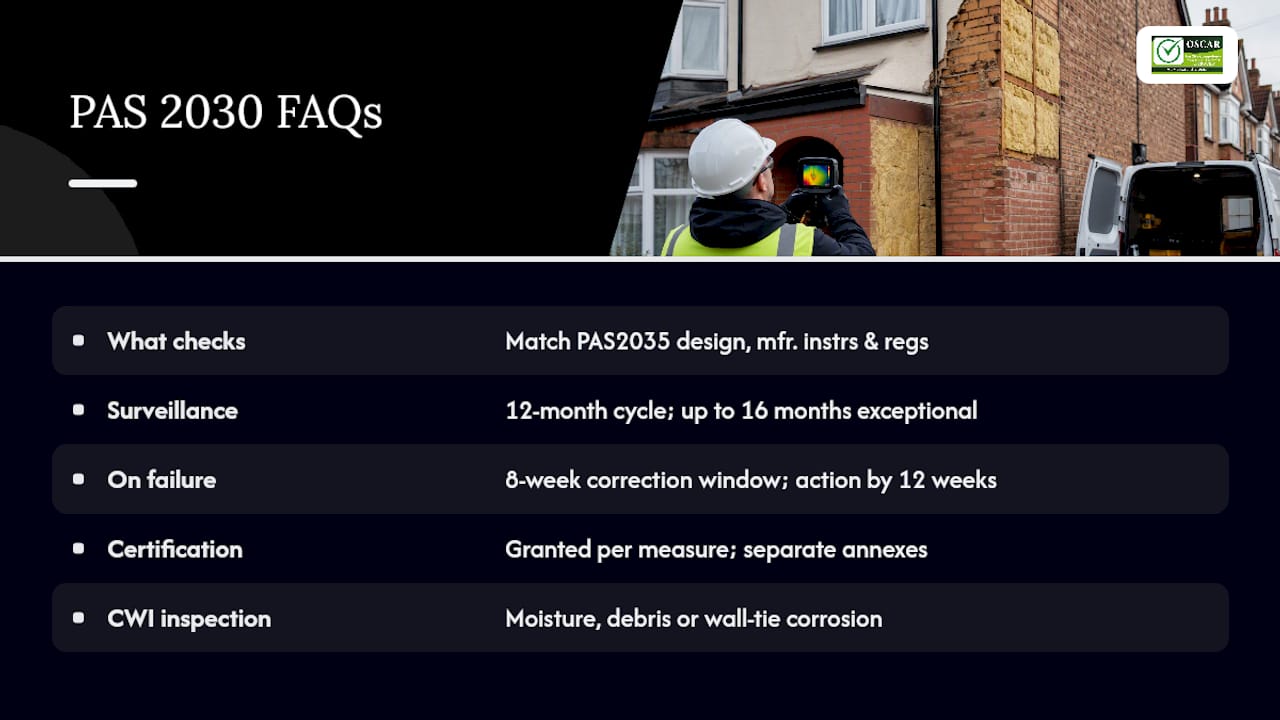
What does a PAS 2030 site audit actually check?
It checks whether your documentation, operative competency records and the physical installation all match the PAS 2035 design, manufacturer instructions and current building regulations.
How often does surveillance happen under PAS 2030:2023?
Certification bodies must complete surveillance within a 12-month cycle, extending to 16 months only where exceptional, justified circumstances apply.
What happens if my firm fails a PAS 2030 audit?
You get an eight-week window to correct any non-conformance in writing; unresolved issues trigger further action, including possible suspension or withdrawal of certification, within twelve weeks.
Is PAS 2030 certification the same across all insulation measures?
No. Certification is granted per measure, and each building fabric measure, from cavity wall to external wall insulation, carries its own annex with distinct evidence requirements.
Why would I need an independent condition survey before extraction?
An independent CWI condition inspection identifies moisture, debris or wall tie corrosion that determines whether extraction is genuinely necessary, giving you documented evidence rather than a visual guess.
Sources
- PAS 2030 scheme update (UKAS technical bulletin)
- What is PAS 2030? Installer requirements and certification (LegalClarity)
- PAS 2030: Complete UK Guide – All You Need to Know (Brighter Compliance)