
You can make a CIGA guarantee claim if your cavity wall insulation was installed under a registered scheme and the installation falls within the 25-year cover window. Contact your installer first. If they don’t resolve it, register a concern with CIGA directly using your property address and postcode.
Three things decide whether a CIGA guarantee claims process will work for you:
- Your property has a live guarantee (check by address if you don’t have the paperwork)
- The problem falls within 25 years of installation
- The insulation hasn’t been altered, disturbed, or partially removed since it went in
Rectification has a maximum financial limit, and extraction isn’t automatic even when CIGA agrees there’s a fault.
Key Takeaways
A CIGA guarantee claim succeeds when you confirm cover, document everything, and let an independent inspection guide the remedy rather than assuming extraction is the answer.
| Point | Details |
|---|---|
| Check cover by address | CIGA can search by property address and postcode even without the original certificate. |
| Report to installer first | Keep dated records; CIGA expects the installer to have had a chance to fix it. |
| Know the timescales | Acknowledgement in 2 working days, inspection in 5, report in 27, remedial work in 50 to 90. |
| Understand the limits | Rectification is capped at £20,000 and altering the insulation can void the guarantee. |
| Get independent evidence | A borescope and thermal imaging survey supports proportionate remedial decisions. |
Table of Contents
- What the CIGA guarantee covers and what it doesn’t
- How do I check if my home has CIGA cover?
- How do you make a CIGA claim step by step?
- What evidence should you gather before you register a concern?
- Will CIGA order extraction, and what are the limits?
- Why commission an independent survey before extraction?
- Getting the right independent inspection before you act
- Frequently asked questions
- Sources
What the CIGA guarantee covers and what it doesn’t
CIGA’s guarantee covers defects in materials or workmanship connected to the original installation. That includes insulation that was fitted incorrectly, the wrong material for the cavity type, or product failure traceable to how the job was done. Remedies are provided free of charge, subject to the guarantee’s terms, and your statutory consumer rights sit alongside this, not instead of it, according to CIGA’s published guarantee summary.
What voids the cover matters just as much as what it includes:
- Insulation that’s been altered, disturbed, or partially extracted since installation
- Damage caused by unrelated building defects (roof leaks, rendering failure, plumbing issues)
- Problems reported outside the 25-year window from the original installation date
The rectification cap currently stands at £20,000 per claim, which covers the vast majority of remedial jobs but is worth knowing before you assume unlimited cover.
How do I check if my home has CIGA cover?
You don’t need the original paperwork to find out. CIGA can search its database by property address and postcode, so a lost certificate isn’t a dead end.
- Contact CIGA with your full address and postcode to confirm whether a guarantee is registered.
- If you’re selling or buying, request confirmation early in conveyancing rather than waiting until exchange.
- If you need a replacement document, CIGA can issue a duplicate guarantee for a £60 administrative fee, inclusive of VAT, though you’ll need to provide proof of ownership first, per CIGA’s FAQ page.
- Guarantees generally transfer to new owners on sale, subject to the original terms, so check this before completion rather than after.
If you’ve just bought a property and aren’t sure what’s in the cavity, a pre-purchase cavity wall survey settles the question before you’re relying on a guarantee you can’t verify.
How do you make a CIGA claim step by step?
Report the problem to your original installer first. Keep a written record of what you told them and when, because CIGA’s process expects the installer to have had a genuine chance to put things right before it steps in.
- Contact the installer and log the date, method (call, email, letter) and their response.
- If nothing happens within around two months, or the installer has gone out of business, register a concern with CIGA via its online form or by emailing concerns@ciga.co.uk.
- Wait for acknowledgement. Follow up if you hear nothing after a week.
- If CIGA schedules an inspection, be available and share any supporting evidence beforehand.
CIGA’s published timescales, according to its consumer concerns procedure, are:
- Acknowledgement within 2 working days of your report
- Inspection arranged within 5 working days
- Inspection report issued within 27 working days
- Remedial work completed within 50 working days for simple cases, or 90 working days for complex ones
If your installer has ceased trading, CIGA takes on the investigation itself rather than leaving you without a route forward, as its complaints procedure sets out. If a dispute remains unresolved after the inspection and report stage, an arbitration route exists as the final step, separate from small claims or court action.
What evidence should you gather before you register a concern?
A well-documented file speeds up CIGA’s investigation and reduces back-and-forth. Before you contact them, pull together:
- Proof of ownership: a current utility bill, plus a recent mortgage statement or Land Registry extract
- Installation details: installer name, approximate installation date, guarantee certificate if you have it, and any past correspondence or reports about the insulation
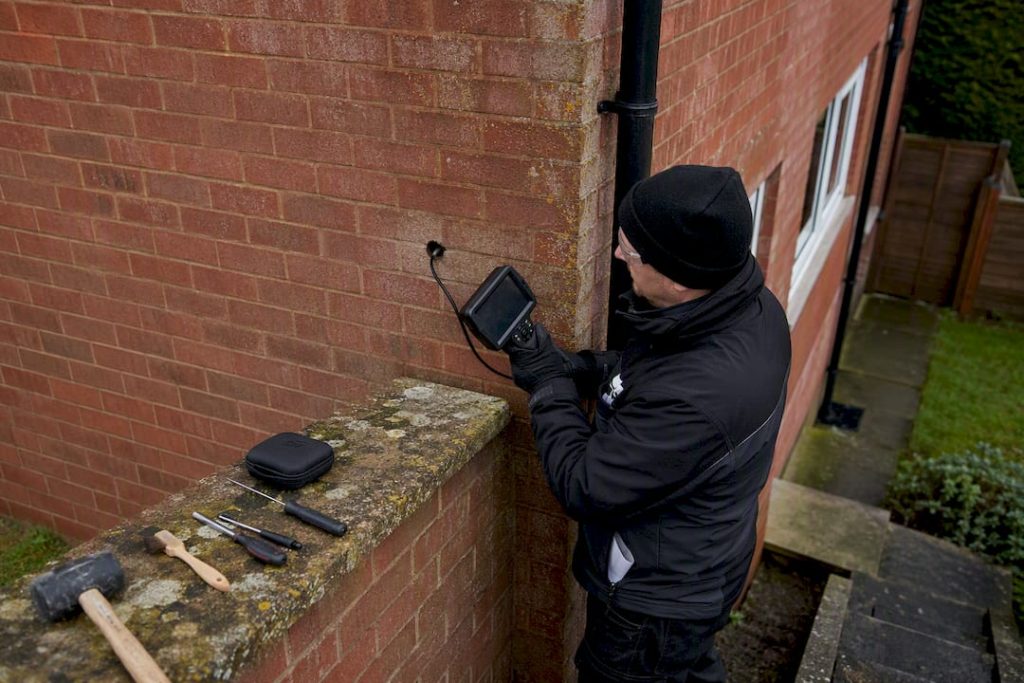
- Photographs of the problem area, thermal images if you’ve had a survey done, and any borescope footage
- A dated chronology: when you first noticed damp, cold spots, or staining, and every time you contacted anyone about it
Pro Tip: Only use CIGA’s published contact channels (its official website, concerns@ciga.co.uk, or its listed phone number). CIGA’s own guidance flags a rise in bogus callers claiming to represent guarantee schemes, and sharing your guarantee number or personal details with an unverified caller can leave you exposed to fraud.
Avoid authorising any intrusive testing or partial removal before CIGA or an independent surveyor has inspected the wall, and if you need professional help with this, consider loft insulation removal services in London. Disturbing the insulation prematurely, even with good intentions, can complicate or invalidate the guarantee you’re trying to use.
Will CIGA order extraction, and what are the limits?
CIGA investigates the concern and either instructs the original installer to rectify it or, if that firm no longer exists, takes on the remedial work itself. What it will not do is jump straight to extraction as a default response.
- Remedial action is proportionate to what the inspection finds, not to what the homeowner assumes is wrong
- Extraction is one possible outcome, not the automatic one, and government consumer guidance explicitly warns against treating removal as the default fix
- Financial rectification is capped at £20,000 per claim
- Unresolved disputes can go to arbitration rather than stalling indefinitely
Be wary of anyone who cold-calls offering to “claim on your behalf” for a fee, especially if they push for extraction before any inspection. Report suspicious approaches to Action Fraud and your local Trading Standards office. CIGA doesn’t operate through third-party claims agents, so if someone says otherwise, treat it as a red flag.
Why commission an independent survey before extraction?
Government guidance is blunt on this point: extraction is not always the correct remedy, and a survey often prevents work that wasn’t needed. Before anyone touches your cavity, get an independent read on what’s actually happening inside the wall.
- Commission a CWI condition inspection using borescope and thermal imaging, unless CIGA has already instructed a specific course of action
- Use the findings to argue for proportionate remedial work rather than blanket removal
- If extraction genuinely is justified, work with an accredited firm and follow up with independent technical monitoring and a clearance certificate once the job’s done
- Keep every report and photograph; it becomes your evidence trail if the guarantee decision is ever disputed
A borescope and thermal imaging inspection gives you objective evidence of cavity condition and moisture ingress, which is exactly what determines whether a partial refill or full clearance is the right call, rather than guessing at it.
Homeowners dealing with condensation rather than obvious insulation failure should read our guidance on cavity wall insulation causing condensation before assuming extraction is the fix.
A measured approach protects both the home and the guarantee
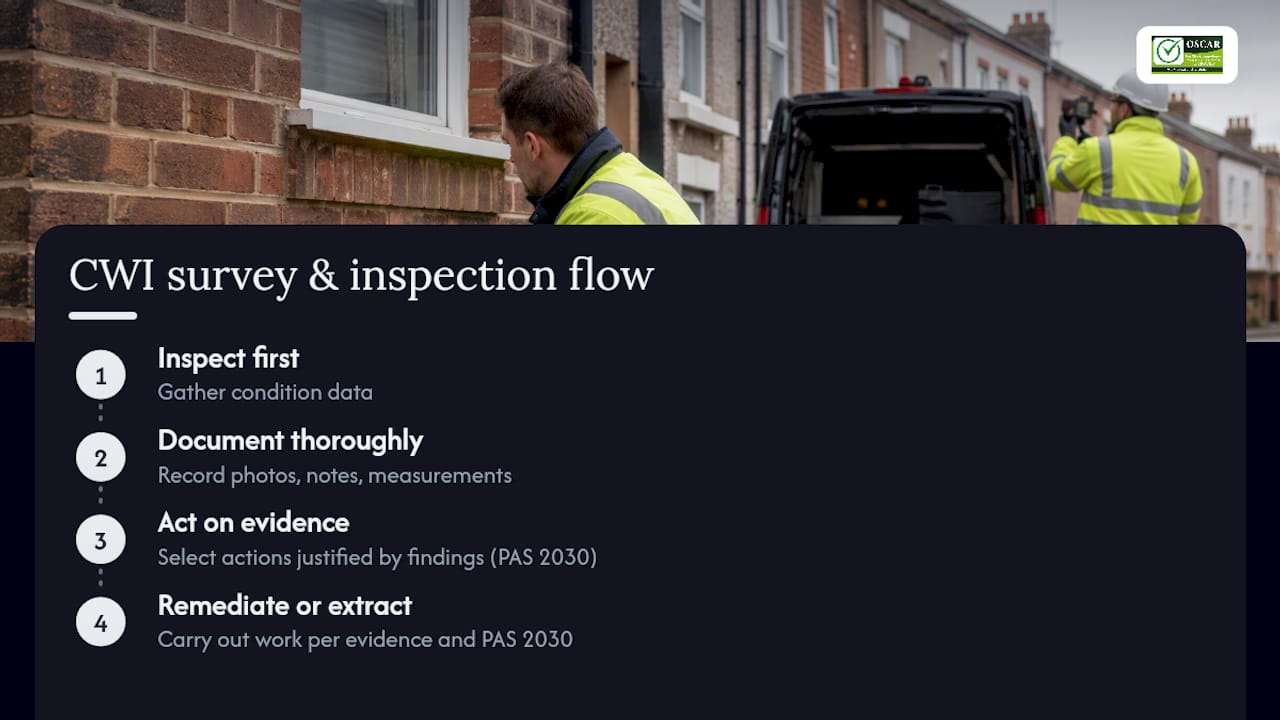
Rushing to extraction before evidence is gathered risks losing cover you’re entitled to and paying for work you didn’t need. OSCAR Onsite authored the UK’s first Level 2 NVQs in CWI Surveying & Inspection and Extraction & Clearance, and every recommendation here follows the same principle those qualifications are built on: inspect first, document thoroughly, act on what the evidence actually shows, in line with PAS 2030:2023.
Getting the right independent inspection before you act
Before you commit to extraction, or even decide a CIGA claim is worth pursuing, get an independent view of what’s actually inside your cavity. OSCAR Onsite’s CWI condition inspection survey uses borescope and thermal imaging to give you evidence rather than guesswork, and it’s the report you’ll want in hand whether you’re negotiating with CIGA, an installer, or a buyer’s solicitor. Where extraction genuinely is the right call, OSCAR Onsite’s accredited member firms carry it out, followed by independent technical monitoring and clearance certification, so the work is verified rather than taken on trust.
Frequently asked questions
How long do I have to make a CIGA guarantee claim?
You have 25 years from the original installation date to notify CIGA of a defect. Report the issue to your installer as soon as you notice it rather than waiting.
Can I claim if I’ve lost my original guarantee certificate?
Yes. CIGA can search its records by property address and postcode, and can issue a duplicate guarantee for a £60 fee once you’ve provided proof of ownership.
Does CIGA always order extraction of the insulation?
No. Extraction is one possible outcome, not the default one. CIGA and government guidance both favour proportionate remedial work based on what an inspection actually finds.
What happens if my installer has gone out of business?
CIGA takes on the investigation and remedial work itself where the case falls within the guarantee’s terms, so an insolvent installer doesn’t leave you without a route.
Is there a limit to how much CIGA will pay for repairs?
Yes, the current rectification cap is £20,000 per claim. This covers most cases, but it’s worth knowing before you assume unlimited cover.
Sources
- The CIGA Guarantee | CIGA
- Issues arising from cavity wall insulation: consumer guidance (gov.uk / Wales)