If the property you are buying was built between 1920 and 2000, or shows any signs of damp, cold spots, or mould on internal walls, you need a specialist pre-purchase cavity wall survey before you exchange contracts. A standard HomeBuyer Report will not tell you whether the cavity wall insulation (CWI) is failing. Only an independent CWI Condition Inspection Survey, combining borescope, thermal imaging, and calibrated moisture metering, will give you the evidence you need.
Take these three steps now:
- Commission an independent CWI Condition Inspection Survey from an NVQ-qualified, accredited specialist.
- Ask your conveyancer to raise the survey requirement in the seller’s enquiries and flag it to your mortgage lender.
- If the survey cannot be completed before exchange, pause exchange. Do not proceed blind.
Specialist pre-purchase CWI surveys typically cost a few hundred pounds depending on property size and location, with most written reports delivered within about a week of the inspection. That is a modest outlay against the cost of failed insulation extraction, which regularly runs into several thousand pounds.
Pro Tip: Book the CWI survey at the same time as your Level 2 HomeBuyer Report, not after it. Waiting for the HomeBuyer Report to flag a problem first costs you two to three weeks of conveyancing time.
Key takeaways
A specialist pre-purchase cavity wall survey is the only reliable way to confirm whether installed insulation is safe, performing, and free from moisture defects before you commit to a purchase.
| Point | Details |
|---|---|
| Commission before exchange | Order an independent CWI Condition Inspection Survey before exchange, not after symptoms appear. |
| Insist on three methods | The report must include thermal imaging, borescope evidence, and calibrated moisture readings. |
| Verify NVQ credentials | Only instruct a surveyor holding NVQ Level 2 in CWI surveying or OSCAR Onsite accreditation. |
| Use findings to negotiate | A costed extraction quote gives you a defensible basis for a price reduction or conveyancer retention. |
| OSCAR Onsite for independence | OSCAR Onsite’s CWI Condition Inspection Survey and Clearance Certification satisfy lender independence requirements. |
Table of Contents
- What is a pre-purchase cavity wall survey and who needs one?
- What does the inspection actually involve?
- What findings should you expect, and what do they mean?
- Which standards and qualifications should you insist on?
- How do you choose and brief the right surveyor?
- How to read the report and what to do next
- Why independent, accredited evidence matters
- What a good pre-purchase CWI report should contain
- The buyer’s mistake that costs the most
- OSCAR Onsite’s pre-purchase CWI inspection service
- Sources
What is a pre-purchase cavity wall survey and who needs one?
A CWI Condition Inspection Survey is a targeted, evidence-led assessment of the cavity wall insulation installed in a property. Its primary objective is to determine whether the insulation is performing safely, whether it is causing or contributing to moisture ingress, and whether it is structurally sound enough to remain in place. This is a specialist defect survey, not a general structural inspection.
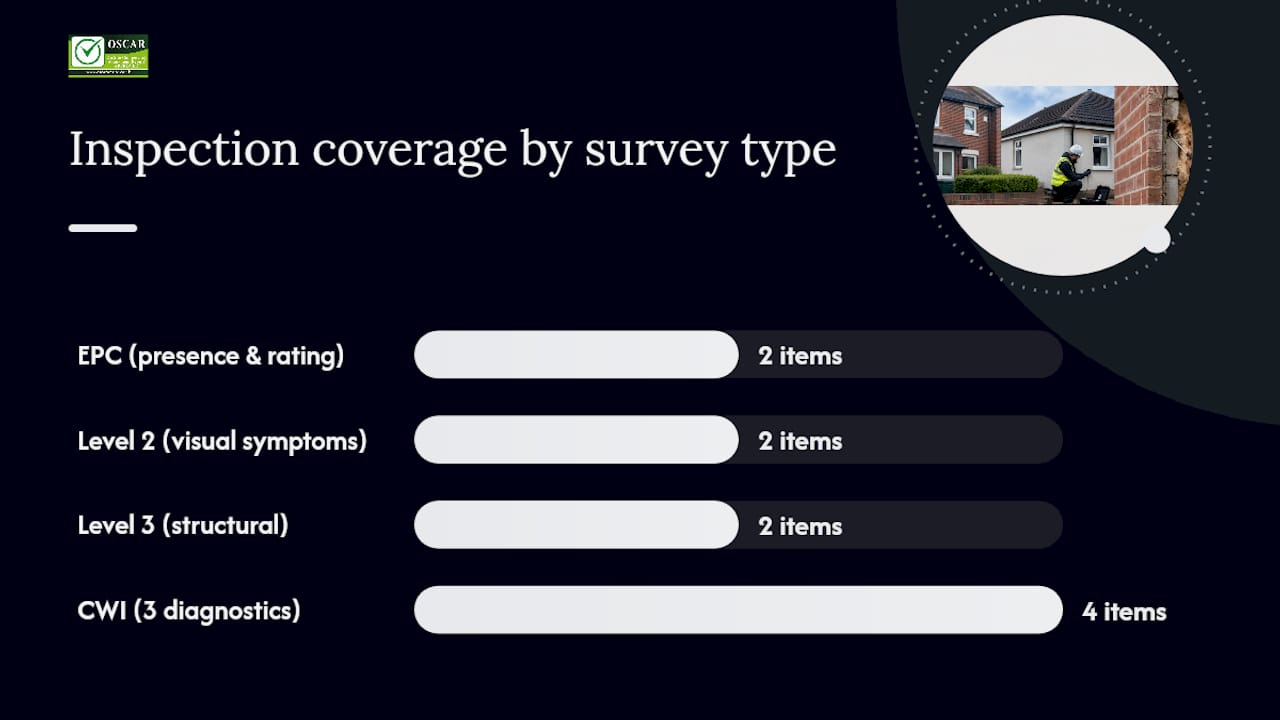
The distinction from a standard HomeBuyer Report matters enormously in practice. An EPC records whether insulation is present and estimates its energy performance. A Level 2 HomeBuyer Report is a visual inspection: the surveyor notes symptoms such as damp staining or mould but cannot confirm whether cavity insulation is the cause. As RRNews reports, specialist CWI Condition Inspection Surveys detect insulation-related defects that standard homebuyer surveys routinely miss, precisely because they combine borescope, thermal imaging, and moisture testing rather than relying on visual observation alone.
| Survey type | What it covers | What it misses |
|---|---|---|
| EPC | Insulation presence, estimated energy rating | Insulation condition, moisture, wall-tie state |
| Level 2 HomeBuyer Report | Visual symptoms, general condition | Cavity insulation condition, concealed defects |
| CWI Condition Inspection Survey | Insulation condition, moisture ingress, wall ties, borescope evidence | Broader structural matters outside cavity scope |
The buyers who most need a specialist cavity wall assessment are purchasing:
- Properties built between 1920 and 2000 with cavity walls that may have been retrofitted with insulation, particularly 1980s and 1990s stock where early blown-fibre and polystyrene bead installations are now ageing.
- Homes showing internal damp patches, condensation on external walls, cold spots, or unexplained mould growth.
- Properties where an EPC or seller’s documentation confirms insulation is present but no condition survey has ever been carried out.
- Any property where the seller cannot produce an installation guarantee or a post-installation inspection certificate.
Pro Tip: If your Level 2 surveyor notes any damp, cold bridging, or mould on an external wall, treat that as an automatic trigger for a specialist CWI instruction. Upgrade to a Level 3 instruction only when you also suspect structural wall movement or significant masonry defects alongside the insulation concern.
What does the inspection actually involve?
A thorough pre-purchase cavity wall inspection uses several diagnostic methods in combination. No single technique is sufficient on its own. Manchester Surveyors’ guidance on Level 3 surveys confirms that combining thermal imaging, borescope footage, and calibrated moisture readings significantly strengthens diagnostic confidence compared with any single method.
The core techniques are:
- External fabric inspection: The surveyor examines the outer leaf for cracked or spalled mortar, displaced perpends (the vertical mortar joints used as fill holes), signs of previous insulation installation, and evidence of driving rain exposure.
- Internal visual checks: Identification of damp staining, tide marks, mould patterns, and cold spots on internal wall surfaces that correlate with external findings.
- Thermal imaging: An infrared camera scans external and internal wall surfaces to map temperature differentials. Voids, slumped insulation, and moisture-laden areas all show distinct thermal signatures. The best thermal imaging cameras for cavity wall surveys produce georeferenced images that can be embedded directly in the report.
- Calibrated moisture metering: Readings taken at multiple internal points, recorded against calibrated baselines, to quantify moisture levels rather than simply noting their presence.
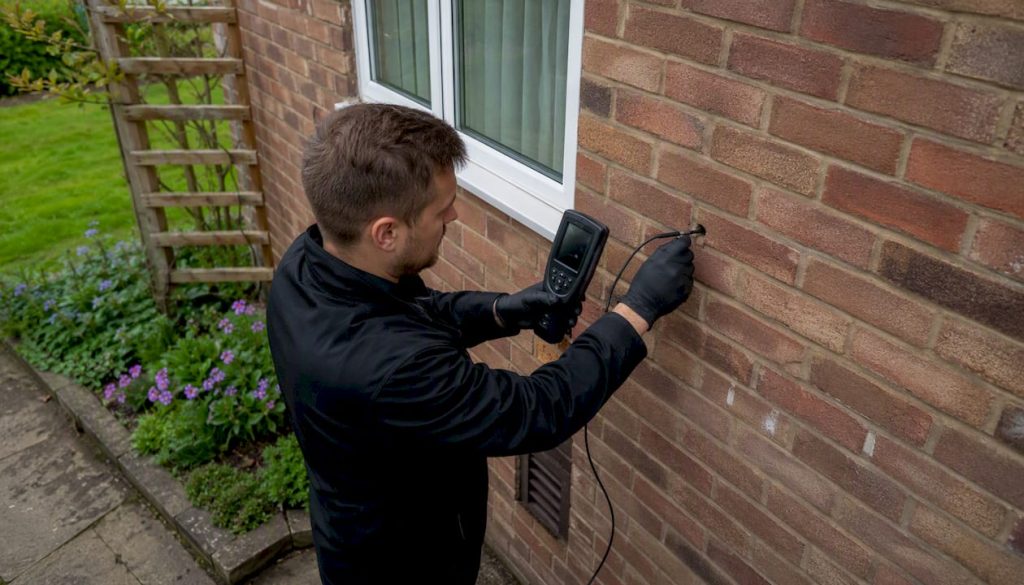
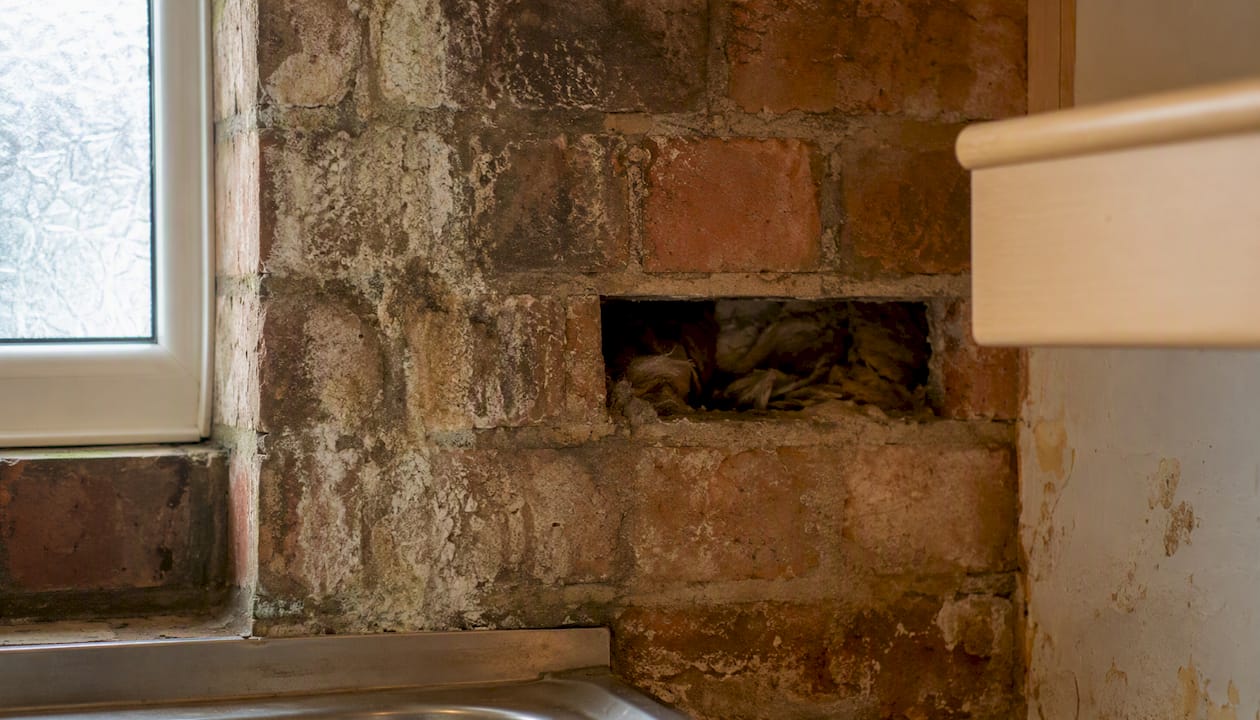
- Borescope inspection: A small camera is inserted through a drilled hole in the mortar joint to provide direct visual evidence of insulation condition inside the cavity. This is the only method that confirms what is actually present, whether insulation has slumped, bridged, or become saturated.
- Wall-tie condition checks: Where accessible, the surveyor assesses tie condition for corrosion, which is a separate but related structural risk in older cavity walls.
- Targeted opening-up: Where thermal imaging indicates a significant problem but borescope access is restricted, limited invasive investigation may be justified. PAS 2035:2023 confirms that retrofit assessments may require invasive tests, and any such opening-up must be recorded with photographs, location coordinates, and reinstatement notes in the report.
A borescope image showing saturated or absent insulation is the single most persuasive piece of evidence a buyer can place in front of a mortgage lender or use in a price negotiation. Thermal maps alone are indicative; borescope footage is definitive.
The written report should include thermal images, borescope stills or video captures, moisture meter readings with locations, and a clear independent conclusion. Without photographic evidence tied to specific wall locations, the report has limited value for lenders or legal negotiations.
What findings should you expect, and what do they mean?
The English Housing Survey 2023–24 provides national context on the prevalence of housing defects across the UK stock, and CWI failures represent a significant and underreported subset of those conditions. The most common findings a specialist survey uncovers are:
- Absent or partial insulation: Fill holes are present but the cavity is empty or only partially filled, often because the original installation was incomplete or material has degraded.
- Slumping: Loose-fill materials such as mineral wool or polystyrene beads have settled over time, leaving voids in the upper sections of the wall. Cold spots and condensation at high level are the typical symptom.
- Bridging: Insulation or debris has created a pathway for moisture to cross from the outer to the inner leaf, producing persistent damp patches that do not respond to surface treatments.
- Hygroscopic or saturated material: Some early installation materials absorb and retain moisture. Once saturated, they actively draw water into the inner leaf rather than resisting it.
- Blocked or contaminated cavities: Construction debris, mortar droppings, or previous failed remediation attempts can obstruct the cavity and prevent drainage.
- Corroded wall ties: Particularly in properties built between 1920 and 1980 using mild steel ties, corrosion can cause tie failure and outer-leaf movement. This is a structural issue that runs alongside but is separate from insulation failure.
When defects are confirmed, the remedial options follow a clear order of invasiveness:
- Targeted extraction: Where slumping or voids are localised, selective removal and reinstatement may be sufficient.
- Full cavity clearance: Where insulation is saturated, hygroscopic, or extensively bridging, complete extraction is the appropriate route. Refer only to an OSCAR Onsite Accredited Member Firm for this work, and always follow with independent Technical Monitoring and Clearance Certification.
- Wall-tie replacement: Corroded ties require specialist structural remediation, which is a separate contract from CWI extraction.
- Repointing and controlled drying: After clearance, the outer leaf mortar joints are repointed and the cavity is allowed to dry before any decision on reinstallation is made.
Practically, confirmed CWI defects affect a purchase in three ways. Mortgage lenders increasingly require evidence of remediation or a clearance certificate before releasing funds on properties with known insulation failures. Insurers may decline or limit cover where damp damage is present and unresolved. And for negotiation, a costed extraction quote gives you a concrete, defensible basis for a price reduction or a retention held by the conveyancer until works are completed.
Liveability impacts are real and immediate: persistent damp, mould growth, cold external walls, and higher energy bills are the lived experience of a property with failed cavity insulation. Understanding whether cavity wall insulation is causing condensation is often the first question buyers need answered, and a specialist survey provides the evidence to answer it definitively.
Which standards and qualifications should you insist on?
Not every surveyor who offers a cavity wall inspection has the vocational competence to carry one out properly. The credentials to verify before instructing anyone are:
- NVQ Level 2 in Cavity Wall Insulation Surveying and Inspection: The national benchmark qualification for CWI surveyors, authored by OSCAR Onsite. Ask for the certificate number and awarding body confirmation. Details of the NVQ Level 2 in cavity wall surveying are publicly available.
- PAS 2030:2023 and PAS 2035:2023 awareness: PAS 2035:2023 requires pre-installation building inspections and sets vocational competence expectations for retrofit measure roles. A surveyor who cannot explain these standards in relation to their inspection methodology is not adequately qualified.
- TrustMark registration or OSCAR Onsite Accredited Member status: These schemes require firms to demonstrate technical competence, carry appropriate insurance, and submit to audit. Neither is a marketing badge; both carry enforceable standards.
- Independent clearance certification: Where extraction is recommended, the clearance certificate must come from an independent body, not the firm that carried out the extraction. OSCAR Onsite’s clearance certification is specifically designed to satisfy this independence requirement.
- Professional indemnity and public liability insurance: Confirm both are current and that the policy covers specialist diagnostic surveys, not just general building inspection.
PAS 2030:2023 updates place increased scrutiny on independent validation of pre-installation inspections. Buyers should expect demonstrable third-party oversight when extraction is proposed — a surveyor who also sells extraction services cannot provide that independence.
Pro Tip: Ask the surveyor directly: “Are you NVQ Level 2 qualified in CWI surveying, and are you OSCAR Onsite accredited?” If they cannot confirm both, request evidence before proceeding. A hesitant answer is itself informative.
Lender and insurer expectations are tightening. Several major mortgage lenders now ask for evidence of PAS-compliant inspection and independent clearance certification before accepting a property with known CWI defects as adequate security. A report produced by an unqualified or non-independent surveyor may not satisfy those requirements, which means the survey cost is wasted and the purchase is delayed.
How do you choose and brief the right surveyor?
Choosing the right specialist for a pre-purchase cavity wall check requires more than a Google search. Use this checklist when comparing quotes:
- Confirm NVQ Level 2 qualification in CWI surveying and OSCAR Onsite accreditation or equivalent.
- Verify that the inspection includes thermal imaging, borescope, and calibrated moisture metering as standard, not as optional extras.
- Ask what the report contains: it must include photographic evidence, borescope images, moisture readings with locations, a wall-tie condition statement, and an independent conclusion.
- Check professional indemnity insurance covers specialist diagnostic surveys.
- Confirm turnaround time: most reputable specialists deliver within five to seven working days of inspection.
- Ask whether the surveyor has any commercial relationship with extraction contractors. If they do, their independence is compromised.
On cost, several variables affect the final price: property size (number of elevations and storeys), accessibility, whether thermal imaging is included as standard, and travel distance. Surveys for a standard semi-detached property typically fall in the £250–£600 range. Larger detached properties or those requiring extensive borescope access may cost more.
Red flags to avoid:
- A quote that excludes borescope inspection or thermal imaging.
- A surveyor who recommends extraction before completing the inspection.
- A report template that does not include moisture readings or wall-tie assessment.
- Any firm that offers a survey and extraction as a bundled package with no independent oversight.
When contacting a surveyor or your conveyancer, a brief instruction along these lines covers the essentials: “I am purchasing [property address]. I require an independent CWI Condition Inspection Survey prior to exchange. The report must include thermal imaging, borescope evidence, calibrated moisture readings, a wall-tie condition statement, and an independent remedial recommendation. I need the report within [X] working days. Please confirm your NVQ qualifications and accreditation before proceeding.”
How to read the report and what to do next
Once the report arrives, work through it in this order:
- Read the executive summary first. A well-structured report leads with its conclusion: pass, advisory, or fail. If the conclusion is buried in technical appendices, ask for a plain-English summary.
- Check the evidence against the conclusion. Every finding in the conclusion should be supported by a named photograph, borescope image, or moisture reading in the body of the report. If the surveyor concludes that insulation is bridging but there is no borescope image to confirm it, request an addendum.
- Obtain remediation quotes before negotiating. A costed extraction quote from an OSCAR Onsite Accredited Member Firm gives you a specific, defensible figure to put to the vendor. Specialist guidance on cavity wall insulation extraction sets out what a proper extraction scope should include.
- Use the report in negotiation. Options include a price reduction equal to the remediation cost, a retention held by the conveyancer until works are certified complete, or vendor-funded remediation before completion. Your conveyancer should raise the findings formally in the seller’s enquiries.
- Pause exchange if the timeline is tight. If remediation is required and cannot be completed and certified before the agreed exchange date, instruct your conveyancer to request an extension. Exchanging with a known defect and no certified remedy in place transfers the full financial risk to you.
Pro Tip: Always request Technical Monitoring and a Clearance Certificate after extraction, not just a contractor’s own sign-off. An independent cavity clearance certificate confirms the cavity is clean, dry, and ready for reinstatement, and it is the document lenders and insurers will ask for.
A clearance certificate from an independent body should state the date of inspection, the methods used to verify clearance, photographic evidence of the cleared cavity, moisture readings post-clearance, and the name and accreditation of the certifying inspector. A certificate produced by the extraction contractor themselves does not satisfy independence requirements.
On timescales: allow at least two to three weeks from commissioning the survey to receiving a clearance certificate if extraction is required. Factor this into your conveyancing timeline from the outset, not as an afterthought when exchange is imminent. For a detailed breakdown, OSCAR Onsite’s guidance on cavity wall extraction timescales sets out realistic sequencing for buyers.
Why independent, accredited evidence matters
The case for independent, evidence-led inspection rests on a straightforward problem: the UK’s CWI industry has a documented history of poor workmanship, inadequate oversight, and sales-led extraction that removes insulation without proper justification. Buyers who rely on a surveyor with a commercial interest in the outcome of their inspection are exposed to both under-diagnosis and over-diagnosis.
OSCAR Onsite was founded by Alan Hoey specifically to address this accountability gap. The organisation’s credentials are:
- Authored the UK’s first NVQ Level 2 Diploma in Cavity Wall Insulation Surveying and Inspection and the NVQ Level 2 Diploma in Cavity Wall Insulation Extraction and Clearance, establishing the National Occupational Standards for the sector.
- Trained and accredited more than 250 independent firms across the UK through its Accredited Member Firm network.
- Provides independent Technical Monitoring and Clearance Certification as a separate, standalone service, ensuring that extraction work is verified by a party with no financial interest in the extraction itself.
- Operates under PAS 2030:2023, BS 8104, and TrustMark requirements.
For buyers, lenders, and conveyancers, the practical benefit of OSCAR Onsite accreditation is that it signals a defined, auditable standard. A report produced by an OSCAR Onsite Accredited Member Firm carries a level of professional accountability that a generic building inspection report does not.
OSCAR Onsite’s CWI Surveyor Awareness Course is specifically designed for RICS surveyors, Building Surveyors, DEAs, retrofit professionals, housing providers, mortgage lenders, and conveyancing solicitors. Cross-professional understanding of CWI condition inspection methodology is what makes reports credible and acceptable across the transaction chain.
The recommendation is clear: commission an independent OSCAR CWI Condition Inspection Survey before accepting any extraction proposal. Where extraction is justified by the evidence, instruct an OSCAR Onsite Accredited Member Firm and follow with independent Technical Monitoring and Clearance Certification. Never accept a sales-led extraction recommendation from a firm that has not first produced an independent condition survey.
What a good pre-purchase CWI report should contain
A report that does not include all of the following is incomplete. Use this as your checklist:
- Executive summary: A plain-English conclusion stating whether insulation is performing adequately, whether defects are present, and what the recommended next step is.
- Scope and limitations: A clear statement of what was inspected, which elevations were accessed, and any areas that could not be assessed.
- Thermal images: Georeferenced infrared images of all inspected elevations, with annotations identifying areas of concern.
- Borescope images or video: Direct visual evidence of cavity condition at each drill point, with location coordinates.
- Moisture readings: Calibrated meter readings at multiple internal points, recorded against baseline values, with a location map.
- Wall-tie condition statement: A specific assessment of tie condition, even if only visual, with a recommendation for further investigation where corrosion is suspected.
- Invasive test records: Where opening-up was carried out, photographs, location coordinates, and reinstatement notes.
- Quantified remedial cost estimates: An indicative cost range for any recommended remediation, sufficient for negotiation purposes.
- Independent conclusion: A clear statement that the surveyor has no commercial interest in the remediation outcome.
Red flags in a report:
- No borescope images where thermal imaging identified a problem.
- Moisture readings absent or recorded without calibration baseline.
- Wall-tie condition not addressed.
- Conclusion recommends extraction without specifying the evidence that justifies it.
- No independent clearance pathway described.
Pro Tip: If the report is missing borescope evidence for a flagged area, write to the surveyor and request an addendum inspection of that specific location before accepting the report as complete. A reputable specialist will return to gather the missing evidence rather than defend an incomplete report.
The buyer’s mistake that costs the most
Most buyers who end up with a damp, cold, or mould-affected home after purchase made the same error: they relied on a Level 2 HomeBuyer Report to tell them something it was never designed to detect. A visual inspection cannot see inside a cavity. It cannot tell you whether the insulation installed in 1988 has slumped, bridged, or turned into a moisture sponge. It notes symptoms; it does not diagnose causes.
The second most common mistake is instructing extraction on the basis of a sales-led recommendation from a firm that profits from the extraction itself. Independent inspection first, extraction only when the evidence justifies it, and independent clearance certification after. That sequence protects buyers, satisfies lenders, and produces a property that is genuinely fit to live in.
Conveyancers and RICS surveyors who have completed OSCAR Onsite’s CWI Surveyor Awareness Course understand this distinction and can advise clients accordingly. If your conveyancer or surveyor has not encountered OSCAR Onsite’s methodology, point them towards it. The cross-professional credibility of the inspection report is what makes it useful at every stage of the transaction.
OSCAR Onsite’s pre-purchase CWI inspection service
OSCAR Onsite provides the UK’s most authoritative independent CWI Condition Inspection Survey for property buyers. The inspection combines borescope, thermal imaging, and calibrated moisture metering, and the written report is produced by NVQ Level 2 qualified surveyors with no commercial interest in any subsequent extraction work.
Where the survey identifies defects that justify extraction, OSCAR Onsite refers buyers to its nationwide network of Accredited Member Firms and provides independent Technical Monitoring and Clearance Certification as a separate, standalone service. This is the only model that satisfies lender independence requirements and PAS 2030:2023 compliance expectations.
OSCAR Onsite also offers NVQ Level 2 training and CPD awareness courses for RICS surveyors, DEAs, retrofit professionals, mortgage lenders, and conveyancing solicitors who need to understand CWI condition inspection methodology. For buyers who need a broader view of the property, the Property Condition Report service extends the scope beyond the cavity.
To commission a pre-purchase CWI Condition Inspection Survey, contact OSCAR Onsite directly via Oscaronsite.
Sources
The following sources underpin the recommendations in this article:
- English Housing Survey 2023 to 2024: health and housing fact sheet
- Is your property survey missing one of the UK’s most overlooked building defects? – RRNews